Weekly Google Business Maintenance Guide
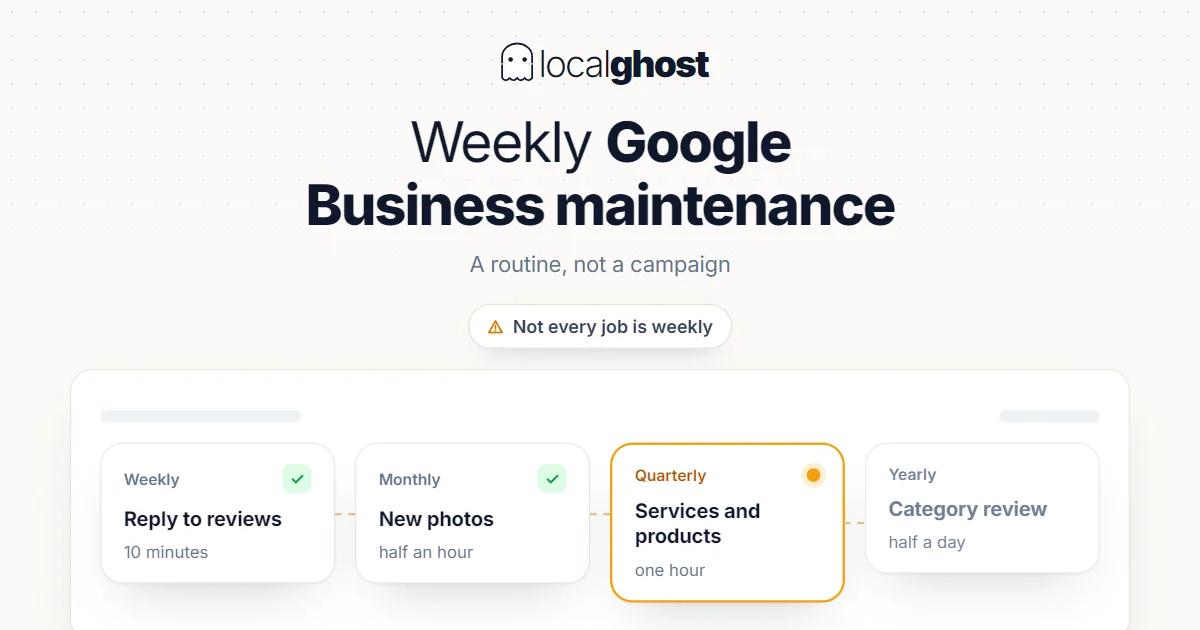
Profile maintenance is a routine, not a campaign. But not every job is weekly — doing some of them weekly causes damage.
In this article
Summarize with AI
Profile setup happens once; maintenance is continuous. But the heading "weekly maintenance" can mislead, because not every field wants weekly attention — some are set correctly once a year and left, and touching them constantly does damage.
This guide separates the jobs by frequency: what is genuinely weekly, monthly, quarterly and annual. The weekly work that falls out of it is shorter than most businesses expect: ten minutes.
Why a routine rather than a campaign
The most common mistake in profile work is working in waves: touching everything one week, then not looking for three months. That backfires for two separate reasons.
First, most signals want continuity. Review recency and photo recency answer the question "when was the last time". A burst every three months leaves the profile silent for the two and a half months in between.
Second, burst work carries risk. A large number of reviews collected in a short window creates an unnatural pattern and the spam filter removes them: increasing Google reviews.
The benefit of a routine: small, continuous work both feeds the signal and occupies nobody's agenda.
Weekly: a ten-minute job
There are three genuinely weekly things.
Reply to new reviews. The most important weekly item. Same day for negatives, two at most; readers look at the reply date. Patterns: review response templates.
Check the questions section. Customers can ask questions on the profile and other people can answer them. A wrong answer stays hanging there. Looking once a week stops wrong information settling in. Asking and answering common questions yourself is also a legitimate use.
Post if you have something to say. Not forced: this week's price, produce that arrived, a changed hour, an offer. Otherwise skip it: how to schedule posts.
Those three total ten minutes. They do not need to take longer, and if they do you have probably crossed into one of the monthly jobs.
Monthly: half an hour
Add photos. One or two images a month is enough, but they should be of something that actually happened that month. The date of the newest photo does more work than the total count: photo optimization.
Check the hours. The reason this item exists is a little-known fact: profile information does not change only when you edit it. Users can suggest changes and some signals can be evaluated automatically. Opening the profile once a month through a customer's eyes is the only way to notice a silent change: hours optimization.
Look at the profile data. Calls, direction requests, clicks. The aim is not to react to one month's fluctuation but to see the trend: reading the statistics.
Enter upcoming holidays. Next month's special days, before they arrive. A blank day falls back to regular hours and you appear open while closed.
Quarterly: about an hour
Review the category and service list. Has the work mix changed? Has a new service been added? Does the primary category still describe the revenue body: how to choose the right category.
Read the search-queries report. Which phrases are finding you? Setting brand queries aside and looking at the remaining service phrases tells you whether your service naming is right: local keyword research.
Look at competitors. From the same three to five points, with the same queries. What you record is not the list but the change: how to do competitor analysis.
Measure ranking. Same method, same points. Daily checking measures noise: how to track rankings.
Annually: half a day
A NAP audit. Are name, address and phone consistent across the five priority sources? Moving premises, a number change and a new branch should trigger this without waiting for the calendar: NAP consistency.
Enter the year's special hours upfront. All the holidays in one sitting. The highest-return five minutes of the year.
Review the description. Update it if the service mix changed; if it did not, leave it alone: how to write the description.
Sweep for duplicates. Search your business name and phone number and check whether a second listing exists. A duplicate splits your reviews.
Event-triggered maintenance: the jobs that do not wait
Alongside the calendar there is event-driven maintenance. These jobs do not wait for the week or the month; they happen the day the event happens.
An hours change. Staffing changed, the season opened, refurbishment started. Not entered the same day, it produces customers turned away at the door.
Moving premises. The order matters: update the profile address first and complete verification if required, then the site, then the major platforms. Leaving the old address behind means appearing to exist in two places.
A number change. Profile, site and major platforms the same day; if an old line survives somewhere, the conversion is lost outright.
Adding or dropping a service. A service that is no longer offered staying on the list means customers arriving for nothing and a negative review.
The same complaint arriving twice. That is a process matter, not a review matter; replying does not close it: turning negative reviews into opportunities.
A temporary closure. For a long break or refurbishment, marking the profile closed beats appearing open and losing customers.
What that list shares: all of it starts with something changing in the real world. That is also the most skipped part of profile maintenance — when reflecting operational change onto the profile is nobody's job, the profile quietly drifts from reality.
What not to do weekly
This half of the list is the half most often skipped. Three things cause damage when done weekly.
Changing the category. A category change refreshes signals. Moving it weekly means never being able to measure the result of any change. The category is a field to set correctly once and leave.
Rewriting the description constantly. The description is standing furniture. Weekly iteration is both unnecessary and every edit can go to review.
Checking ranking daily. Local results move naturally by time of day and with competitor activity. Daily checking produces a stream that is mostly noise, and reacting to noise leads people to change five things at once.
There is a fourth: editing the profile in order to "do something". If there is nothing to change, not touching it is also a decision — and given that profile edits can go to review, an unnecessary edit carries a small risk for zero benefit.
Who owns the routine
Even the best maintenance list does not work without an owner. Three things are enough:
One person. "Whoever is interested" means in practice nobody looks.
A fixed time. The same day each week, ten minutes. Written in the calendar.
Notifications on. With new-review notifications off, late replies become inevitable, and delay is read as indifference by whoever is reading.
In a multi-branch setup one more separation is needed: replies centrally, review requests at the branch, and the check read per branch — the chain average hides the weak one: multi-location management.
Frequency shifts by sector
The calendar is general; in some sectors some items move up.
Trades where hours are weekly. In restaurants break hours, special days and seasonal changes move often; the "open now" filter decides this category: Google Business guide for restaurants.
Trades where posting is daily. In scrap buying the price per kilo changes daily and that is exactly what the customer searches: scrap metal and recycling.
Trades where product flow is weekly. In wholesale food, the week's arrivals and prices: wholesale food suppliers.
Trades where reviews are weekly. In salons clients come often and the result is visible immediately; the flow is naturally weekly: local SEO for hair salons.
Trades that freeze off-season. In accommodation, maintenance drops to monthly out of season but hours and closure information must stay current: local SEO for hotels.
Frequently asked questions
How long does weekly maintenance take? The three genuinely weekly items total ten minutes: review replies, the questions check and a post if warranted. If it runs longer you have crossed into a monthly job.
Should I post every week? If you have something to say. Publishing an empty post is not better than publishing none. If nothing changes weekly in your sector, once a fortnight is enough.
How often should I review the category? Review quarterly, but only touch it if the work mix genuinely changed. Moving it weekly keeps resetting the signals.
Can my profile information change by itself? Yes. User suggestions and automatic evaluation can change it. A monthly check is the practical way to notice.
Is checking the questions section really necessary? Yes, because others can answer them and a wrong answer stays hanging there. Once a week is enough.
How often should I measure ranking? Quarterly, from the same points with the same method. Daily checking mostly measures noise and lowers decision quality.
Written by
Yunus Akan
Related tools: AI review responses · Profile analysis · Photo GPS tagging · All local SEO tools