360-Degree Photo Guide for Google Business
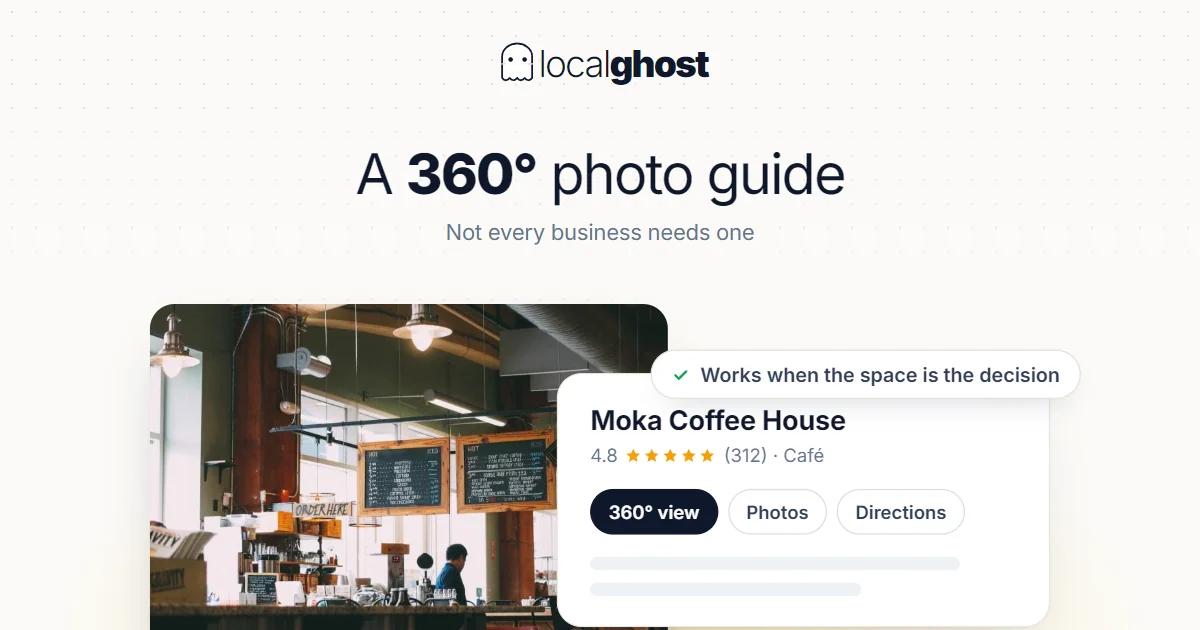
A 360 photo is not required for every business. It works when the space itself enters the buying decision, and it is decoration when it does not.
In this article
Summarize with AI
A 360-degree photo is not a better normal photo — it is a separate type doing a different job. A normal photo shows a frame: the plate, the haircut, the corner of a room. A 360 photo shows the space itself: how big it is, how it is laid out, where a person stands inside it.
Without that distinction two mistakes follow. On one side, businesses whose space has no bearing on the decision pay for expensive 360 shoots. On the other, businesses whose space decides everything never use the field at all.
Who it helps and who it does not
The test is one question: does the customer want to see the space before arriving?
Trades where the answer is yes:
- Accommodation. The room and the property are the decision. Guests want to see before arriving.
- Food and drink. The feel of the room, the seating layout, how busy it looks. Decisive for group and celebration bookings especially.
- Event and meeting spaces. Describing square metres does not work; people need to see.
- Gyms and studios. Equipment density and floor size affect the decision.
- Health and care. The job here is different: not curiosity about the space but reducing anxiety. A space that looks clean and open makes booking easier.
- Large facilities. Market halls, car dealerships, trade warehouses. The customer is asking whether they will get lost inside.
There are trades where the answer is no, and a 360 shoot stays decorative there: mobile services with no premises, trades where the friction is price or availability, and small points where the customer only stays a few minutes anyway.
So the order is: if photo coverage is not complete, do not touch 360 at all. Base coverage — exterior, interior, the result of the work, the team — always comes first: photo optimization.
How to shoot: two routes
A spherical photo on a phone. The free route. Using the phone's own panorama or sphere mode, shooting from a fixed point while turning. The result is not the quality of a professional 360 camera, but it is enough in small spaces.
A 360 camera. Devices that capture the whole area in one frame. Fewer stitching errors, better light balance, less time. If you are shooting from several points the gap widens.
In both, the technical details that decide the result are the same:
- Use a tripod. Shooting handheld shifts the centre of rotation and produces stitching errors. This is where the biggest quality difference sits.
- Keep the height at eye level. Shooting too low or too high makes the space look different from reality.
- Balance the light. Shooting into a window darkens the interior. Daytime, curtains half closed, interior lights on.
- Keep the space empty and tidy. Moving people create stitching errors; sharing faces without consent is also a problem.
- Plan the shooting points. Entrance, main area, an upper floor or back section if there is one. You do not need every room; the areas that affect the decision are enough.
- Keep yourself out of frame. Stand behind the tripod or outside the field.
The publishing flow has changed over time; the current route is worth checking in the Maps app. Before uploading, make sure the file has kept its spherical metadata — some editing tools strip it, and the image then uploads as a normal photo.
When a professional shoot makes sense
There are cases where your own shoot is not enough: very large areas, complex floor plans, low-light spaces, chains that need a brand standard. In those, a professional or accredited shoot makes sense.
The deciding factor is not cost but how much the decision depends on the space. For a hotel a professional shoot is an investment; for a small salon the same spend does not return.
Common mistakes
- Stitching errors. Handheld shooting and moving objects. The most visible flaw.
- A dark frame. An interior shot without balanced light looks smaller and more neglected than it is.
- Faces. Sharing recognisable people without consent is both a privacy problem and a reporting cause.
- An outdated shoot. A 360 not updated after a refurbishment creates an expectation mismatch. This is more serious than with normal photos, because a 360 is viewed on the assumption that it shows reality.
- Choosing the wrong points. Shooting the back of the kitchen or the storeroom instead of the area that decides.
- Shooting 360 while base coverage is missing. A blurry cover photo, no interior shot, but a 360 exists. An ordering error.
Does it affect ranking
The clear answer: not as a direct lever. Google documents three factors for local ranking — relevance, distance and prominence — and 360 photos are not named in any of them. The mechanism: how the 3-pack works.
What it does is on the conversion side: more people choosing you from the same position. It also contributes to the recency signal that shows a profile is alive, but that is no different from what a normal photo flow does.
So planning 360 as a ranking investment creates the wrong expectation. The right question is not "will it lift my ranking" but "does it answer the question in the head of a customer deciding before they arrive".
What to shoot, by sector
In accommodation, one shoot per room type. A single lobby shot is not enough; the guest wants to see the room they will stay in — local SEO for hotels.
In restaurants, the seating area and atmosphere. Not the kitchen, the room the customer will sit in — Google Business guide for restaurants.
In clinics, the waiting area and treatment environment. The aim is not to impress but to reduce anxiety, and patient privacy means nobody should be in frame — Google Maps SEO for dental clinics.
In salons, the floor layout. Number of chairs, how open it feels, the waiting area — local SEO for hair salons.
In large facilities, wayfinding. In market halls and wholesale the customer has to find you inside the facility; a 360 works as directions here — wholesale food suppliers.
In mobile services, not needed. For businesses that hide the address and travel to the customer, vehicle and job photos take the place of 360 — service-area businesses.
Frequently asked questions
Will 360 photos improve my ranking? Not as a direct lever. They work on the conversion side, making the decision easier for a customer who wants to see the space.
Is shooting on a phone enough? It can be in small, well-lit spaces. Using a tripod makes more difference than the gap between a phone and a camera.
How many points should I shoot? As many as affect the decision. Entrance, main area and an upper floor if there is one is usually enough; you do not need every room.
When should I update a 360 shoot? When the space changes. A shoot not updated after refurbishment produces expectation mismatch and negative reviews.
Is it a problem if customers or staff appear? Sharing recognisable faces without consent is a privacy problem and a reporting cause. Shooting the space empty is safer technically and legally.
Is a professional shoot required? No. The deciding factor is how much the buying decision depends on the space. An investment for a hotel or event venue; unnecessary for a small service point.
Written by
Yunus Akan
Related tools: Add GPS to photos · Post scheduling · All local SEO tools