Increasing Google Reviews: 7 Effective Strategies
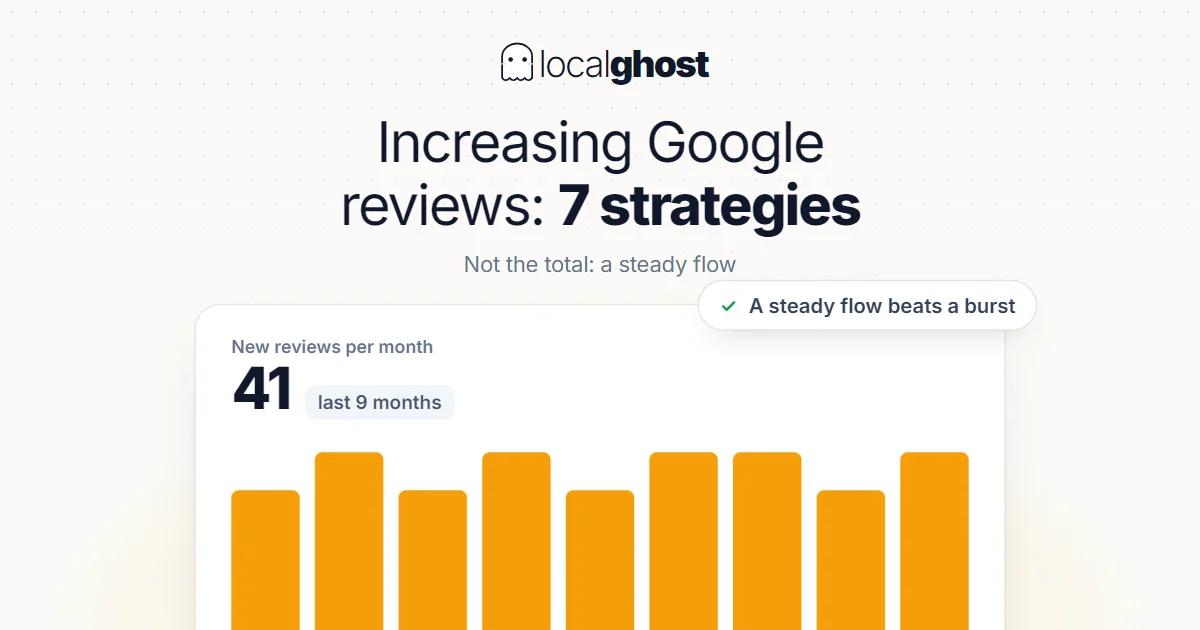
Reviews are not about the total: a steady flow beats a one-off burst. The methods that work and the tactics that put your profile at risk.
In this article
Summarize with AI
Reviews are the most visible part of the prominence signal in local search, and also the thing customers look at hardest when deciding. Because those two overlap, review work touches both ranking and conversion — very few other fields on the profile do that.
But the usual plan is built wrong: a target of "let's collect fifty reviews". That target gets completed once, the field then freezes, and six months later the profile starts to look stale. The right setup is not a target but a flow.
Volume or recency
Both count, but they do different jobs.
Volume is a threshold problem: a profile with a handful of reviews looks weak beside competitors with high counts. That threshold varies by sector — ten reviews is few for a salon, very few for a hotel.
Recency is a signal that keeps working. A profile with two hundred reviews whose newest is a year old reads as a business in decline. The customer sees the same thing: what answers "is this place still good" is the date of the latest review.
The practical consequence: a steady flow beats a one-off burst. One or two reviews a week beats thirty arriving in a single month. A sudden pile also carries risk as an unnatural pattern.
There is a third dimension that gets skipped: what the review says. A review is not only a score, it is text. A review where the customer names the service in their own words creates context for that service; one that says "very happy" carries only the score. This is not an argument for directing review content — directing it is problematic in itself — but it explains why saying "feel free to mention which service you had" in the ask makes a difference.
If you want to know where reviews sit inside ranking, how the three factors work is a separate article: how the 3-pack works.
What actually works
Catching the right moment. Success in asking depends less on the method than on timing. The right moment is when satisfaction peaks: the minute the work is finished and the result is visible. In front of the mirror at a salon, as the report is handed over at an inspection, once the furniture is in place after a move. A message sent a day later has missed that moment.
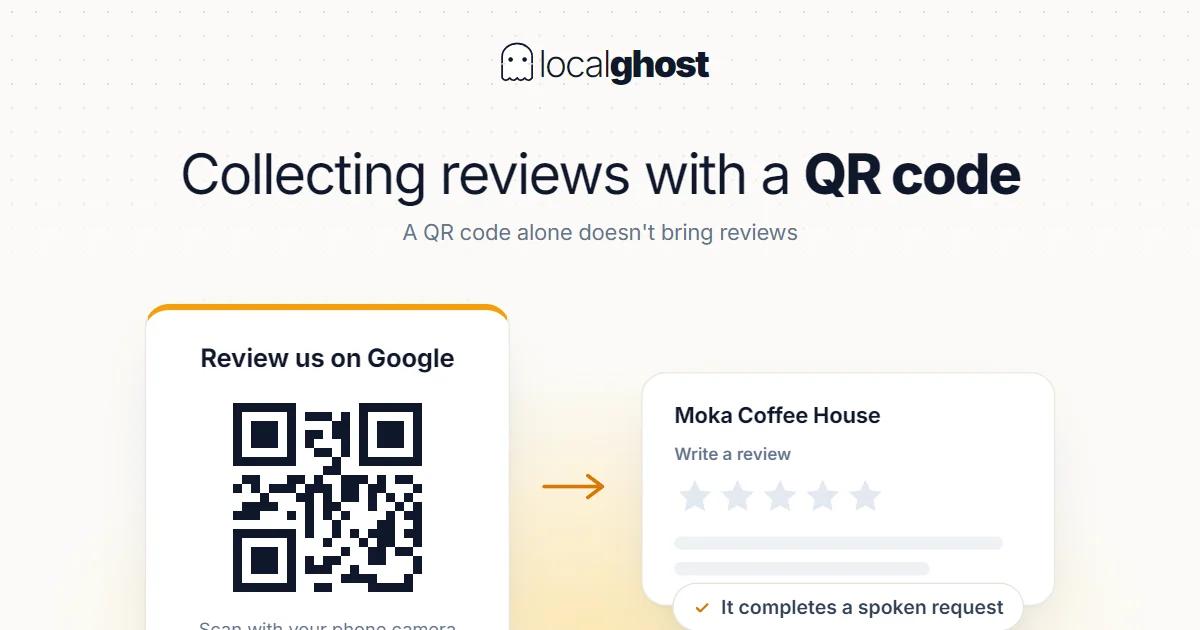
Ask in person and hand over the link immediately. The highest-converting combination is a spoken request plus a short link or QR ready to hand. Without the spoken request the link does not work; without the link the request is not remembered. The implementation side: collecting reviews with QR codes.
Removing friction. Asking a customer to open Maps and search for the business loses half the requests. A short link straight to the review form should sit in the same place on the receipt, in the message and on the table.
Tie the asking to one person and one routine. "Everyone should ask" means "nobody asks" in practice. Whoever is responsible at the end of a shift, at the till or at handover should be named.
Replying. Replies generate new reviews: arriving customers read them and see that leaving one gets a response. It is also an active-business signal. For patterns: review response templates.
The wording of the ask changes the result
After the method, the biggest difference comes from the sentence itself. Three rules save it.
Say what to do in one step. "Could you review us on Google" is vague; "two lines through this link is enough" is clear. When the customer does not know how much work it is, they postpone, and postponing means forgetting.
Do not direct the content. "Give us five stars" or "mention this service" both distorts the outcome and lowers credibility; steering the score also brushes against the guidelines. What works is asking them to write what they experienced.
Make it specific. A message that looks bulk-sent converts noticeably worse. Even a single sentence referring to the actual job makes the difference.
One practical convenience: your profile can generate a short link that goes straight to the review form. Taking that link once and putting it on the receipt, in the message template and on the table card produces less friction than searching manually every time.
What Google explicitly prohibits
This section matters, because some advice online recommends outright guideline violations, and the price ranges from review removal to profile suspension.
Incentives for reviews. Discounts, gifts, prize draw entries, free products — offering any benefit in exchange for a review is prohibited. A "coffee for a review" campaign falls in scope however harmless it sounds.
Buying reviews. Paid reviews, review swaps, review farms. When detected, reviews are removed and the profile is flagged.
Gating. Asking "were you satisfied" first and routing only the happy ones to the review page. This bends the review flow artificially and is not accepted.
Leaving negative reviews on competitors. Done through an employee or a relative, this is both a violation and an easily detected pattern.
Reviewing your own business. Family, staff, a second account. Reviews from the same network create an unnatural pattern.
The distinction lands like this: asking for reviews is allowed, buying or steering them is not. Asking everyone and accepting the outcome as it comes is legitimate; choosing whom to ask based on satisfaction is not.
Negative reviews are managed, not avoided
A flat five out of five does not look natural and raises suspicion. The negative review itself is not the problem; the unanswered negative review is.
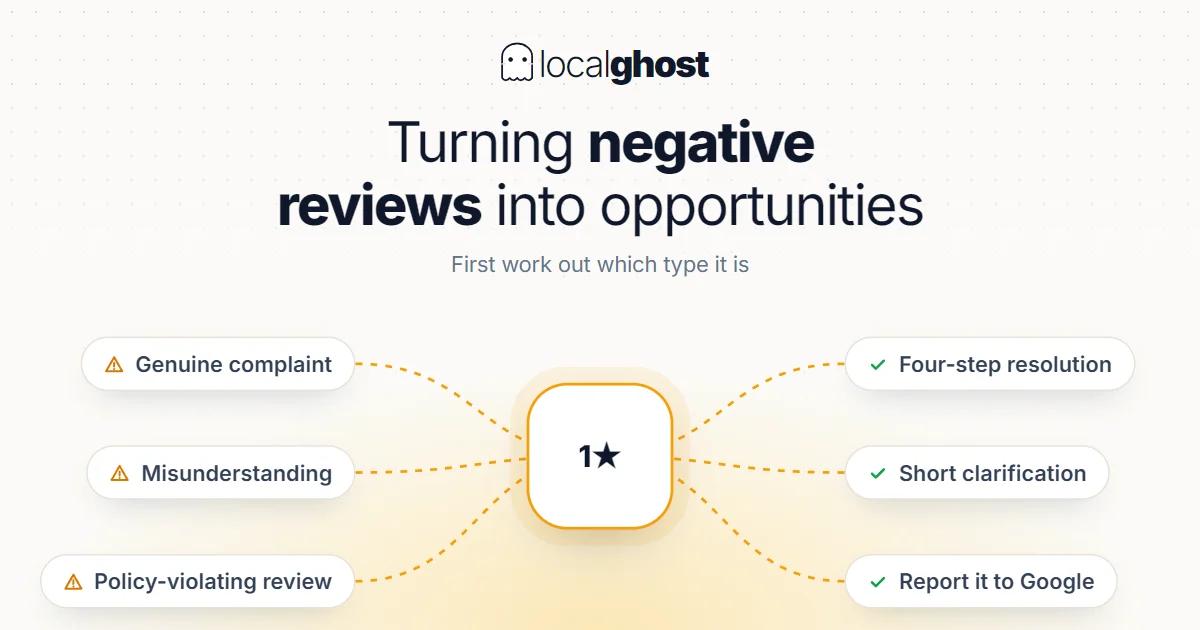
Two things work: a fast, non-defensive reply, and moving the matter off the profile where possible (phone, email). The real audience for the reply is not the person who wrote it but the next customer who reads it. Detail: turning negative reviews into opportunities.
My reviews are disappearing: likely causes
A falling review count is common and usually not a fault:
- The spam filter. Google automatically removes suspicious reviews. Reviews from the same IP, very short ones, repetitive ones and sudden piles get caught.
- The reviewer deleted it or closed their account. Outside your control.
- A policy violation report. Review content against the rules gets removed.
- A duplicate profile merge. If you had two listings your reviews were split; counts move during the merge.
If you see a sudden large drop, check in this order: was there a recent review campaign (pile pattern), does the profile have duplicates, did the reviews come from a single source.
Review mechanics by sector
The difficulty and the subject of reviews vary.
In salons review velocity is a structural advantage: clients come often and the result is visible immediately, so natural opportunities to ask are plentiful — local SEO for hair salons.
In healthcare reviews are sensitive: patient privacy means replies cannot contain clinical detail, and incentive rules may additionally fall under professional regulation. You have to check your own regulator's position — Google Maps SEO for dental clinics covers that boundary.
In removals and transport reviews are the highest-risk area, because complaints concern concrete losses like damage and delay: moving company SEO.
In scrap buying the subject of a review is almost always the scale and the payment; the argument is not about price but about trust — scrap metal and recycling.
On the wholesale side counts are low and weight is high: reviews from a few trade buyers do more work than a hundred retail ones — wholesale food suppliers.
Frequently asked questions
Is asking customers for reviews against the rules? No. What is prohibited is offering a benefit in exchange and choosing who leaves a review based on satisfaction (gating). Asking everyone and accepting the outcome is legitimate.
How many reviews are enough? There is no fixed number; the benchmark is competitors in your sector. But setting the goal as a total is the wrong frame — what matters is that the flow continues, because recency is read continuously.
Can I offer a discount for a review? No. Collecting reviews in exchange for incentives is explicitly prohibited and can lead to review removal and a flagged profile.
Can I get a negative review removed? Only if it breaches policy (abuse, irrelevant content, personal data, a fake competitive review). A genuine review describing dissatisfaction is not removed; the move is to reply.
My review count dropped. Why? The most common cause is the spam filter: reviews arriving in a pile or from a single source get removed. Reviewers deleting their own reviews and profile merges also move the count.
Does replying to reviews affect ranking? Replying is an active-profile signal and contributes directly to conversion; rather than treating it as a ranking lever on its own, think of it as a field that generates new reviews and gets read at the moment of decision.
Written by
Yunus Akan
Related tools: Review Management · Local Grid Scan · Local SEO Audit · All local SEO tools