Local SEO Strategies for Hair Salons and Barber Shops
Category choice, service naming, hours accuracy and portfolio photos decide whether a salon or barber shop shows up in local search. Here is what moves the needle, in order.
In this article
Summarize with AI
A hair salon and a barber shop compete in one of the tightest local search markets there is. In a typical city district there are dozens of them within walking distance of each other, they all serve the same intent, and the searcher almost never scrolls. Ranking fourth in this category is close to ranking nowhere.
The good news is that most salons get the basics wrong in ways that are cheap to fix, and the fixes compound. This guide goes in the order that actually matters, not the order that is easiest to write about.
Your primary category decides which searches you can win
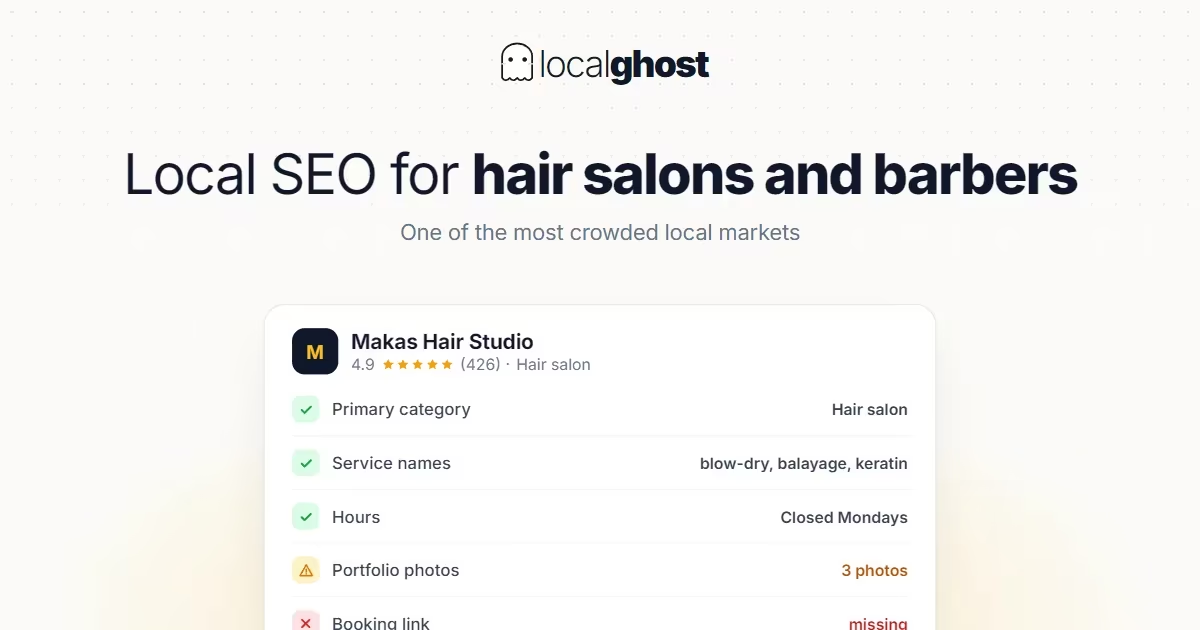
Google Business Profile treats Hair Salon, Barber Shop, Beauty Salon and Hairdresser as separate categories, and your primary category is the strongest single lever you control. It does not just describe you — it decides which query pools you are eligible for.
This is where a lot of shops quietly lose. A men's barber shop that picks "Hair Salon" as its primary category is competing in the wrong pool: searches for *seo for barbers*, *barber shop near me* and *barbershop* weight the barber category, and the shop has opted out of them. The reverse happens too — a full-service salon listed as a barber shop stops showing for colour and treatment searches, which are the higher-ticket ones.
Practical rules:
- Primary category = what you are known for and want more of. Not the broadest option, the most accurate one.
- Secondary categories are cheap, primary is not. Add "Beauty Salon", "Hair Removal Service", "Nail Salon" as secondaries if you genuinely offer them. They widen your reach without diluting the primary signal.
- If you serve both markets under one roof, pick the primary that matches your higher-margin work and cover the other with a secondary category plus explicit service entries.
- Re-check after Google category updates. Category lists change, and an old listing can end up on a deprecated or merged category without any notice.
One category change can move a listing more than a month of posting. It is also the change most owners never make, because the profile "already works".
The sector-independent rules: how to choose the right category.
Name your services the way clients search for them
The services section of your profile is a matching surface, not a menu you paste in. Google reads service names, and clients search in very specific language that rarely matches salon-internal terminology.
Write services as the client would type them:
- Specific over generic. "Men's haircut", "beard trim", "skin fade", "buzz cut" beat a single "Haircut" entry. For salons: "balayage", "root touch-up", "keratin treatment", "olaplex", "bridal hair" beat "Colour" and "Treatment".
- Include the words that carry intent. "Kids haircut", "walk-in haircut", "same-day appointment" match real query patterns.
- Add a short description to each service. A sentence that names the technique and roughly who it suits gives Google text to match and gives the client a reason to choose you.
- Price where you can. Salons that publish price ranges get fewer tyre-kickers and better-qualified calls, and price is the most common question in messages.
Two things not to do: do not stuff city names into service entries (Google's guidelines treat that as keyword stuffing, and it reads badly to humans), and do not list services you do not perform to widen reach. A "balayage" entry with no colourist on staff produces one-star reviews, which cost more than the extra visibility earns.
Hours accuracy is both a ranking signal and a revenue leak
This industry has an hours problem that most others do not. Salons and barber shops commonly close on Mondays, run different Saturday hours, and rely heavily on walk-in traffic — which means a large share of searches are *open now* searches.
Google filters and reorders results for those. If your hours are stale, you are removed from the result set at exactly the moment someone was ready to walk in.
What to keep tight:
- Regular hours, updated when they change, not when you remember.
- Special hours for public holidays. Google prompts for these; the prompt is worth answering. A profile marked "hours might differ" gets a visible warning that pushes people to call a competitor instead.
- Last-appointment reality. If you stop taking clients 45 minutes before closing, your published closing time is misleading. Either adjust the hours or say so in the service descriptions.
- Temporary closures for holidays. Marking a two-week closure is far better than leaving the profile open and collecting "went there, was closed" reviews.
Hours are the least glamorous item on this list and the one with the most direct revenue impact.
Holiday hours, special hours and temporary closures in full: hours optimization.
The portfolio is the product
In most local categories photos are supporting evidence. In hair and beauty they are the deciding factor — clients are picking a result based on whether the work looks like what they want.
What consistently matters:
- Real work, not stock. Stock salon imagery is recognisable and it reads as a shop with nothing to show.
- Consistent framing on results shots. Same lighting, same angle, plain background. Ten consistent photos look more professional than fifty inconsistent ones.
- Cover the range you want to sell. If you want colour work, the grid needs colour work. Clients assume the photos represent your typical output.
- Keep uploading. Recency matters more here than volume; a profile whose newest photo is eighteen months old reads as closed or coasting.
- Interior and exterior shots. These do a different job: they answer "will I feel comfortable walking in" and "will I find the door".
Get consent before posting client photos, even when the face is not visible. It costs one sentence at the chair and avoids a real problem later.
Review velocity is your structural advantage — use it
Salons have a retention pattern most local businesses envy: clients return every four to six weeks. That means you can build review volume faster than a plumber or a dentist ever could, and review signals are heavily weighted in this category.
Turn that into a routine rather than a campaign:
- Ask at the chair, not by email. The moment the client looks in the mirror and likes it is the moment with the highest conversion. A QR code at the till or on the mirror removes the friction of typing.
- Ask the stylist to ask. Requests from the person who did the work convert far better than requests from the front desk.
- Never incentivise. Discounts for reviews violate Google's policy and risk the whole review set, which is a catastrophic trade for a handful of stars.
- Reply to all of them, including the good ones. Replies are visible to the next reader, and a shop that answers looks like a shop that cares.
- Let clients name the service. You cannot script reviews, but you can prompt: "if you mention the balayage it really helps others find us." Reviews that name services add matching text to your profile in the client's own words.
On negative reviews, the reply is for the next reader, not the reviewer. Acknowledge the specific issue, say what changed, offer to make it right offline. Defensive replies do more damage than the original review.
A comparison of the ways to ask: increasing Google reviews.
Booking links convert visibility into appointments
Ranking well and being fully booked are different problems. A profile that ranks in the map pack but has no booking path leaks the traffic it earns.
Google Business Profile supports a booking link, and integrations with the platforms this industry actually uses — Booksy, Fresha, Squire, Treatwell and similar — surface a Book action directly in your listing. That removes the phone call, which is the step most clients under thirty will not take.
Two details worth checking: make sure the booking link lands on your own booking page rather than a marketplace listing that also advertises your competitors, and make sure it works on mobile, since almost all of this traffic is mobile.
What "near me" really means for a salon
Proximity is weighted heavily for this category, more so than for most. Clients will not travel far for a haircut, and Google knows it.
The practical consequence: your visibility radius is small, and it is normal to rank well within a kilometre and disappear beyond three. Chasing the far edges of your city with profile edits will not work, because the limiting factor is distance and you cannot edit distance.
Where you can move the needle inside your radius:
- Fix the fundamentals first — category, services, hours, photos, reviews. A listing that ranks below competitors on its own street has a profile problem, not a geography problem.
- Only then look at content. For most single-location salons, one strong page about your work beats ten thin location pages, and thin location pages for areas you do not serve tend to be treated as doorway pages.
- If a neighbouring district genuinely matters commercially, that is an argument for a second chair or a second location, not for more keywords.
A realistic first month
If you are starting from a neglected profile, the sequence matters more than the effort:
- Week one — audit and fix the primary category, add secondary categories, rewrite the service list in client language, correct regular and holiday hours.
- Week two — photo session. Ten to fifteen consistent results shots plus interior, exterior and team. Upload and keep a small backlog.
- Week three — set up the review routine: QR at the till, brief the stylists, connect the booking link and test it on a phone.
- Week four — reply to every existing review, then measure. Take a baseline of your map visibility so the next month has something to compare against.
Expect the profile changes to register within days and the review and photo signals to take weeks. Checking rankings daily in this category tells you nothing useful; comparing month to month tells you everything.
Frequently asked questions
Should a barber shop use "Hair Salon" as its primary category? No. Use "Barber Shop" as the primary and add "Hair Salon" as a secondary if you also serve that market. The primary category determines which query pools you are eligible for, and barber searches weight the barber category.
How many photos does a salon profile need? There is no threshold that unlocks anything. Aim for consistent coverage of the work you want to sell — roughly ten to fifteen results shots plus interior, exterior and team — and keep adding. Recency matters more than the total.
Do I need a separate page for each neighbourhood I serve? Almost never, for a single location. Thin pages for areas you do not physically serve are treated as doorway pages. One strong page about your work, with your real service area described honestly, performs better.
Can I ask clients to mention a specific service in their review? You can ask them to describe what they had done, which is normal and useful. You cannot offer anything in exchange for a review, and you cannot write or dictate the text. Incentivised reviews put your entire review set at risk.
Why do I rank first from my own shop but not two streets away? Proximity is a strong ranking input for this category. Some drop-off with distance is expected and cannot be edited away. What is not normal is ranking below competitors at your own address — that points to the profile itself.
Written by
Yunus Akan
Related tools: Map rank tracking · SEO audit tool · Add GPS to photos · All local SEO tools