Review Response Templates: Ready-to-Use Examples
The real audience for a reply is not the person who wrote the review. It is the next customer reading it. Every template here assumes that.
In this article
Summarize with AI
Replying to reviews is the lowest-cost and most postponed job on the profile. The reason for postponing is usually "I do not know what to write" — especially for negative reviews. This guide gives you templates, but one thing has to be settled first, because a reply written on the wrong assumption does not work.
The real audience for your reply is not the person who wrote the review. A customer who has written a complaint has usually decided and left. The person who will read your reply is the next customer, deciding whether to work with you. Every template below is built on that: the aim is not to win the argument with the reviewer, it is to win the reader.
Six rules for writing a reply
Be fast rather than perfect. A flawless reply a week later does less work than a plain one within two days. Readers look at the date.
Do not repeat the complaint. "You mentioned your hair was cut incorrectly" writes the complaint out one more time for the reader and the search engine. Name the subject, do not enlarge the detail.
Do not get defensive. Corrections along the lines of "actually you arrived late" do not change who the reader thinks is right; they only make you the arguing party.
Do not share private information. Appointment details, clinical information, order contents, addresses. Even if the customer put it in their own review, do not repeat it in the reply.
Do not offer compensation in public. "We are refunding you" sitting somewhere everyone reads sets an expectation. Move the resolution to private: phone or email.
Do not use a template as a template. Pasting the same three sentences onto thirty reviews looks worse than not replying. Something must change in every reply: one concrete detail about the job, the person or the issue.
Positive reviews (6 templates)
With a positive review the aim is more than thanks: naming the service mentioned in the review tells the reader once more that you do that work.
- "Thanks [name]. Glad the [service] met your expectations. See you next time."
- "Thank you for the review. [Concrete detail: early appointment / fast delivery / cleanliness] matters to us too, and we track it."
- "Really pleased to hear it, [name]. I passed it on to [team member], who was glad as well."
- "Thank you. If any questions come up about aftercare following the [service], do call."
- "Thanks for taking the time. I know you have been with us a long while; reviews like this make the job easier."
- "Thank you [name]. If you let us know suitable days ahead of the next [service], it is easier to plan."
Negative reviews (7 templates)
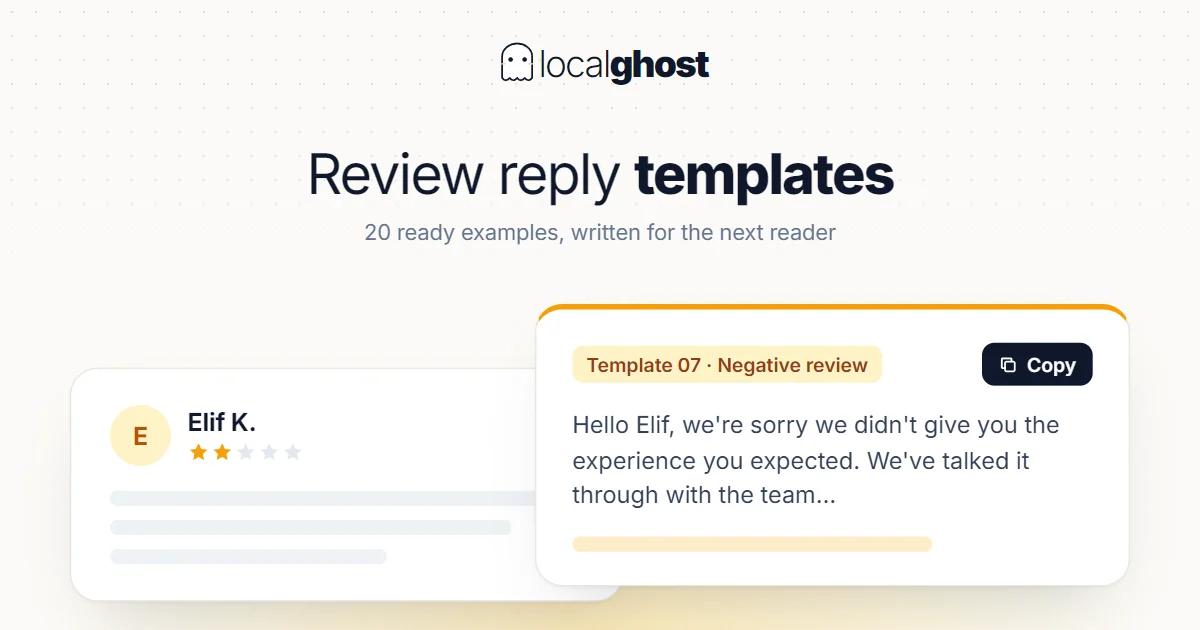
The structure is always the same: acknowledge, take ownership, move the fix to private, close the argument.
- "I am sorry about this experience. The [short subject] you describe is not our standard. Could you reach me on [phone] so we can go through the detail and fix it?"
- "A fair criticism. We have made a change on the [short subject] side; if you would like to try again, I will follow it personally."
- "Thank you for the feedback, this is how we learn. We reviewed it with the team and took the [short action] step."
- "You are right about the waiting time. We had unexpected volume that day and have reviewed our appointment planning accordingly."
- "It sounds like there was a breakdown in communication. I would like to find your record and establish what happened — could you write to [email]?"
- "I am sorry the price did not match your expectation. Setting out the scope of the [service] clearly upfront is our job, and we will be more explicit about it."
- "I have only just seen your review, apologies for the slow reply. If the matter is still open I would like to resolve it — would [phone] suit?"
Neutral and three-star reviews (3 templates)
Three stars is the most skipped and most winnable group: the customer is not describing a bad experience, they are describing an incomplete one.
- "Thank you. From your note I take it [the good part] went well but [the missing part] fell short — is that right? If you can tell me, we can put it right."
- "Thanks for the feedback. We are working on [the missing part]; I would like you to notice the difference next time."
- "Your review is useful to us. If you can expand a little on where the experience fell short, I would like to make a change accordingly."
Special situations (4 templates)
- Stars only, no text: "Thank you for the rating. If there is somewhere we fell short, I would be glad to hear it."
- A review meant for another business: "This review does not appear to relate to us — [brief reason]. If there is a mix-up I would like to help; you can reach us on [phone]."
- Someone who was never a customer: "I cannot find any trace of this experience in our records. It may be the wrong business; could you write to [contact] so we can check?"
- A serious allegation about a member of staff: "This is a serious allegation and we take it seriously. I would rather address it directly than here: [phone]."
In the last two cases replying is not enough: if the review breaches policy it also needs reporting. Which cases are reportable and how the process runs is covered separately: turning negative reviews into opportunities.
Limits on replies, by sector
The templates are general; in some sectors the content of a reply is additionally restricted.
In healthcare, patient privacy means a reply cannot contain treatment, diagnosis or appointment detail — even confirming that the person was a patient can be a problem. So the healthcare version of the templates above has to be shorter and more general. Rules on reviews and promotion also vary by country and professional body, which is something to ask your own regulator. Where the boundary sits: Google Maps SEO for dental clinics and Google Business for doctors and clinics.
In removals the complaint concerns concrete loss such as damage and delay, so wording that accepts liability can have insurance and legal consequences; moving the resolution to private here is not just courtesy but necessity: moving company SEO.
In scrap and wholesale the argument is almost always about the scale and the payment; describing the concrete measurement process in the reply is what works best: scrap metal and recycling.
In restaurants reply speed is decisive, because the decision is made the same day: Google Business guide for restaurants.
When the review is in another language
In tourist areas and in trades like transfers and accommodation, some reviews arrive in another language, and two mistakes get made here.
The first is leaving a foreign-language review unanswered. Google can show reviews translated into the reader's language, so an unanswered review reads as "they do not respond" to the next customer who speaks it.
The second is replying in your own language regardless. The rule is simple: reply in the language the review was written in. The reply can be short; two sentences in the right language land better than a long one in the wrong language. If you are unsure, one reply in both languages also works: the review's language first, then yours.
This touches demand directly in transfers and accommodation, because the customer decides before ever arriving: taxi and airport transfer and local SEO for hotels.
Making replies sustainable
The real benefit of templates is speed, but a template alone does not create a routine. Three things are enough:
Give it an owner. Replying does not happen when it belongs to "whoever has a moment". One person, one fixed slot a week.
Turn notifications on. If new-review notifications are off, late replies are inevitable.
Keep it short. Two or three sentences is enough. A long reply reads as a defence. When you finish, ask one question: would a stranger reading this want to work with you? If the answer is no, the problem is not the length but the tone.
Replying also generates new reviews: arriving customers see the replies and understand that leaving one gets a response. The side about building the flow: increasing Google reviews.
Frequently asked questions
Do I need to reply to every review? To every negative and neutral one, yes. Replying to all positive ones is ideal, but if volume is high you can be selective — in that case prioritise the ones that include text.
How fast should I reply? For negative reviews, the same day, two at most. Readers look at the reply date and read delay as indifference.
Can I use the same template on more than one review? The structure can stay, but one concrete detail must change each time. The identical text appearing on thirty reviews leaves a worse impression than no reply at all.
Can I edit a reply later? Replies can be edited and deleted. Fixing a mistaken or angry reply is possible, but it is safer to write assuming a screenshot may already exist.
Should I use the customer's name? Using the name shown on the review adds warmth. In sensitive fields like healthcare it is safer to avoid it, so you are not confirming the person as a patient.
Can negative reviews not be deleted? A review describing a genuine experience is not removed. Only reviews breaching policy are taken down after a report. The one effective tool left is the reply.
Written by
Yunus Akan
Related tools: Review replies · SEO audit tool · Post scheduling · All local SEO tools