Multi-Location Management: Best Practices
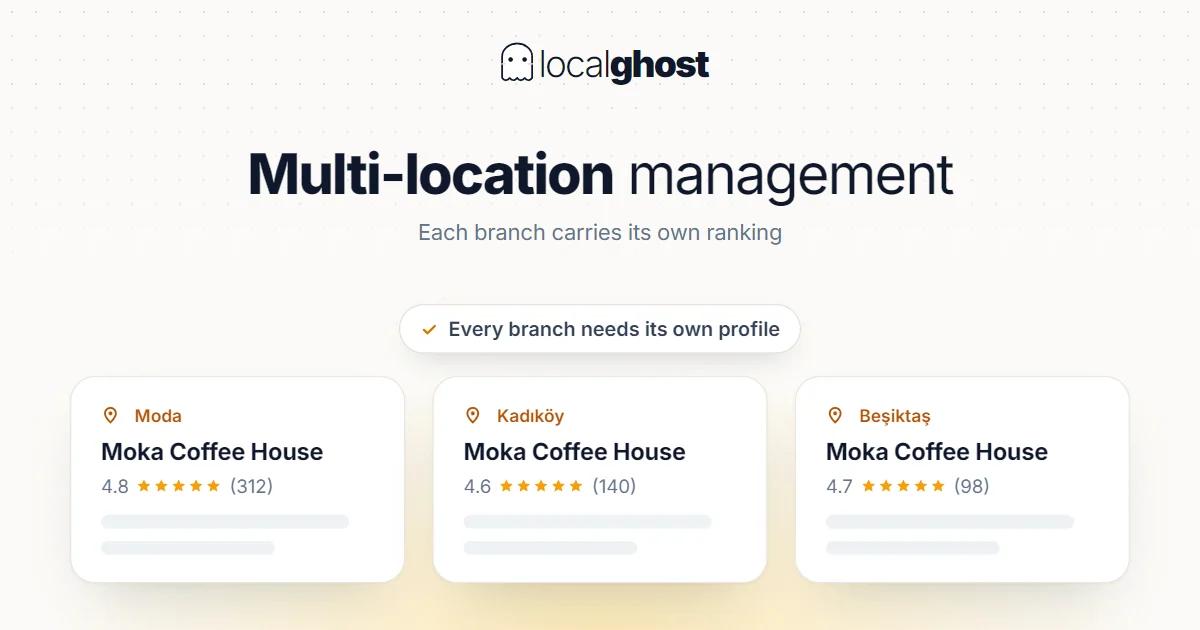
In a multi-branch business the most expensive mistake is running on one profile. Each branch carries its own ranking and its own reviews.
In this article
Summarize with AI
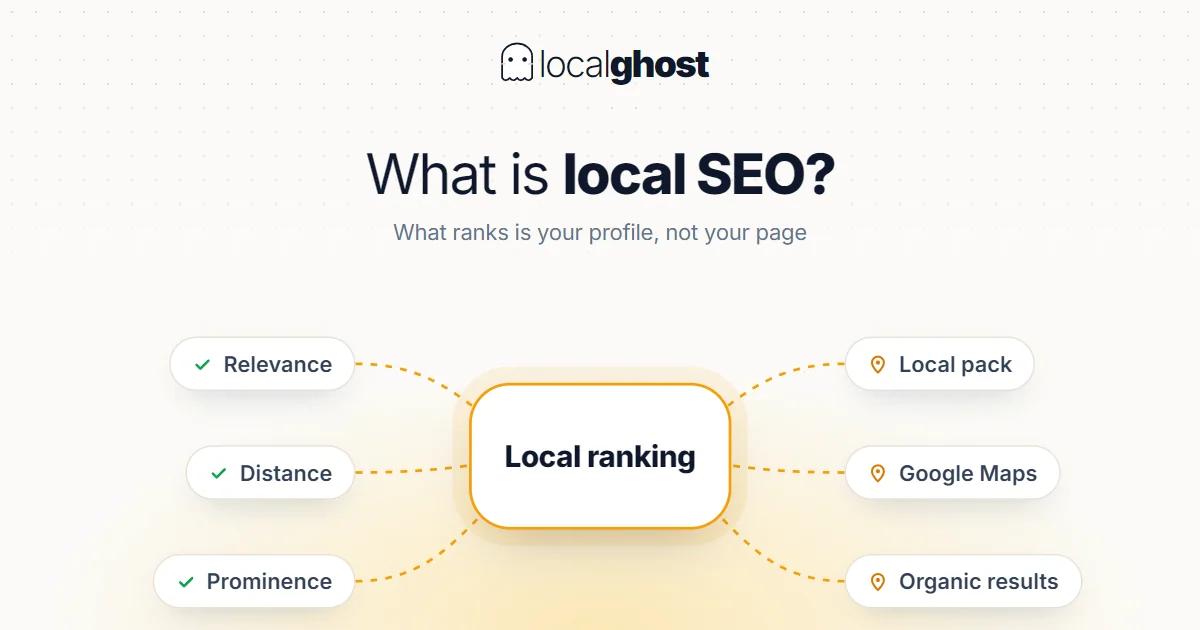
In multi-branch businesses the most expensive mistake is running everything through a single profile. The reason: local ranking is calculated per location. Because distance is a ranking input, only a listing tied to that address can enter searches in the neighbourhood of your second branch. One profile leaves all the demand around the other branches on the table.
The same logic applies to reviews: reviews accumulate per listing. A chain running on one profile is collecting five branches' experience under a single score and cannot see branch-level problems.
Each branch wants its own listing
The rule is simple: every physical location a customer can actually visit deserves its own listing. That has three concrete consequences.
Its own ranking. Each listing enters the searches around it. The mechanism: how the 3-pack works.
Its own reviews. Branch-level reviews give the customer accurate information and give you operational feedback.
Its own hours. Branches open at different times and holiday patterns can differ — hours optimization.
The exception: warehouses, offices and purely administrative addresses customers do not visit are not a reason to create a listing. Creating listings for addresses that are not actual service points creates a guidelines problem.
How to name a branch
This is the field where most mistakes happen, and the source of the rule is clear: Google asks you to represent the business as it is recognised in the real world.
In practice:
- The brand name stays the same. Five name variations across five branches scatters the brand signal.
- The distinguishing suffix has to be real. Whatever the branch is genuinely known as — on the signage, on the invoice, on the phone.
- No services or keywords in the name. Using a district name to distinguish a branch is reasonable if that is genuinely how it appears on the signage; adding it to win rankings is a violation.
So there is one test for the distinction: how do customers refer to this branch?
The category does not have to be identical across branches
The common assumption is that every branch in a chain sits in the same category. In practice the work mix can differ: one is takeaway only, another has seating; one is full service, another limited.
The category decision belongs to each branch separately, with the same test: whatever that branch's revenue body is, that is the primary category — how to choose the right category.
The service list should be branch-level too. Keeping a service listed at a branch that does not offer it means customers arriving for nothing, and a negative review.
Duplicates and the filtering risk
Two different problems get confused in multi-branch setups.
Duplicate listings. Two listings for the same branch: reviews split, signals scatter. Usually born from a listing created and forgotten in the past. The fix is merging or closing the extra one, not managing both in parallel.
Proximity filtering. Google suppresses listings it considers duplicative. Two branches very close together, in the same category and with similar details, can see one filtered. This is not a bug, it is design. What to do is make the two listings genuinely different: different service lists, different photos, accurate and separate address information.
How to run a listing sweep is a separate topic: why NAP consistency matters.
Running review flow per location
In a multi-branch setup review management should be centralised but the data has to be read per branch.
An arrangement that works:
- Replying sits centrally. One person or a small team, consistent tone. Patterns: review response templates.
- Asking sits at the branch. Reviews are asked for where the work finishes; head office cannot do that — increasing Google reviews.
- Track per branch. Where has the flow stopped, whose score is falling. The chain average hides it.
- Move recurring complaints into operations. If the same issue arrives at two branches, the problem is not the branch but the process — turning negative reviews into opportunities.
The website side: a page per branch
As important as the profile architecture and more often skipped: your website needs a separate page for each branch.
Two reasons. First, consistency between profile and site: if a branch's profile shows an address and phone, a page for that branch on the site should carry the same information. Listing five branch addresses on one "contact" page weakens that match.
Second, the search side: a user searching service plus district sometimes lands on a page rather than a profile. Without that page the demand goes unanswered.
A location page that works carries: that branch's address and phone, its own hours, the services offered there, access and parking information, and photos of that branch. What to avoid is duplicating the same text with the branch name swapped — five nearly identical pages devalue each other.
The test is simple: the page should hold at least three pieces of information specific to that branch and untrue of the others. Otherwise the page has no reason to exist.
Access structure: who can reach what
The most common accident in a growing business is losing access to a branch's profile. The cause is usually the same: the listing was created on an employee's or an agency's personal account, and that person left.
Two rules prevent it:
Ownership belongs to the organisation. The primary owner role should sit on an account belonging to the business; branch managers and agencies should be added with manager roles.
Document the access list. Who can reach which profile should be written down. Without it, after an employee leaves you have to start a request-access process, and that takes weeks.
Measurement: finding the weakest link
Reading the report per branch is on its own the highest-return habit in a multi-branch setup. The chain total can look fine while one branch sits at the floor.
What to compare: the share of unbranded searches, call and direction request counts, review flow rate, the date of the latest photo. Comparing the same metrics across branches shows directly which branch is not doing the profile work — reading the statistics.
Branch architecture by sector
Franchise structures. Brand at the centre, owners separate. The real risk here is inconsistency: each franchisee editing their profile independently. A central guide and access structure are essential — local SEO for franchise businesses.
Multi-specialty clinics. The relationship between the practice listing and practitioner listings is its own architectural question; patients often search by clinician name — Google Business for doctors and clinics.
Restaurant chains. Menu and hours differences between branches generate the most complaints; the "open now" filter works per branch — Google Business guide for restaurants.
Multi-property accommodation. Each property wants its own listing and its own attribute set — local SEO for hotels.
Frequently asked questions
Do I have to open a separate profile for every branch? For every location customers actually visit, yes. Ranking and reviews work per listing; one profile leaves the demand around the other branches on the table.
Should I add the district to the branch name? Reasonable if that is genuinely how it appears on signage and in real use. Adding it purely for ranking is a guidelines violation.
My two branches are very close. Will both show? Google can suppress listings it considers duplicative. Making the listings genuinely different (service list, photos, accurate address) reduces the filtering risk.
Should I create listings for warehouses and offices? Not if customers do not visit. Creating listings for addresses that are not actual service points creates a guidelines problem.
Should replies come from head office? Replying centrally, asking at the branch. Tone consistency needs one hand on replies, while asking has to happen where the work finishes.
I lost access to one branch's profile. What can I do? You have to use Google's request-access flow, and it takes time. The prevention: keep primary ownership on a corporate account and add staff and agencies as managers.
Written by
Yunus Akan
Related tools: SEO audit tool · Map rank tracking · Review replies · All local SEO tools