How to Conduct Competitor Analysis in Local SEO
In local search there is no single answer to 'who are my competitors': it changes with where you ask. Analysis has to start there.
In this article
Summarize with AI
Competitor analysis is relatively simple in classic SEO: whoever outranks you for the same keyword is your competitor. In local search that definition collapses, because distance is a ranking input. The same query returns different businesses two streets apart, so "who are my competitors" has no single answer — it changes with where you ask.
That changes the first step. Before drawing up a competitor list you have to decide where you are going to look from.
Finding the real competitors: where to look from
The common mistake is searching from your own premises and treating the results as the competitor list. That list is the most biased sample available, taken from the closest possible point.
What works:
- Split your service area into three to five points. The centre, two edges, one or two neighbourhoods customers actually come from.
- Run the same query from each point in a clean session.
- Note the top five businesses at each point.
- Look at the intersection. The ones appearing at several points are structural competitors — genuinely in the same pool as you. Those appearing at only one point are neighbours showing up there on proximity; chasing them is usually wasted effort.
That distinction is critical: confusing a structural competitor with a neighbourhood one leads to trying to fix something you cannot fix, namely distance. The mechanism: how the 3-pack works.
There is also somewhere else to look: the "more places" link opens the full ranked list. Seeing your own position and the five or ten businesses above you there is far more informative than looking only at the top three.
What to compare
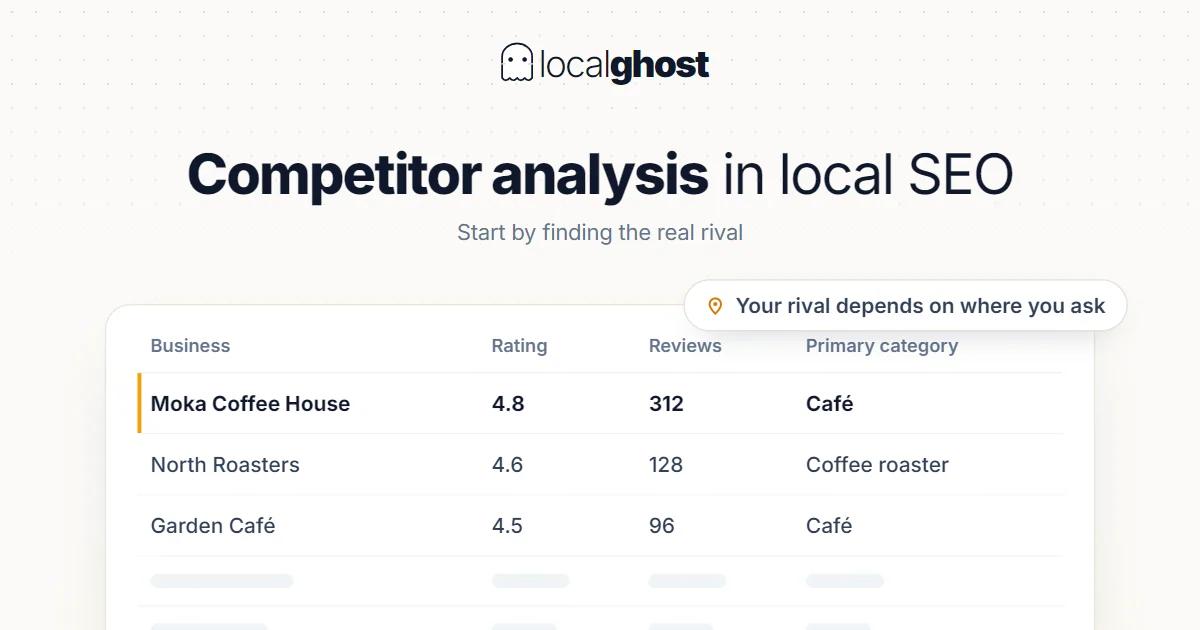
Competitor profiles are public, so no special tooling is required. The fields to compare, roughly in order of impact:
Primary category. The first place to look. Do the businesses above you share your category? If not, understanding why is on its own the most valuable output of most analyses — how to choose the right category.
Review count and the date of the latest review. Note both together. A competitor with a hundred reviews whose newest is a year old can be weaker than one with thirty and a weekly flow — increasing Google reviews.
Whether they reply to reviews. A pile of unanswered reviews is a closeable gap.
Photo coverage and recency. Not how many, but which types exist and when the latest was added — photo optimization.
Profile completeness. Service list, description, attributes, hours. Empty fields are the competitor's weak spot.
Service naming. Which words has the competitor used for services? That is a free clue about the language customers actually use.
Putting these side by side in a table is enough. The aim is not scoring but finding a closeable gap: areas where the competitor is ahead and you can fix it in a week.
What not to copy
The riskiest part of analysis is applying what you see directly.
Do not copy the category blindly. The competitor may be in the wrong category; outranking you does not prove their category is right — it could be distance or reviews. The measure is your own revenue mix.
Do not copy the business name. Seeing a competitor with services and districts in their name and doing the same is a guidelines violation. That the tactic works temporarily does not make it safe.
Do not run a campaign to match review volume. Rapidly collecting reviews to overtake a competitor creates a pile pattern and the spam filter removes them.
Study the competitor's presentation, not their price. Pricing is not the subject of this analysis; the lesson is how they present information.
Spam competitors: what to do and not do
Sometimes the business above you is not a legitimate competitor. Three signs to check:
- Keywords stuffed into the name.
- The address is not real: checking it turns up a home, empty land or a virtual office.
- The reviews are not natural: a pile arriving in a short window, all without text, the same phrasing.
These can be reported through Google's business redressal flow. Realistic expectation: the process is slow, the outcome is not guaranteed, and documented reports get more traction. What not to do is adopt the same tactic — the short-term gain carries suspension risk.
Turning the findings into an order of work
The output of an analysis has to be an order, not a list. Otherwise a ten-row "the competitor is better" table just sits there.
Split the findings into three boxes:
Closeable this week. A missing service list, an empty description, wrong hours, a missing photo type. If the competitor leads here, the gap is a few hours of work.
Spread over months. Review volume and recency, photo accumulation, citation coverage. You cannot pass a competitor here in one move; what you build is a routine.
Not closeable. Distance, and in some cases brand recognition. If the competitor is more central than you, no profile setting fixes it; the strategy is a second location, paid coverage, or focusing on the demand types where proximity loosens.
Ordering by those three boxes is the single step that turns analysis into action. Skipping to the second box before finishing the first is the common mistake: while you try to build a routine, a week's worth of work waits on the table.
Making the analysis repeatable
A one-off competitor analysis is a photograph; what works is being able to retake the same measurement.
A practical arrangement: the same three to five points, the same queries, once a quarter. What you record is not the list but the change: who moved up, whose review count accelerated, who changed category.
The method for that measurement is a separate topic and has to be set up correctly, or the difference you see may be a measurement artefact: how to track rankings.
What counts as a competitor, by sector
Who your competitor is also varies by sector, and that sets the scope of the analysis.
Where proximity is tight the list is short and local. In salons, the three to five within walking distance; a good salon across the city is not a competitor — local SEO for hair salons.
Where proximity loosens the list is city-wide. For dental clinics and holiday accommodation people travel, so the pool is wide — Google Maps SEO for dental clinics and local SEO for hotels.
Where the competitor is a platform. In taxi and transfer the real competition is often not the neighbouring rank but the apps. Analysis then cannot stop at competitors inside Maps — taxi and airport transfer.
Where competitors are few and relationships decide. In wholesale and B2B the list is short, but the decision runs on referral more than on reviews and photos — wholesale food suppliers.
Frequently asked questions
How do I identify my competitors? Run the same query from several points across your service area and look at the intersection. Those appearing at several points are structural competitors; those at one point are neighbours showing up on proximity.
Is searching from my own shop enough? No. That is the sample taken from the closest location with the most biased history. Like a ranking read, a competitor list has to come from multiple points.
Should I copy a competitor's category? Looking is useful for sanity-checking, copying is not. The competitor may be in the wrong category. The measure is your own revenue mix.
A competitor has far more reviews. What should I do? Build the flow rather than chasing the volume. A fast campaign creates a pile pattern and the reviews get filtered. Also check the date of their latest review; if volume is high but the flow has stopped, there is a closeable gap.
The business above me looks like spam. What can I do? Document the name stuffing, the address that is not real and the unnatural review pattern, and report it through Google's redressal flow. The process is slow; adopting the same tactic is a suspension risk.
How often should I redo the analysis? Once a quarter is enough. What matters is repeating it from the same points with the same queries; otherwise the difference you see may be measurement variance rather than real change.
Written by
Yunus Akan
Related tools: Local SEO Audit · Local Grid Scan · Review Management · All local SEO tools