Google Maps SEO for Wholesale Food Suppliers
Wholesale food will not bring a hundred calls a day from Maps. But one call can be a restaurant owner, and one buyer means years of steady revenue.
In this article
Summarize with AI
In the wholesale food business the expectation from Google Maps has to be set correctly from the start: you are not going to get a hundred calls a day from it.
This is not retail. Your buyer is not a consumer walking past; it is a restaurant operator, a supermarket buyer, a hotel chef, a canteen manager. These people usually stay with the supplier they have used for years, and they find new suppliers mostly by referral.
Which is precisely why writing Maps off would be a mistake. Because:
- A newly opened business is looking for suppliers. One of the first jobs of someone opening a restaurant is searching for a wholesaler.
- A buyer unhappy with their current supplier is looking for alternatives. That search is quiet and its intent is high.
- Buyers from out of town do not know the area and start from the map.
- Buyers hunting a specific product ("wholesale avocado", "organic vegetables wholesale") search very specifically.
The volume of this demand is low and its value is high. Winning one restaurant client means years of recurring revenue. So the right question is not "how many calls arrive" but "how many of the arriving calls are real buyers".
Opening hours: this sector's biggest technical problem
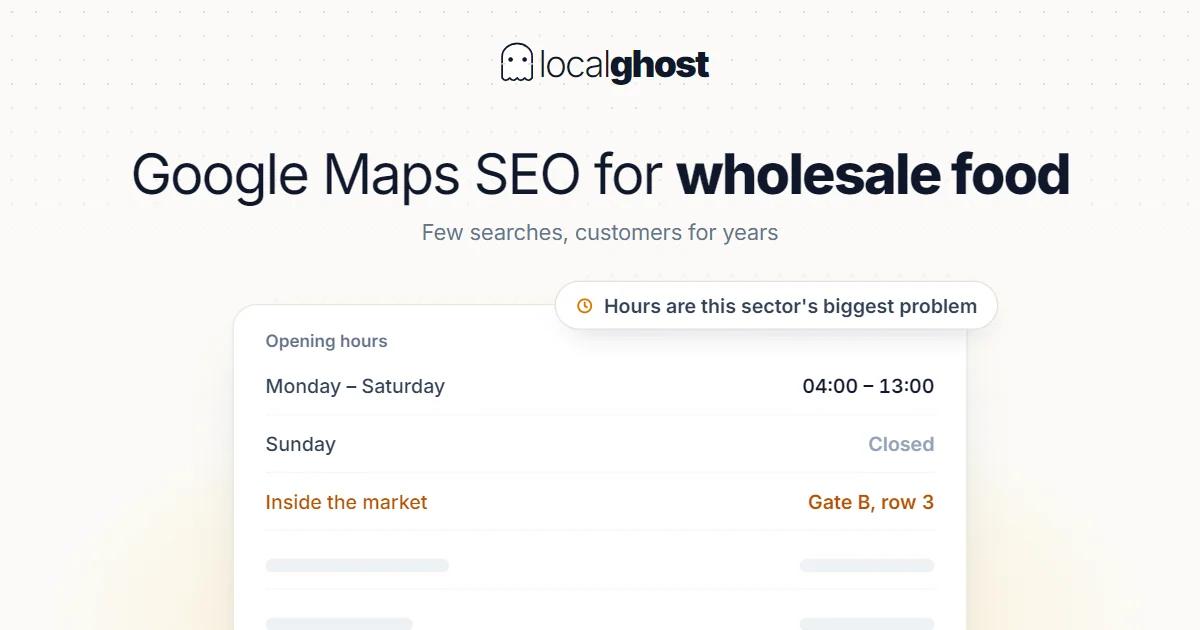
This is where wholesale food separates from every other sector. Market-hall traders open after midnight and close at nine in the morning. Nobody works 09:00 to 18:00.
Google's hours field supports that pattern, but it has to be entered correctly:
- Ranges that cross midnight can be entered. A range such as 02:00-09:00 is valid on its own. The common wrong practice is splitting it into 02:00-23:59 plus 00:00-09:00, or entering nothing at all.
- Entering no hours is the worst option. A profile without hours never passes the "open now" filter, so a buyer searching for a supplier at four in the morning does not see you at all.
- Weekend and holiday patterns need their own entries. Market days differ from city to city and the buyer does not know yours.
- Seasonal shifts. If your working pattern changes with the produce season, the profile has to follow.
None of these items are exciting, but they are the highest-return work in this sector. For a buyer searching at four in the morning, passing the "open now" filter is worth more than ranking first.
How ranges that cross midnight are entered on Google's side: hours optimization.
If you are inside a market hall, directions are a separate job
Businesses inside a wholesale market hall have a particular problem: the address reads like "X Market, Block Y, Unit Z" and mapping services usually do not recognise the internal block structure. The buyer reaches the market but cannot find you.
What can be done:
- Place your map pin as precisely as possible. Not the market entrance — your own block or unit position.
- Write the block and unit number into the address field in full, without abbreviations.
- Add spoken directions to the business description. A sentence like "second block on the right after the main entrance, unit 14" cuts phone traffic on its own.
- Photograph your frontage. A picture of your sign and your unit is more useful than a map to someone searching inside the hall.
- Name a nearby reference point. Buyers give directions inside a market using the neighbouring trader or the block number.
The buyer's first three questions belong on the profile
A B2B buyer running a search wants to know three things, and all three are usually missing from the profile:
Is there a minimum order? A supplier with a 500 kilo minimum is meaningless for a café. Leaving this out means unsuitable buyers call and suitable ones never do.
Do you deliver, and where? A buyer collecting in their own van and a buyer receiving a delivery are two entirely different services. Delivery area and delivery days sit at the centre of the decision.
What are the payment terms? Cash, credit terms, whether cheques are accepted. For a restaurant operator this question comes before price.
All three belong in your service descriptions and business description. Once they are written, the quality of incoming calls rises noticeably — and in this sector the goal is not more calls but the right call.
Categories and product naming
Google Business Profile carries categories such as wholesaler, produce wholesaler, food wholesaler, meat wholesaler, dried-fruit and nut wholesaler. Your primary category should be your main product group; choosing the generic wholesaler option means giving up the strongest signal in product-level searches.
Product naming follows a different logic from retail: the buyer searches by product group and quality grade.
- "Wholesale vegetables", "wholesale fruit", "locally grown", "certified organic", "export grade", "first class"
- Seasonal produce: buyers search specifically for things like wholesale strawberries or wholesale citrus, and that demand concentrates in season
- Sector-level service: "restaurant supply", "hotel supply", "canteen supply" — the buyer searches for their own business type
Listing your main product groups and the business types you serve in the services list is the most practical way to match the right buyer.
The general rules: how to choose the right category.
Certificates are a trust signal here
In food supply the buyer is taking a risk: what they buy goes on to their own customers. That makes documentation do more work in this sector than in most others.
Food safety certificates, producer certifications, organic certification, export permits — these belong in the business description and the service descriptions. They can be uploaded as photographs too.
If you have cold-chain capability, say so plainly. Cold storage and refrigerated vehicles are a direct quality guarantee for the buyer, and most of your competitors do not mention them on their profile.
Reviews: low count, high weight
Review counts stay low here because B2B buyers do not have the habit of writing them. The consequence: every review you do have carries a lot of weight.
A wholesaler with five reviews is at a clear advantage over a competitor with none. And the content of those reviews is different: a retail review says "the produce was nice", while a B2B review says "we've been buying regularly for two years and deliveries never slip". The second is far stronger for a new buyer.
The most productive route to reviews is asking the customers you have supplied for a long time — not new ones. A restaurant or shop you serve regularly will mention continuity in what they write, and that sentence is exactly the reassurance a new buyer is looking for.
Do not offer a discount or free produce in exchange; it breaches Google's policy, and in this sector your reputation is your only sales tool.
Photos show product quality
In wholesale food, photographs are the only remote evidence of product quality.
- Product shots in real crates and on pallets. Not a retail display — the state the buyer will actually receive.
- Warehouse and cold storage — showing capacity and storage conditions.
- The vehicle fleet — delivery capacity, and refrigerated vehicles if you have them.
- The unit or counter — this is what makes you findable inside a market hall.
- Seasonal produce, as it arrives. Photo freshness here answers the question "do they have this right now".
Do not use stock food photography. The buyer is a professional and spots it immediately; the trust you lose is worth more than the effort you saved.
The rare B2B case where posts actually work
In most sectors Google posts are a weak signal. Wholesale food is different, because your content genuinely changes daily: what arrived, which season opened, which way prices moved.
Season openings, new arrivals, promotional periods — these are real, time-bound information. A wholesaler posting the day's arrivals keeps the profile active *and* gives the buyer the information they were actually after.
Turning posts into a regular rhythm: how to schedule posts.
Setting the expectation correctly
Back to the observation this guide opened with. What you should expect from Google Maps in wholesale food is not traffic volume.
What you should expect is this: a handful of new buyers a year, each of them long-term. With the profile set up properly, the quality of incoming calls rises, unsuitable buyers stop calling, and suitable ones arrive having already found the information they needed.
This is not a visibility race like the salon or restaurant sectors. It is closer to being findable and credible at the moment the right buyer searches. Low cost, slow return, but it lasts.
Frequently asked questions
I work overnight. How do I enter my hours? Google supports ranges that cross midnight; a range such as 02:00-09:00 can be entered directly. Entering nothing is the worst option, because a profile without hours never passes the "open now" filter and the buyer searching before dawn does not see you.
I am inside a market hall and buyers cannot find me. What can I do? Place the map pin on your own unit rather than the market entrance, write the block and unit number into the address field in full, add spoken directions to the business description, and upload a photo of your sign. Inside a market hall a photograph is more useful than a map.
Will publishing my minimum order lose me customers? It loses the unsuitable ones, which is the point. Leaving it out makes unsuitable buyers call *and* makes suitable ones hesitate. In this sector the goal is call quality, not call count.
Is it realistic to collect reviews in a B2B business? Hard but valuable, precisely because the low count gives each one weight. The most productive route is asking long-standing customers; their review mentions continuity, which is exactly the reassurance a new buyer wants.
I also sell retail. One profile or two? If it is at a different address and genuinely a separate operation, a second profile can be right. Opening a second profile at the same address counts as a duplicate, splits your reviews and invites filtering. Doing both in one place means one profile plus secondary categories.
Written by
Yunus Akan
Related tools: Grid rank tracking · AI review responses · All local SEO tools