How Restaurants Can Increase Their Star Rating
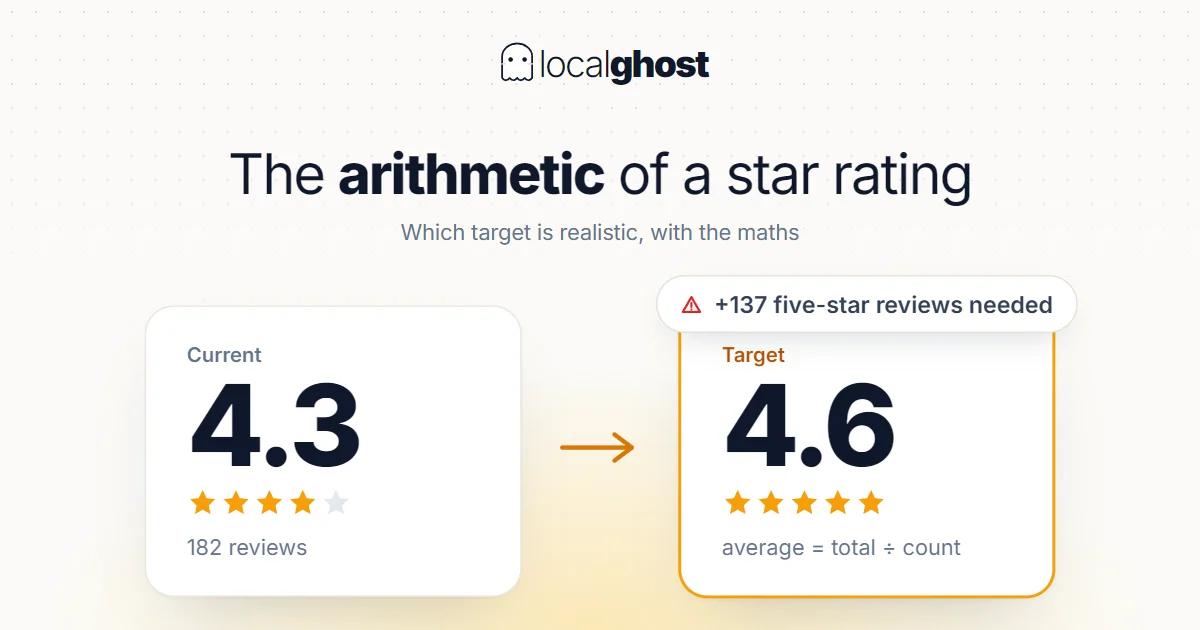
An average rating is not a perception, it is a sum divided by a count. Once you do the arithmetic, which targets are realistic becomes obvious.
In this article
Summarize with AI
Raising the star rating is the thing local businesses talk about most and calculate least. Yet an average is not a perception: it is the sum of the ratings divided by the number of them. So "let's get to 4.9" is first an arithmetic question.
This guide does that arithmetic. It does not describe a particular client; it gives a calculation anyone can repeat with their own numbers. The result usually surprises people, because most targets are arithmetically unreachable.
How the calculation works
The formula is simple. If you have N reviews and an average of A, the sum of the ratings is N × A. After x new five-star reviews the average becomes:
(N × A + 5x) / (N + x)
Setting that equal to your target average and solving for x gives the exact answer to "how many reviews does this take".
Take a concrete case: you have 50 reviews and an average of 3.2. So your rating sum is 160.
- To reach 4.0: 160 + 5x = 4.0 × (50 + x) → x = 40 new five-star reviews.
- To reach 4.5: 160 + 5x = 4.5 × (50 + x) → x = 130 new five-star reviews.
- To reach 4.9: 160 + 5x = 4.9 × (50 + x) → x = 850 new five-star reviews.
That last line is the point. Going from 3.2 to 4.9 means adding 850 flawless reviews on top of the existing 50 — and that assumes not a single four-star arrives in between to spoil the sum. In practice not every review is five stars, so the real number is higher still.
What the cost of one bad review is
The same formula works in reverse, and knowing the answer changes decisions: how many good reviews does it take to offset one bad one?
Say you have 100 reviews and an average of 4.5; your sum is 450. One one-star review arrives, giving 101 reviews and a sum of 451, so the average falls to 4.46. To get back to 4.5:
451 + 5x = 4.5 × (101 + x) → 0.5x = 3.5 → x = 7
So a single one-star review costs seven five-star reviews. At a 4.7 average the same calculation is harsher: offsetting one one-star takes roughly 12 five-star reviews, because as the target approaches five the denominator narrows.
The practical consequence matters more than review collection: cutting off the cause of a bad review is seven times more efficient than gathering new ones. Correct opening hours that stop a customer arriving at a closed door do the work of seven review requests.
The weight of the first reviews
This is where the arithmetic bites hardest. On a profile starting from zero, the first review sets the average on its own; the second halves it.
Concretely: if four of your first five reviews are five stars and one is a one-star, the average is 4.2. The same distribution across 100 reviews would give something far more stable — but on a new profile a single bad experience stays on top of you for months.
The practical consequence: at a new opening, let the service settle first, then ask for reviews. Collecting aggressively in the first weeks, while the kitchen, the service or the team have not settled, makes low ratings permanent. Waiting a week or two saves the following year.
The two things that actually move the average
The arithmetic shows there are two ways to pull the average up, and one is far stronger than the other.
A flow of new positive reviews. The slow-working but only legitimate route. A steady flow beats a sudden pile — it looks natural and does not get filtered. Methods and prohibited tactics: increasing Google reviews.
Cutting off the cause of negative reviews. This is the side that does not show in the arithmetic and is stronger. Every new one-star takes back several of the five-stars you earned. Chasing the average without closing the source is filling a leaking bucket.
The practical reading of the second point: if the same complaint has arrived twice, it is no longer a customer error but a process error. Triage and process: turning negative reviews into opportunities.
Why the shortcuts do not work
Because the arithmetic is hard, shortcuts get tempting. None of the three delivers:
Buying reviews. When detected the reviews are removed — so the money goes and the average returns to where it was. The profile also gets flagged.
A burst campaign. A large number of reviews arriving in a short window creates an unnatural pattern and the spam filter removes them. The effort goes, the average does not move.
Trying to get a negative review deleted. A review describing a genuine experience is not removed. Only ones breaching policy come down after a report; "I think it is unfair" is not a reason.
There is also the route that is prohibited but assumed harmless: a discount or a free item in exchange for a review. Collecting reviews for incentives is explicitly banned.
What to watch instead of the average
The arithmetic shows the average itself is a slow-moving number. For day-to-day decisions two indicators are more informative.
The last thirty days' average. The overall average carries history; the last month's average describes the business as it is now. If the overall is 3.8 but the last month is 4.6, things are improving — and someone looking only at the overall cannot see it.
The count of one- and two-star reviews. These pull the average down the most, and they usually come from a single cause: waiting time, order errors, price surprises. Counting the cause rather than the number prevents several future reviews with one fix.
Tracking those two monthly produces results faster than forcing the average, because the average is already the outcome of both.
What drags a restaurant's rating down
The sector-specific causes are known, and most are solvable on the profile side:
Wrong opening hours. Appearing open while closed means a customer turned away and a one-star directly. The "open now" filter decides this category: hours optimization.
Expectation mismatch. Stock or outdated photos create disappointment on arrival. Images have to show reality: photo optimization.
Menu and price ambiguity. A price not visible on the profile turns into a complaint when the bill arrives.
Unanswered reviews. An unanswered negative is worse than the negative: the reader sees the complaint and the indifference. Patterns: review response templates.
The whole sector: Google Business guide for restaurants.
Do your own calculation
You need three numbers: your current review count, your current average, your target average. Then:
Five-star reviews required = N × (Target − Current) / (5 − Target)
Example: 80 reviews, 3.8 average, target 4.4 → 80 × 0.6 / 0.6 = 80 new five-star reviews.
The logic of the formula: the (5 − Target) term in the denominator shrinks as the target approaches five, which is why the number required grows so fast.
Once you have that number, ask the second question: over how many months can I collect it? If you do not know your realistic monthly rate, look at how many reviews arrived in the last three months. If the target needs more than two or three times that rate, it is not a target but a wish.
Frequently asked questions
Is going from 3.2 to 4.9 possible? On a profile with 50 reviews the arithmetic requires 850 flawless reviews. So in practice, no. A realistic target is the 4.3 to 4.6 band.
At how many reviews does the average stabilise? The more reviews, the stiffer the average: at 10 reviews one bad rating drops it sharply, at 200 the effect is small. That is also where the protection comes from.
Can I get a negative review deleted? Only if it breaches policy. A review describing a genuine experience is not removed; the move is to reply and to cut off the cause.
Can I offer a discount for a review? No, collecting reviews for incentives is prohibited and can lead to the reviews being removed.
Is a perfect 5.0 average good? Possible with few reviews, but it does not look natural and raises suspicion. A few four-stars show the average is real.
My average fell. What should I do? Find the cause first: if several reviews concern the same issue, that is an operations problem rather than a review problem. Collecting new reviews without closing the source does not fill the hole.
Written by
Yunus Akan
Related tools: Review Management · All local SEO tools