Local SEO for Hotels and Accommodation
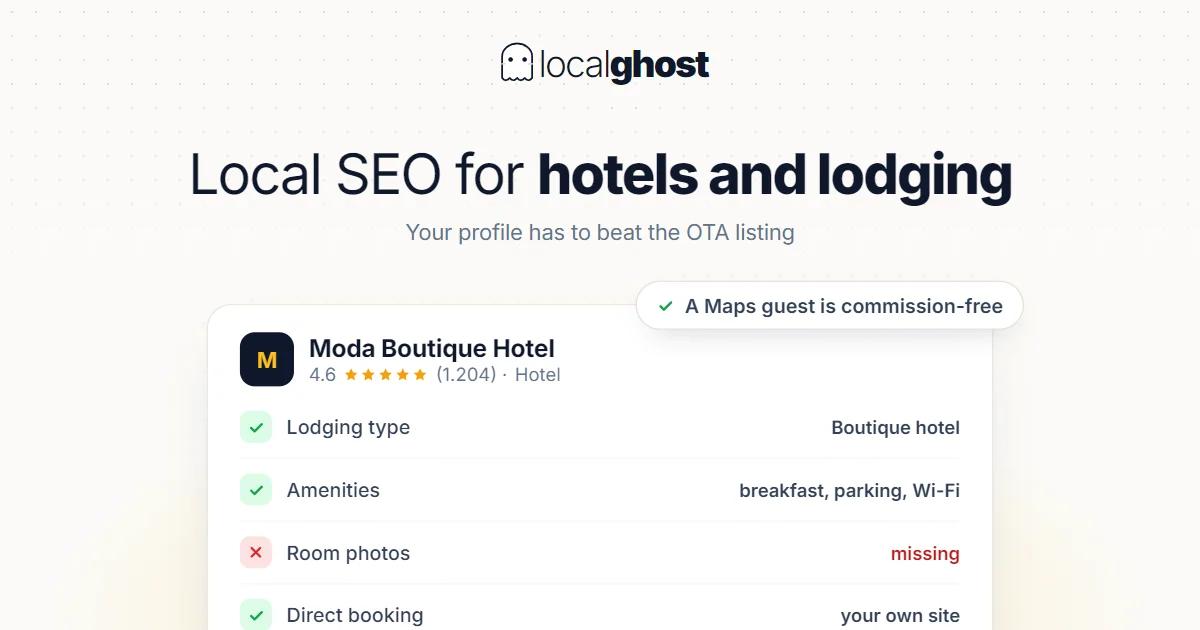
A guest who finds you through Maps is your most valuable guest: commission-free and direct. But winning them means your profile has to beat the OTA listing.
In this article
Summarize with AI
To understand where Google Maps fits in hospitality, start by accepting something: in this sector the search results are the OTAs' garden. Search "hotels in Istanbul" and the first things you see are Booking, Trivago and Google's own hotel search module.
That does not make Maps irrelevant. The opposite: a guest who arrives through your profile is your most valuable guest, because they are commission-free and direct. Every OTA booking costs 15-25% in commission; a guest from your profile pays full rate.
The point is this. Competing with OTAs on generic "city + hotel" searches is hard. But your profile can win outright on these:
- Brand searches — the guest has heard of your hotel and is looking it up. Here your profile competes with the OTA's page for your own hotel, and whoever wins decides who takes the commission.
- Proximity searches — "hotels near me", or near the airport, station or hospital
- Niche demand — "pet friendly hotel", "hotel with early check-in", "hotel with meeting room"
- Last minute — a guest looking for a room tonight prefers the phone
- Corporate and groups — contracted accommodation, wedding and event parties
Beating the OTA on your own brand search
When a guest types your hotel's name, two results compete: your profile and the page an OTA created for your hotel. If the guest clicks the OTA link, you pay commission on a guest who came looking for you by name.
What strengthens the profile in that contest:
Point the booking link at your own site. Google Business Profile has a booking link field. Putting an OTA link there means paying commission on your own profile traffic. Send it to your booking engine, or to your enquiry page if you do not have one.
Keep rates consistent. If the guest sees a price on your profile and finds it cheaper on an OTA, direct booking collapses. Rate parity is the basic condition for this channel to work at all.
Do not leave the website field empty, and point it at the booking page rather than the homepage — one extra click is a measurable loss in conversion.
Make sure the phone reaches reception. Last-minute demand arrives by phone; getting lost in a switchboard is a lost booking.
Wiring the booking platform to the profile: booking platform and Google Business integration.
Category choice defines what kind of stay you are
Accommodation is not one category in Google Business Profile: "Hotel", "Boutique Hotel", "Apartment Hotel", "Guest House", "Hostel", "Resort", "Campground", "Holiday Home".
This distinction also sets guest expectations. A guest who books an "apartment hotel" expecting full hotel service arrives dissatisfied, and that lands in a review. The right category is not only a ranking question — it is how you attract the right guest.
Distinctions like boutique hotel and resort are also entry tickets to niche searches. Someone searching "boutique hotel" wants a specific kind of experience, and a generic "Hotel" category does not carry that signal.
Secondary categories matter too: if you have a restaurant, spa, meeting rooms or beach access, these can be added as categories and marked as attributes. Those markings are what put you into Google's filtered results — when a guest filters for "hotels with a pool", attributes are how you stay in the list.
Attributes are the filter keys in this sector
Accommodation has one of Google's richest attribute sets, and filling those fields translates directly into visibility.
What guests actually filter on:
- Free parking — the most decisive filter for city hotels
- Free breakfast — the first thing checked in a price comparison
- Wifi — an expectation now; its absence is the signal
- Pet friendly — a small but highly decided audience
- Accessibility — wheelchair access, lift
- Pool, spa, fitness — decisive in leisure demand
- Air conditioning — a standalone reason to book in hot regions
- Family rooms, cots — the filter for family demand
- Early check-in / late check-out — critical for guests with transfer connections
When these fields are blank, Google leaves you out of the corresponding filtered results. A blank attribute is not read as "not available" but as "unknown", and the guest applying that filter never sees you.
Seasonal operation: hours and closures
For properties that operate seasonally, profile management differs from a year-round hotel.
Mark off-season closure as temporarily closed. Leaving the profile open during a closed period generates "called, no answer" and "went there, it was closed" reviews — and those reviews are still sitting on your profile when the season opens.
Reception hours must be real. If you do not have 24-hour reception, do not show it that way; a guest arriving at night is left at the door and that review is expensive.
Announce the season opening as a post. Posting has a genuine function in this sector: season opening, early-booking windows, special-period packages. The content really is time-bound.
Booking-window dates. Early booking is a real demand window in hospitality, and stating it on the profile converts directly.
The general framework for managing the off-season on the profile: SEO for seasonal businesses.
Photos: no room shown, no booking made
In accommodation, photos are the centre of the decision. Guests do not book a place they have not seen.
- Room photos, by room type. Standard, deluxe and family rooms separately. Selling different price tiers on one room photo disappoints the guest who arrives.
- The bathroom. The most-checked frame, and the thing guests worry about most.
- Breakfast and dining area. If breakfast is included, what kind of breakfast it is decides bookings.
- The view — the real view. A sea-view claim that photos do not support costs you rating points.
- Exterior and entrance. So guests can find the property, especially on late arrivals.
- Shared areas. Pool, lobby, terrace.
Extreme wide-angle and heavily edited photos backfire here: the guest arrives, sees the difference, and writes about it. Realistic photography is more profitable than beautiful photography.
You cannot remove guest photos. The counter is to add your own current ones regularly.
Guest reviews: high volume, high sensitivity
Accommodation has some of the highest review volume of any sector — guests are already used to writing reviews on OTAs. That is an advantage and a risk at once: in this sector the rating average is the single number that most influences the booking decision.
Points specific to hospitality:
- Reviews are usually about one of four things: cleanliness, noise, staff attitude, or a mismatch with the photos. The first three are operational; the fourth is a profile-management problem and entirely within your control.
- Answer cleanliness complaints concretely. "We apologise" is not enough — say what changed. The person reading that reply is the next guest.
- Ask at check-out. If the guest is happy as they leave, that is the moment. Emails sent afterwards convert far worse.
- Never offer a discount or upgrade in exchange. It violates Google's policy, and because the practice is common in hospitality, detection is more likely rather than less.
- Reply to foreign-language reviews in that language. For international guests this is a trust signal, and it adds multilingual text to your profile.
Ready reply patterns and tone: review response templates.
Proximity: tight for city hotels, loose for resorts
Proximity is a ranking input in every local search, but accommodation shows two distinct behaviours.
For a city hotel proximity is narrow and sharp: the guest wants closeness to the airport, station, hospital or exhibition centre. In this demand it helps to state the relationship to those reference points — a line like "15 minutes from the airport" in your service descriptions answers the guest's question and creates a match at the same time.
For a resort proximity is nearly meaningless: the guest is coming from another city or country and searching "region + hotel". Here review volume, photo quality and attribute completeness matter far more than distance.
So for a city hotel, fix the fundamentals and state your reference points; for a resort, invest in review and visual strength.
Frequently asked questions
Should the booking link point to an OTA? No. A guest arriving through your profile is a commission-free guest; putting an OTA link there routes your own brand traffic into a paid channel. If you have no booking engine, point it at your enquiry or reservation-request page.
Does filling in attributes really make a difference? Yes, because guests use filters. A blank field is treated as "unknown" rather than "no", and you drop out of the filtered list. Parking, breakfast, pet policy and accessibility are the most-filtered fields.
Should I close the profile out of season? Mark it temporarily closed rather than removing it. Leaving it open generates "went there, it was closed" reviews, and those remain on the profile when the season reopens.
Should I publish room rates on the profile? Rates move with season and occupancy, so a fixed price is hard. Rate parity is what matters: if the guest sees your profile price and finds it lower on an OTA, your direct channel does not work.
How many room photos do I need? Separate photos for every room type you sell. Selling different price tiers on one photo disappoints the arriving guest and it lands in your rating. Do not skip the bathroom; it is one of the most-viewed frames.
What should I do for international guests? Reply to foreign-language reviews in that language and make sure the English versions of your profile details are correct. International guests search rather than install an app, so the profile is their first point of contact.
Written by
Yunus Akan
Related tools: Local SEO Audit · Local Grid Scan · Post Management · All local SEO tools