New Business SEO Checklist
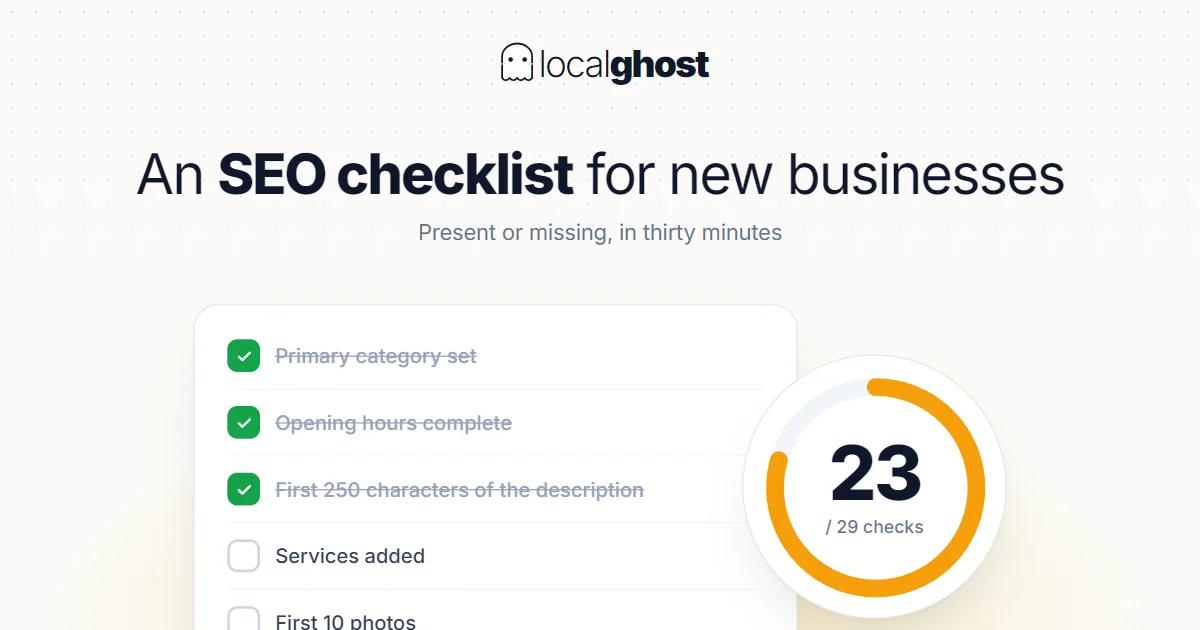
This is not a schedule of things to do but a present-or-missing list. Run it end to end in thirty minutes and mark the gaps.
In this article
Summarize with AI
There are two different needs here and they call for two different documents.
If you want to know the order — what to do in which week — you need a timeline: 30-day plan for a new business.
If you want to know whether something is missing, this is the list. Not a timeline but a completeness audit: every item answers "present" or "missing".
That distinction has a practical consequence: this list suits not only a new business but one trading for two years. In most profiles, missing items go unnoticed for years.
The list runs end to end in thirty minutes. Each item also says how to verify it, because "we did that" and "it works" are different things.
Core identity
An error in this block affects everything below it.
Does the business name match the sign? Verify: put a photo of the sign next to the name on the profile. Keywords, a district or campaign wording breach the naming rules.
Is the address complete and correct? Verify: press directions and check the pin sits at the building entrance. A pin on the back street loses customers.
Is the phone number right and answered? Verify: call it from another phone.
Does the primary category describe the body of your revenue? Verify: which work produced the largest share of last month's revenue? Is that the category? The narrowest accurate option wins: how to choose the primary category.
Have secondary categories been added? For the other work you do.
Is verification complete? An unverified profile shows up limited. Video verification works for physical storefronts, service-area and hybrid businesses: video guide.
Information completeness
Every field left blank is an unanswered customer question.
Are opening hours entered? Verify: look at today's hours and compare against reality.
Are special-day hours entered? Verify: check the holidays in the next three months. A special day left blank falls back to regular hours: hours optimization.
Is there a description, and does the first sentence say what you do? Verify: look on mobile; the full text is not visible, so the first sentence decides: how to write the description.
Is the service list in the customer's words? Not industry jargon: local keyword research.
Are attributes ticked? Parking, accessibility, payment methods, outdoor space.
Is the website field filled and pointing at the right page? With multiple branches, at the branch page rather than one contact page.
Is there an appointment, booking or ordering link, and does it work? Verify: click it and go all the way through. Not every business is eligible for every link type; if the field is absent, your category may not qualify.
Visual content
Is there an exterior photo? This is the one that helps customers recognise the business when they arrive.
Is there an interior photo? So the customer knows what they are walking into.
Is there a photo of the work itself? Category-specific photos are recommended.
Is the newest photo from this month? Verify: open the photo section and look at the most recent. Recency carries more meaning than the total count: photo optimization.
Do the photos read on a phone? A distant, busy shot says nothing on a small screen.
Reviews
Is there a process for asking? Verify: how does a customer served today get asked for a review? If the answer is "whoever remembers", there is no process.
Is the request made as the service ends? A request sent two days later goes unanswered.
Are reviews being replied to? Verify: are any unanswered? Replies go through moderation and can sometimes take up to 30 days, so also check that what you sent appears live.
Are incentives avoided? A discount or free service in exchange for a review is strictly prohibited: strategies for increasing reviews.
Are common questions written into the questions section? Left blank, other people can answer them wrongly.
Consistency
This block is the most skipped and the most insidious.
Are name, address and phone identical everywhere? Verify: put the profile, your own site and the priority sources side by side: NAP consistency.
Is there a duplicate listing? Verify: search your business name and phone number. A duplicate splits your reviews.
Are the priority sources claimed? Not hundreds of directories, a handful of important ones: what local citations are.
Is an old closed listing marked permanently closed? If you moved or a branch shut.
The site side (if you have one)
A site is not required, but if it exists it has to work.
Is the phone tappable on mobile?
Is the address written as text? An address baked into an image cannot be copied and is not machine-readable.
Is the content complete on mobile? Content that does not load on mobile may not be indexed: mobile-first SEO.
Is there a page for each main service? A real page, not the same text duplicated with the district name swapped: website SEO for local businesses.
Have you filled in and submitted the form? Verify: did a notification arrive? Forms breaking silently is more common than assumed.
Measurement
Without this block you cannot know whether any of the above is working.
Is profile data being read? Search views, calls, direction requests, website clicks: reading the statistics.
Is "how did you find us?" asked and recorded? Free, and data no tool provides.
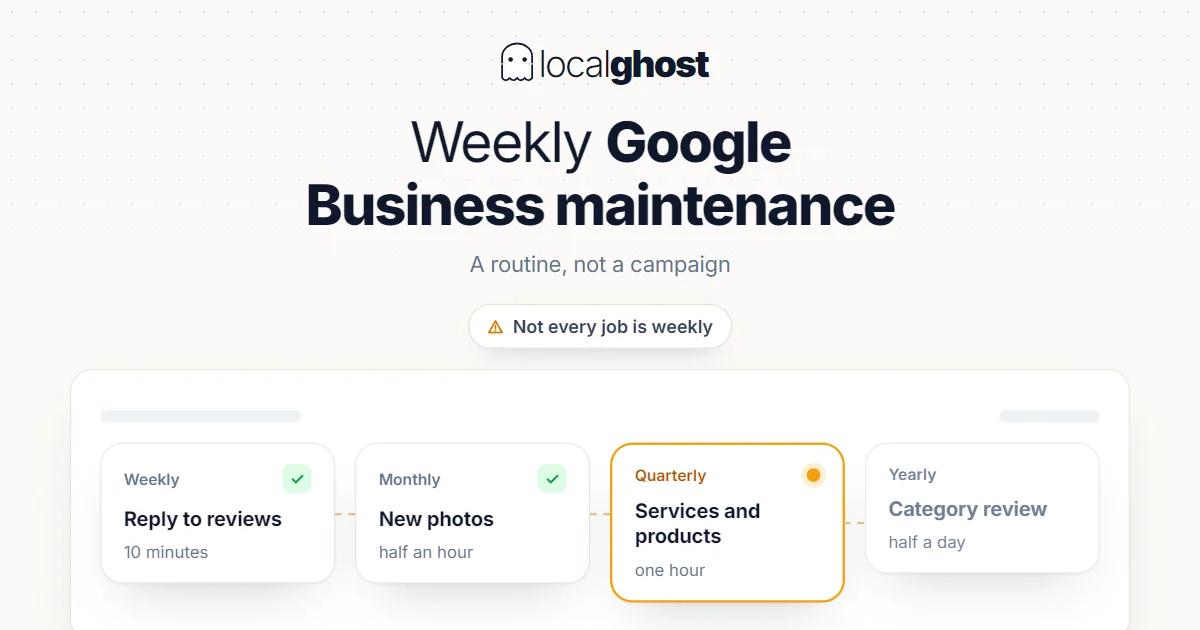
Is the maintenance routine in the calendar? Ten minutes weekly, half an hour monthly: weekly maintenance calendar.
How to use the list
A list you run in thirty minutes produces value when repeated monthly. A one-off audit finds the gaps; a repeated audit finds newly formed gaps — and profiles decay quietly: links die, hours go stale, photos age.
A note on priority: the items are not equal. A wrong category and wrong hours cost many times more than missing attributes. If you find gaps, work top to bottom.
With multiple branches the list has to be run per branch. A chain average hides the weak one: multi-location management.
And a limit: this list measures completeness, not ranking. A completed profile is a starting point in competition; you have no control over distance and accumulation: Google Maps ranking.
Frequently asked questions
Is this different from the 30-day plan? Yes. The plan gives order (what in which week), this list audits completeness (present or missing). Neither substitutes for the other.
Is it only for new businesses? No. In profiles trading for two years, missing items sit unnoticed for years.
How long does it take? Thirty minutes end to end. Repeating it monthly is far more valuable than running it once.
Which items matter most? Primary category and opening hours. An error in either caps the effect of everything below.
If I complete every item, will I rank at the top? No guarantee. The list measures completeness; you have no control over distance and accumulation. A completed profile is a starting point, not an outcome.
How is it used across multiple branches? Run separately per branch. A single central audit does not reveal information broken at one location.
Written by
Yunus Akan
Related tools: Profile analysis · Content calendar · Photo GPS tagging · All local SEO tools