New Business: 30-Day Local SEO Plan
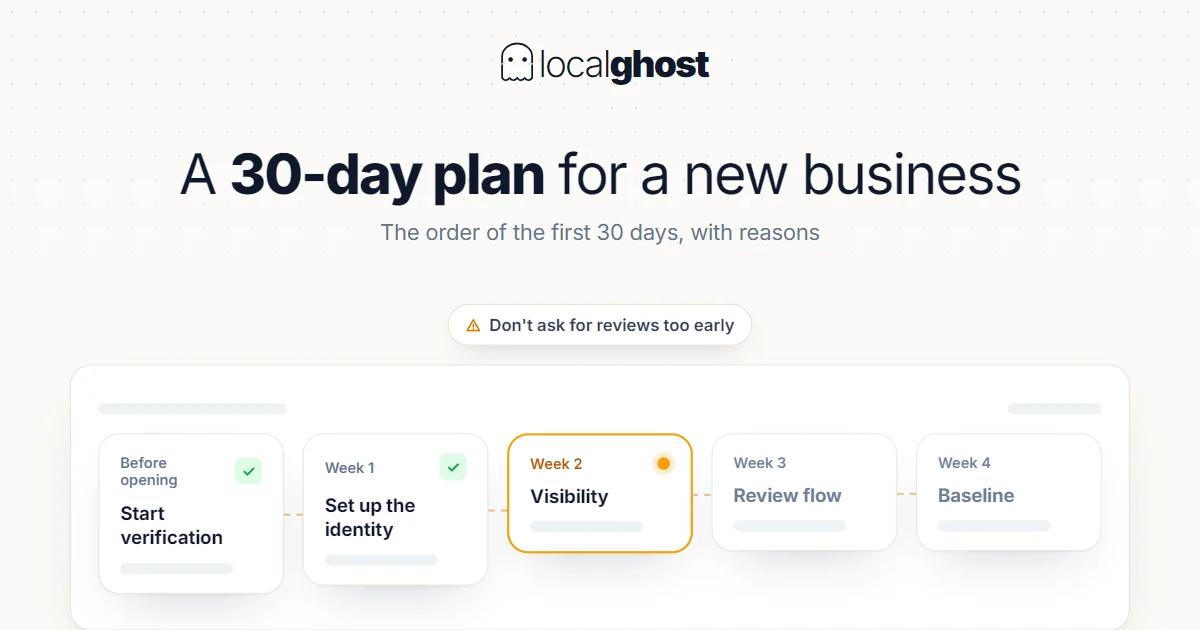
The most expensive mistake at a new opening is asking for reviews too early. The order of the first 30 days, with the reasons.
In this article
Summarize with AI
In a newly opened business the profile is usually the last job anyone thinks of, and that means missing the most intense curiosity of the opening period. Yet what can be done in the first 30 days is surprisingly large — as long as the order is right.
The most important item in this plan runs against instinct: you do not start asking for reviews on day one. The reason is arithmetic, set out below.
Before opening: start verification
Verification can take days, and on an unverified profile most of the fields you fill in do not work; photos do not appear. So leaving the listing until opening day means wasting the first week.
To do before opening:
- Create or claim the listing. Google may have generated an unclaimed listing from other data sources without your knowledge. The first step is to search: is the business already on Maps? If it is, the job is claiming it.
- Settle the address. Changing it later triggers verification again.
- Start verification. The method varies by category and country; if video verification is required, signage, equipment and footage of the space should be ready.
What the profile is and which surfaces it feeds: what is Google Business Profile.
Week 1: establish the identity
The fields filled this week are the ground everything else will sit on.
The primary category. The strongest single field, deciding whether you are eligible to rank at all. The measure is the revenue body; pick the narrowest accurate option rather than the broadest: how to choose the right category.
Opening hours. At a new opening hours have not settled; entering the widest safe range and updating as they change is right. Enter special days upfront too: hours optimization.
The service list. In the words customers use, item by item. After the category, the most direct relevance signal.
Address and phone. Identical to your own website — the most commonly skipped place: NAP consistency.
Those four are a few hours of work, and the fastest visible effect is the category.
Week 2: build visibility and persuasion
Photo coverage. A coverage target rather than a count: exterior, entrance, interior, the result of the work, the team, products or menu where relevant. A phone camera is enough; good light matters more than a tripod: photo optimization.
The description. 750 characters, and the first sentence has to carry the message alone because most readers never tap "more": how to write the description.
Attributes. The fields unlocked by your category: parking, accessibility, payment types, outdoor seating. Every attribute left empty is a filter you do not enter.
The booking link. If you have one, connect it this week; it is the field that turns visibility into work.
Week 3: start the review flow, and why now
The reason for starting review requests in week three rather than day one is arithmetic.
On a profile starting from zero, the first review sets the average on its own and the second halves it. If four of your first five reviews are five stars and one is a one-star, the average is 4.2 — and that number sits on top of you for months. The same calculation continues: at 100 reviews and a 4.5 average, offsetting a single one-star takes seven five-stars. The full arithmetic: the arithmetic of raising your star rating.
So collecting aggressively in the first weeks — while the kitchen, the service or the team have not settled — makes low ratings permanent. Waiting two weeks saves the following year.
What gets built in week three is a routine rather than a campaign:
- Who asks has to be defined; "everyone should ask" means in practice nobody does.
- The sentence has to be ready, short enough to memorise.
- The link or QR has to be to hand; without removing friction, requests drop by half: collecting reviews with QR codes.
- No incentives and no gating. Both are prohibited: increasing Google reviews.
Week 4: take the baseline
Nothing new gets added this week; measurement gets set up.
Record the profile data. Calls, direction requests, website clicks, messages. These numbers become the baseline for every later comparison: reading the statistics.
Take the first ranking measurement. From several points across your service area, with the same queries. A check from your own premises tells you almost nothing: how to track rankings.
A first look at competitors. The category, review count and latest review date of the businesses appearing at those points: how to do competitor analysis.
On a new profile the first weeks' data does not give a meaningful baseline; so the week-four measurement is not the answer to "good or bad" but the reference point for the months ahead.
Two jobs outside the profile in the first 30 days
The plan is profile-focused, but two jobs sit outside it and both fit in the first month.
Listings on the major platforms. Apple Maps, Bing Places and Facebook. These generate direct traffic and feed data to other services. Opening them early in a new business has a side benefit: it stops someone else creating a listing with wrong information without your knowledge. If your sector has a main platform (ordering, booking, appointments) it belongs in this group: what are local citations.
Contact details on the site matching the profile. The site is assumed correct because it is "ours", which makes it the most commonly skipped place. Address, phone and hours should be identical to the profile.
Everything else — directory listings, content production, social media — is not the business of the first 30 days. Structure does not go up before the ground is laid.
What not to do in the first 30 days
An aggressive review campaign. It both makes low ratings permanent and gets caught by the spam filter as a burst pattern.
Buying reviews. When detected the reviews are removed and the profile is flagged. On a new profile that means ending before starting.
Stuffing keywords into the business name. A guidelines violation and a common suspension cause. Scrutiny is tighter on new profiles.
Changing five things the same day. You cannot attribute the result to any of them. Filling fields on a new profile is one thing; moving an existing field constantly is another.
Checking ranking daily. Movement in the first weeks is natural; daily checking only measures noise.
A realistic expectation for 30 days
Being clear prevents disappointment.
Within days: appearing for branded searches once the profile is verified. Someone searching your name finds you.
Within weeks: starting to appear for service-plus-district searches. If the category is right and competition is low this is possible in the first month.
Measured in months: entering the 3-pack in a competitive urban category. The distance and prominence inputs take time: how the 3-pack works.
What you should have at the end of 30 days is not a ranking but a working foundation and a measurable baseline. After that it turns into routine: the weekly maintenance schedule.
Setting that distinction up front also prevents the most common second-month mistake: breaking the foundation because results have not arrived. Reshuffling the category and description in month two also makes month one's measurement unusable.
The first 30 days by sector
Accommodation. If it coincides with the season opening, photos and room information move to week one, and so does the booking platform connection: local SEO for hotels.
Restaurants. Menu and hours accuracy come ahead of everything else; the "open now" filter decides this category: Google Business guide for restaurants.
Service-area businesses. Verification takes more steps and the area definition should be limited to where you actually go: service-area businesses.
Healthcare. The category should be chosen at specialty level, and review-request rules may fall under professional regulation; that is one to ask your own regulator: Google Business for doctors and clinics.
Chains opening a new branch. This plan applies to a new branch too, with one warning: opening a branch by changing an existing listing's address carries the old branch's reviews over and leaves one branch unlisted: multi-location management.
Frequently asked questions
Should I create the profile before opening? Yes, because verification can take days. But do not start asking for reviews before the business is actually operating.
Why not start asking for reviews immediately? On a new profile the first reviews set the average on their own. Low ratings collected before the service has settled stay for months.
Will I reach the first page in 30 days? You will appear for branded searches within days. Entering the 3-pack in a competitive category is measured in months.
Which field makes the most difference? The primary category. If it is wrong, all the other effort accumulates in the wrong pool.
Do I need a professional photo shoot? No. A well-lit phone photo beats uploading nothing while waiting for a studio session.
How many reviews should I target in the first month? Do not set a count; build the routine. One or two a week is both safer and more permanent than thirty in a month, because a pile gets caught by the spam filter.
Written by
Yunus Akan
Related tools: Review Management · Local SEO Audit · Free Photo Geotag Tool · All local SEO tools