Google Maps SEO for Scrap Metal and Recycling Yards
In scrap buying the customer is not spending money, they are making it. That single difference changes everything from the search to the reviews.
In this article
Summarize with AI
For local search purposes, the scrap and recycling business works almost inversely to every other sector: the customer is not spending money, they are making it.
That single difference changes everything. Someone looking for a hair salon is buying a service and wants the price to be low. Someone looking for a scrap yard is selling material and wants the price to be high. So the search intent here is not "find a good service" but "find the best price".
The consequences, in order:
- The customer searches to compare prices, not services. What gets searched is a material name and a price: "copper price per kilo", "scrap steel prices", "who buys scrap metal".
- They decide the same day. The material is sitting there, taking up space, and they want cash.
- The distrust is not about the price, it is about the weighing. Nobody thinks the price is invented; everybody thinks the scale will come up short.
Your profile's job is to answer those three points. And this sector is so neglected on the profile side that simply doing the fundamentals properly creates a visible gap.
Two separate customers, two separate searches
There are two kinds of demand here that have nothing in common, and most profiles speak to only one.
Households and small volumes. A family moving out, old white goods, a kitchen being replaced, a broken air conditioner. Little material, one car load. This customer asks one thing: "do you come, do you carry it out, do you pay cash". Price is secondary, because the real aim is getting rid of the material.
Industrial and commercial volumes. Factory production waste, demolition material, tonnage lots, standing contracts. This customer asks something entirely different: do you place a container, do you issue weighbridge tickets, do you invoice, what is the price per tonne.
These two are not served by the same sentence. Writing them separately in your services puts you in two different query pools. The commercial side is smaller in volume but many times higher per transaction and far less contested — because most competitors' profiles say nothing beyond "we buy scrap".
Prices change daily: the sector where posts genuinely work
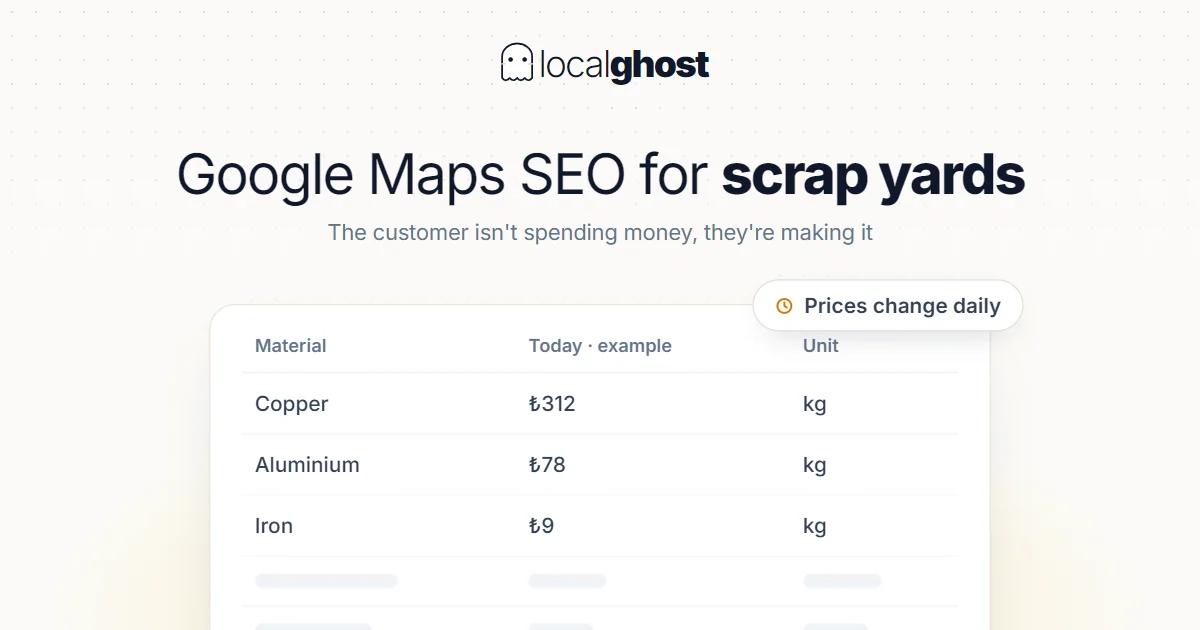
Scrap pricing is commodity pricing. It moves with metal markets, currency rates and export demand — daily, sometimes within the day. That makes publishing a fixed price impossible, and most businesses therefore say nothing at all about price on their profile.
But what cannot be published is the exact figure; there is plenty that can be said:
- State plainly that pricing is set daily. A line such as "prices follow the daily market; call and we'll quote the day's rate" closes the customer's biggest uncertainty, which is not knowing how the price is formed at all.
- Open a path for asking. Saying that prices can be requested by message captures the customer who would rather not phone.
- Explain what moves the price. How clean the material is, whether it has been separated, the quantity. Explaining that separated copper earns more than mixed scrap builds trust *and* brings you better material.
And here this sector has a possibility the others do not: Google posts. In most local sectors posts are a weak signal, because there is no genuine news to share. Here it inverts: your content really does change daily. A weekly "this week's buying prices" post keeps the profile active *and* is exactly the information the customer came for. This is one of the rare places where the posts feature carries real functional value.
Keeping the posting rhythm steady: how to schedule posts.
Weighbridge trust: the quietest objection
This is the most decisive and least discussed point in the sector. The customer asks the price, is satisfied, brings the material in, and has one thing on their mind: that the scale will be rigged.
That suspicion is stuck to the sector's reputation, and customers usually do not say it out loud. Because they do not say it, nobody answers it on their profile. The business that does answer it stands out sharply.
What can be published:
How weighing is done. Whether it happens in front of the customer, which scale is used, whether it is certified, whether a weighbridge ticket is issued. None of this is a secret and none of it gets written.
When payment happens. Immediately after weighing, in cash, by transfer. "Cash paid immediately after weighing" is one of the strongest single lines available in this sector.
Documentation and invoicing. For a commercial customer, an invoice and a weighbridge ticket sit at the centre of the decision; even for a household customer they signal seriousness.
If you hold licences, permits or environmental certifications, publish those too — but only the ones you actually hold. In this sector a commercial customer can verify a claim, and an unverified one ends the relationship in a single step.
Category choice: scrap buying and recycling centres attract opposite intent
Google Business Profile carries several categories here: scrap metal dealer, recycling centre, waste management service, metal recycler, container hire, vehicle dismantler.
The distinction is not just wording, it is intent — and it produces a very concrete result in this sector:
Someone searching for a recycling centre usually wants to drop material off. Their motivation is environmental; they expect no payment and sometimes accept paying. Glass, plastic, paper, electronic waste.
Someone searching for scrap buying wants to sell. Their motivation is cash. Metal, copper, aluminium, white goods.
Confusing the two brings the wrong customer. A business that buys metal and pays for it but sets a recycling-centre category as primary spends its time on visitors dropping off jars, and withholds its strongest signal from the customer who wants to sell.
The rule holds as always: make the primary category the work that brings the most revenue. If you dismantle vehicles, that is a separate and valuable category; the customer searching for it does not look at generic scrap results.
The general rules: how to choose the right category.
The material list *is* the search
Customers here are not searching for a service, they are searching for a material name. "Who buys scrap copper", "old battery buyers", "white goods collection", "aluminium frame scrap".
So your services list should really be your materials list, written out in as much detail as possible:
- Iron, steel, cast iron
- Copper (cable, pipe, separated)
- Aluminium (profile, window frames, engine blocks)
- Brass, lead, zinc, stainless
- Batteries and scrap cells
- White goods, air conditioners, boilers
- Electronic waste, cable, transformers
- Paper, cardboard, plastic film
- Scrap vehicles and vehicle parts
Publishing what you do not take works just as well as publishing what you do. Naming the material types you refuse prevents a wasted journey and the negative review that follows it. "Drove all the way there, turns out they don't take it" is a common review in this sector and entirely preventable.
Yard or service area
On the setup side there are two versions of this business, and the wrong choice limits visibility directly.
If you have a yard or facility where customers can drop material off, this is a normal address-based profile. You appear as a pin on the map and "scrap yard near me" searches find you. That demand is substantial here, because the customer is looking for the nearest place they can haul material to.
If you only collect from site and have no address that receives customers, this is a service-area business. The address is hidden and the areas you serve are defined instead.
The most common mistake is presenting a yard or plot that does not receive customers as a normal business address. Google's rules expect a real, visitable location; if it is not, the service-area setup is the correct one. A virtual office, or a plot with nothing but a sign, is a suspension risk.
If you offer collection — and in this sector that is decisive — list it as a service and add three details: which areas you cover, whether there is a minimum quantity, and whether you carry material down. The third is the question household customers ask most and profiles answer least.
Define the service area realistically. Demand from a distance you will not travel is both an operational burden and a source of negative reviews.
Reviews: the subject is the scale and the payment
Reviews here are almost never about "service quality". They are about one of three things:
- The weighing — the claim that it came up short, the most common and most damaging
- The price — being paid less than was quoted on the phone
- Not turning up — a collection promised and not made
All three are concrete and all three are preventable. The antidote to the second is publishing in advance that pricing is daily and how it is set. The antidote to the first is describing the weighing process on the profile. The third is purely operational.
In replies, what works here is explaining the process: which scale is used, that a ticket is issued, which day's price applied. The reader has already heard the complaint; giving them information about your process is what convinces the next customer.
On collecting reviews, this sector has a genuine advantage: the customer leaves with cash in hand. That is one of the most productive review moments in any local sector. A request made as you hand over payment converts far better than one made later.
Do not offer a better rate or a top-up in exchange. It breaches Google's policy, and here it confirms the very suspicion customers already hold about the scale.
A comparison of the ways to ask: increasing Google reviews.
Photos: the scale, the yard and the truck
The job of photography here is to show you are a serious operation, because the customer's biggest fear is turning up to something makeshift.
- The weighbridge or scale. The single most important photo. Making the weighing visible answers the sector's biggest objection visually.
- The yard and sorting area. An organised yard reads as a proper business; a scattered heap reads as the opposite.
- The grab truck and lorries. Evidence of collection capacity and a direct input for commercial customers.
- Container types and sizes. This is exactly what an industrial customer is looking for and most competitors never show it.
- Sorted material groups. Faster than words at communicating what you buy.
Do not use stock recycling imagery. Customers here want to see the real yard and the real scale; a generic green recycling graphic answers nothing.
Setting the expectation correctly
What to expect from Google Maps in this sector is clear: customers holding material who want to sell it today. The demand is real, the search volume is not low, and competition on the profile side is weak.
The reason it is weak is simple: most businesses here never fill their profile in. No material list, no hours, no photos, not a word about how weighing works. Which means advanced tactics are not needed — completing the fundamentals is enough to get ahead.
Frequently asked questions
Prices change daily. What do I put on the profile? Not an exact price. Say that pricing follows the daily market and how it can be requested, and explain what affects it (cleanliness, whether the material is separated, quantity). A weekly "this week's buying prices" post also genuinely works here, because the content really is current.
Recycling centre or scrap metal dealer as my category? If you buy material and pay for it, the scrap buying category. Someone searching for a recycling centre usually wants to drop material off and expects no payment; attracting that demand brings the wrong customer. If you do both, make one primary and the other secondary.
I only collect from site and have no facility. Can I have a profile? Yes, as a service-area business. The address is hidden and the areas you serve are defined. Presenting a yard or plot that does not receive customers as a normal business address breaks the rules.
I received a complaint about the weighing. How should I reply? Explain the process: which scale you use, that it is done in front of the customer, that a ticket is issued. But the real fix is preventive — describing the weighing process on the profile closes the sector's biggest objection in advance, and very few businesses do it.
Do I need to publish the materials I do not accept? It is fair to say you do. "Drove all the way there and they don't take it" is a common review here and entirely preventable. Naming the types you refuse prevents the wasted journey and the review that follows.
What should I write for commercial customers? Container provision, tonnage-based buying, standing contracts, invoicing and weighbridge documentation. This demand is smaller than the household side but many times more valuable per transaction and much less contested, because most competitors' profiles say nothing but "we buy scrap".
When is the best moment to ask for a review? As you hand over payment. The customer is leaving with cash in hand, and that is one of the most productive review moments in local business. Do not offer a better rate in exchange — it breaches Google's policy and confirms the suspicion customers hold about the scale.
Written by
Yunus Akan
Related tools: Review Management · Local Grid Scan · All local SEO tools