Google Business Category Selection: How to Choose the Right Category
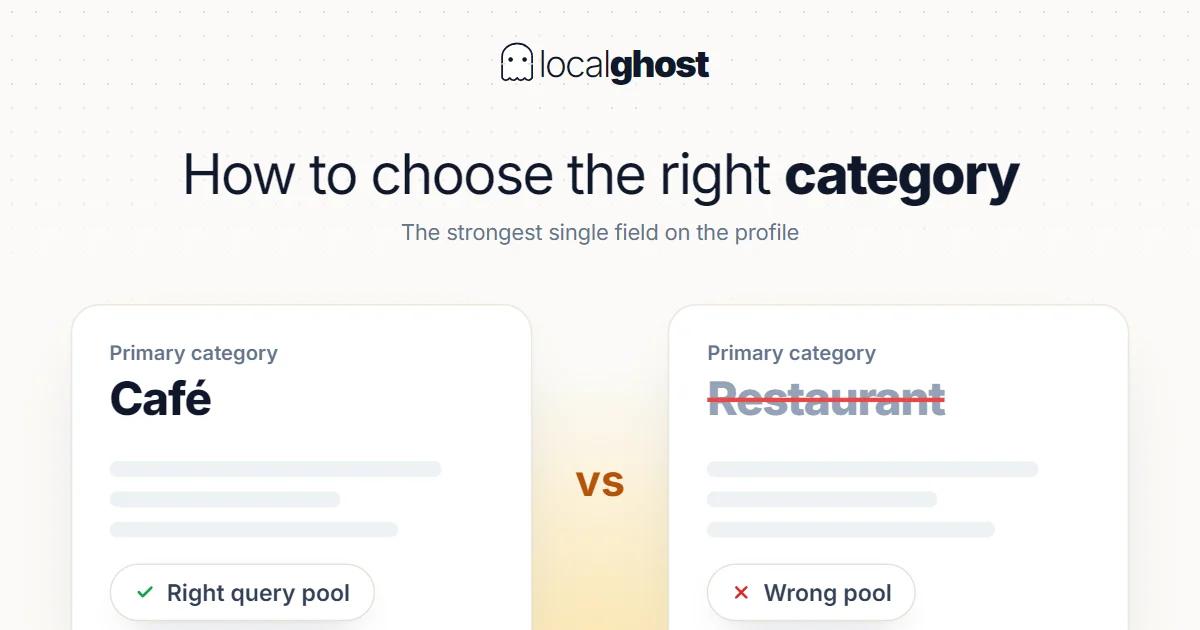
Category is the strongest single field on the profile: it decides which query pools you are eligible for. Get it wrong and everything else is wasted.
In this article
Summarize with AI
If you had to pick one field on the profile to get right, it would be the category. The reason is simple: the category does not rank you, it makes you eligible to rank. A business in the wrong category is not in the race for that query, however good it is — it is outside it.
Which is why most "why am I not ranking" questions turn out to be category problems wearing a disguise. Collecting reviews, uploading photos, writing the description: all of it accumulates on top of a correctly categorised profile. If the category is wrong, that effort accumulates in the wrong pool.
What the category actually does
Google documents three factors for local ranking: relevance, distance and prominence. The category is the strongest single component of relevance.
In practice it works like this: when a query arrives, Google first assembles the set of businesses eligible for it, then ranks that set. The category does its work at the first step — getting into the set. If you are not in the set assembled for "pizza delivery", how well you would have scored inside it is never asked.
Two consequences follow:
- The category is an eligibility key, not a ranking lever. Moving to the right category is rarely a gradual "three places up"; it is usually a threshold jump from absent to present.
- The right category is the narrow one. A broad category looks like entry to more searches, but in practice it drops you into a much more crowded pool with weaker intent.
If you want the whole mechanism, it has its own article: how the 3-pack works.
Primary category: one choice, the highest impact
Google lets you pick several categories, but they are not equal. The primary category carries the most weight and defines the profile's identity.
The question to ask is not "what do I do" but "where does most of the revenue come from". Those two often diverge:
- A business that started as a garage and now mostly does pre-purchase inspections stays under "Auto Repair Shop" while the body of the work is inspection.
- A breakfast place that also serves dinner ends up as "Restaurant" while most of the searching is for breakfast.
- A dental practice sits in something broad like "Medical Centre".
All three end with the same result: giving up the strongest signal available. So choose the primary category against your revenue mix, not against the business's history.
How to find the right category
The category picker suggests options based on what you type, which means you never see the full list. That leads people to take the first plausible option and never notice a better match.
What works:
- Type the word your customer uses, not your industry term. Customers type "inspection", not "vehicle valuation service".
- Try several synonyms separately. Category names are not interchangeable — "hairdresser", "barber" and "beauty salon" are separate categories and separate pools.
- Look at the category of competitors outranking you. Categories are visible on the profile. Not to copy, but to sanity-check your own choice.
- Pick the narrowest accurate option. If two are accurate, the one that describes the body of the work more precisely wins.
- Do not enter a category for "reach" if it does not describe you. Choosing a category for work you do not actually do is a guidelines problem, and the demand it brings does not convert anyway.
Do not confuse categories with service naming either: the category decides the pool, the service list sharpens the match inside that pool. Name your services in the words customers use.
Secondary categories: what they help, where they hurt
Secondary categories exist for additional work you genuinely do, and used correctly they open access to extra query pools.
Two rules save the situation:
Keep the count low. Google asks you to describe your core business with the fewest categories. A long list blurs what your profile is about; each addition scatters the signal a little further.
Only add services you actually deliver. "Maybe one day" and "sort of related" categories hurt: irrelevant demand arrives, does not convert, and your profile performs weakly for that query.
A common failure is the main business sitting in a secondary while a side activity holds the primary. Reviewing the list once a year and confirming the primary still describes the revenue body is enough.
The category also decides which fields you get
A little-known side effect that matters a lot in practice: the category you choose determines which additional fields and attributes the profile offers you. These are category-based; not everyone gets the same list.
The examples are concrete. Food and drink categories unlock menu, reservations, takeaway and dine-in fields. Accommodation categories bring room features, check-in and check-out times and facility amenities. Health categories surface appointment links and payment or insurance information. Service-area categories offer the option to hide the address and define a coverage area instead.
Two consequences. First, staying in a broad category narrows not only your query pool but the fields available to you: a breakfast place sitting under "Restaurant" never sees some of the fields a narrower category would unlock. Second, when you cannot find a feature on your profile, the problem is usually not Google but your category — the place to look is the primary category, not the settings.
So check the effect of a category change not only on ranking but on the fields that newly appear. If those new fields stay empty, the gain you expected from the change stays half-realised.
Is changing the category risky
Short answer: change it if it is wrong, but change it alone and measure.
What to know:
- A category change refreshes signals. Some movement immediately afterwards is normal, and it does not mean the change was wrong.
- Do not change five things the same day. Changing category, name, address and hours together means you cannot attribute the result to any of them. Change one variable, wait weeks, re-measure the same way: how to track rankings.
- Moving to the right category can look like a drop short-term. Going from broad to narrow removes irrelevant impressions; impressions can fall while calls rise. Reading impressions alone misleads here.
- Edits can be rejected. Google notes that profile edits can go to review. If the category you saved is not showing, wait rather than repeating the same edit.
Category decisions by sector
The logic is universal but the decision point varies. The most common fault lines:
The same service under two different category names. In hair, "hairdresser", "barber" and "beauty salon" are distinct pools, and which one you are in changes who finds you — local SEO for hair salons.
Cuisine type or venue type. In restaurants, choosing between "Restaurant" and a cuisine-specific option means deciding whether you describe the room or the food: Google Business guide for restaurants.
Specialty beats generic. In healthcare the specialty itself is both narrower and more accurate than "Doctor" — Google Business for doctors and clinics and Google Maps SEO for dental clinics.
Separating two opposite intents. In scrap, "scrap metal buyer" and "recycling centre" attract opposite intent: one brings someone who wants to sell, the other someone who wants to dispose — scrap metal and recycling.
The accommodation type is itself the category. Hotel, aparthotel, guesthouse and boutique hotel are separate pools and separate filters: local SEO for hotels.
Rank or service. In the taxi trade a fixed rank and a transfer service are two different profile structures and two different category decisions: taxi and airport transfer.
Category is right and you still do not show
The category is an eligibility key; it opens the door but does not decide the ranking alone. If the category is correct, the next suspects are:
- Distance. The input you cannot edit. In a competitive category you do not cover a whole city from one address.
- Profile completeness. Hours, services, description, photos — each a short job: hours optimization, writing the description, photo optimization.
- Review volume and recency. If a competitor gained forty reviews you were passed without getting worse: increasing Google reviews.
- Consistency across the web. Conflicting directory records weaken prominence: NAP consistency.
Frequently asked questions
How many categories should I choose? The fewest that describe your core business. The primary should describe the revenue body; add secondaries only for services you actually deliver. A long list scatters the signal.
Can I change the primary category later? Yes. Signals refresh and brief movement is normal. Do it as a single change and measure over weeks.
I do something that is not in the category list. What now? Pick the closest narrow category as primary and describe the detail through your service list and description. The category list is closed; new options cannot be added to it.
Does copying a competitor's category work? Looking is useful for sanity-checking; copying is not. The competitor may be in the wrong category, or their business may differ from yours. The measure is your own revenue mix.
My impressions dropped after changing category. Did I make a mistake? If you moved from broad to narrow, falling irrelevant impressions is the expected outcome. Compare actions — calls, direction requests, website clicks — rather than impressions.
Does category choice replace keywords? No, they are separate jobs. The category decides the pool; service naming and the description sharpen the match inside it. Stuffing keywords into the business name is a guidelines violation.
Written by
Yunus Akan
Related tools: Local Grid Scan · Review Management · Local SEO Audit · All local SEO tools