Google Business Guide for Restaurants
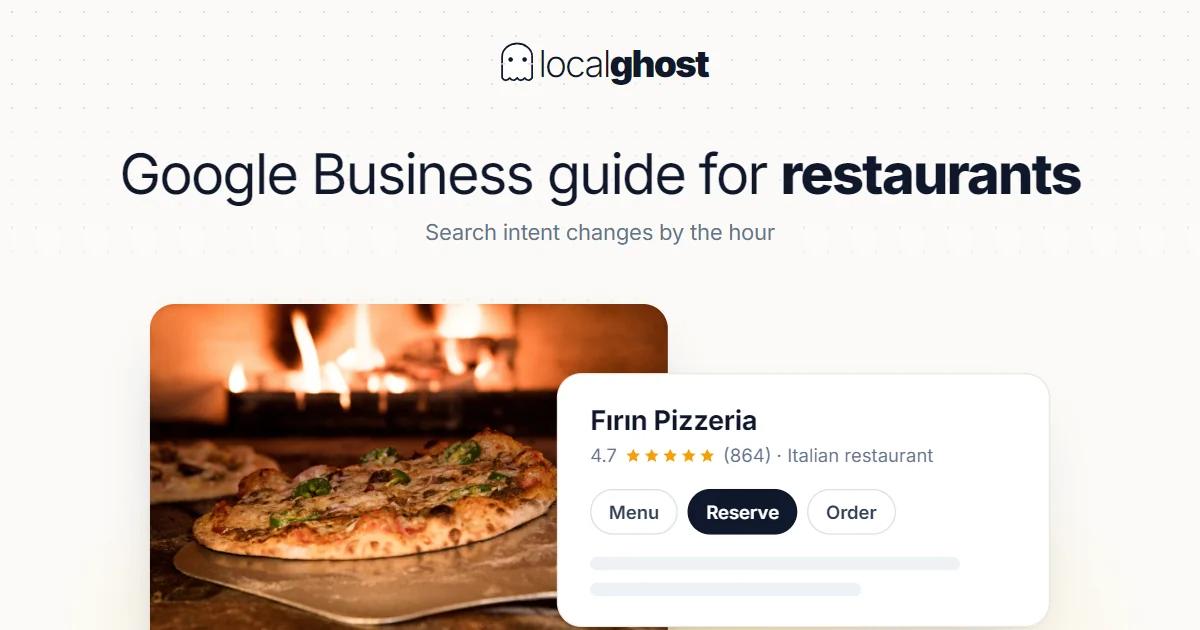
Food search is the one category where intent changes by the hour: breakfast, lunch, dinner and late-night are four different searches. The profile has to fit that rhythm.
In this article
Summarize with AI
Food search differs from every other local category in one respect: intent changes by the hour.
Someone searching "breakfast near me" at nine in the morning is looking at menus and prices. Someone searching "lunch near me" at half past one wants fast and close. Someone searching "good restaurant" at eight in the evening is reading reviews and looking at photos. Someone searching "restaurants open now" at midnight cares about exactly one thing: are you open.
These are not four different customers. They are four different moments, and one profile serves all of them. Fitting that rhythm is the single most important property of a restaurant profile.
The "open now" filter decides this category
Google applies the hours filter aggressively for food searches, and the logic is sound: a closed restaurant is useless to the person searching.
The consequence is that wrong hours cost more than a lost ranking position. Being third is one thing; being absent from the result set is another.
Hours are unusually complicated in this sector:
- Separate service periods. Google supports multiple time blocks per day — 08:00-12:00 and 18:00-23:00, for example. Entering one continuous block means appearing open during the gap and turning customers away at the door.
- Kitchen close is not venue close. If last orders are at 22:30, publishing 23:00 as your closing time generates "arrived, no food" reviews.
- Holiday hours. These are exactly when food demand peaks and most profiles are least accurate. The special-hours field exists for this and the prompt is worth answering.
- Seasonal changes. Terrace opening, winter hours. If it changes and the profile does not, the profile is quietly wrong.
- Temporary closures. If you are closing for two weeks, mark it. Leaving the profile open collects "it was closed" reviews that outlive the holiday.
Special days and break hours included, the full hours setup: hours optimization.
The menu is your strongest matching surface
The menu and services fields do more work in food than in any other sector, because people search by dish name.
"Full breakfast", "brunch", "wood-fired pizza", "sunday roast", "vegan breakfast", "mixed grill", "baklava" — these are search terms. If those names do not appear in your menu, your matching signal for those searches is weak.
Practical approach:
- Enter your signature dishes under their real names. You do not need the entire menu; the items that draw demand and define you are enough.
- Include prices. Price is the most common question in food search, and omitting it produces both unnecessary phone calls and undecided customers.
- Add dietary information. "Vegan", "gluten-free", "halal" work as both matching signals and customer filters. Use Google's attribute fields as well.
- Group items meaningfully. Dishes under a "Breakfast" heading help breakfast searches; those under "Desserts" help dessert searches.
What not to do: stuffing city or neighbourhood names into menu entries. It sits on the wrong side of the guidelines and reads badly to humans.
Category choice: venue type or cuisine type
Google Business Profile offers both venue-type and cuisine-type categories for food businesses: "Restaurant", "Cafe", "Breakfast Restaurant", "Barbecue Restaurant", "Pizza Restaurant", "Bakery", "Diner", "Bistro".
This decision determines which query pools you can enter. A barbecue-led restaurant setting a generic "Restaurant" as primary gives up its strongest signal for barbecue searches. The reverse is also true: a broad-menu kitchen that locks itself to a single dish loses the rest.
The rule that works: make the primary category what defines you and sells most, and add the rest as secondary categories. If breakfast is a sideline, "Breakfast Restaurant" can sit as a secondary; if breakfast is the business, it should be primary.
Notes by sub-segment:
- Grill / barbecue houses: the barbecue category plus grill dish names in the menu. "Charcoal grill" is a distinct demand.
- Breakfast and brunch venues: the breakfast category plus terms like "full breakfast" and "brunch". Time blocks are critical here — if breakfast ends at 11:00, the profile must reflect that.
- Canteens and lunch-led kitchens: lunch demand dominates. Posting the daily menu genuinely works in this segment because the content really does change daily.
- Cafes: for the work-from-cafe customer, wifi, power sockets and seating attributes matter, along with photos of the seating area.
Photos do the job the menu cannot
In food search, photos decide. Customers judge portion size, presentation and atmosphere from photos, and honest amateur photos outperform stock imagery.
An effective set:
- Dishes as they are actually served. Over-styled shots disappoint the customer who arrives, and that disappointment lands in your rating.
- Tables and seating — people want to see where they will sit.
- The exterior — so they can find you. "Could not find it" is a real cause of lost custom in this sector.
- Busy service — a full room is social proof.
- The menu as an image — supports the menu field rather than replacing it.
Customer photos also appear on your profile and you cannot remove them. The only real counter is to add your own regularly: fresh, good photos of your own reduce the weight of the rest.
The technical side of the photo surface: photo optimization step by step.
Reviews: velocity and replies, not volume
Restaurants have high customer turnover, which makes review collection easier here than in most sectors. It is an advantage that mostly goes unused.
Points specific to food:
- Food reviews are specific, and that helps. "The mixed grill was excellent" adds matching text in the customer's own words. You cannot script reviews, but it is worth knowing that dish names in reviews do work.
- Negative reviews here are usually about one of three things: waiting time, portion versus price, or staff attitude. Your reply needs to be concrete — say what changed. "We apologise" alone does nothing.
- Rating averages are more visible in food than elsewhere. Customers do distinguish 4.1 from 4.6, and one bad stretch drags the average for a long time.
- Never offer anything in exchange. Discounts for reviews violate Google's policy and put your entire review set at risk. The violation is common in hospitality, which means detection is likely.
The concrete steps that move the average up: how restaurants can increase their star rating.
Distance changes by meal — unique to this sector
Proximity is a ranking input everywhere, but the distance a customer will accept changes by meal, and that is not true so sharply in any other category.
- Lunch is almost walking distance. Office workers will not walk more than five to ten minutes. Your visibility radius for this demand is narrow and distance decides it.
- Breakfast is near on weekdays, far at weekends. Weekend breakfast is a plan; people will drive twenty or thirty minutes. The same venue serves neighbourhood customers midweek and city-wide customers on Saturday.
- Dinner is mid-range, and review and photo signals partly compensate for distance. A strong profile can pull a customer from further out.
- Special occasions and niche cuisine ignore distance. For a genuinely good grill house or a specific regional kitchen, people leave the city. Here your competitor is not the place down the road but the best example in the region.
Practical consequence: if you are invisible for lunch searches on your own street, the problem is the profile — category, hours, menu. If dinner customers are not coming from across town, the problem is more likely review volume and photo quality than geography. Chasing distant districts with profile edits does not work.
The one sector where posting genuinely helps
In most categories Google Posts are a weak signal. Food is the exception, because your content actually changes daily: today's menu, a seasonal dish, the weekend programme, live music.
This is one of the few sectors where posting is not forced. A kitchen posting its daily menu keeps the profile active and gives searchers genuinely useful information at the same time.
Posts are also the right place for offers and promotions — not the description field. The description is standing furniture; offers expire.
Common mistakes
- Adding cuisine type or district to the business name. Names like "Tony's Pizza Best Downtown" violate the guidelines, are among the most reported forms of local spam, and get profiles suspended. Cuisine belongs in the category, location in the address.
- One time block per day. Appearing open during a service gap costs you a customer and earns a bad review.
- Not stating kitchen close. A profile without a last-orders time collects "arrived, kitchen closed" reviews.
- Stock food photography. Recognised instantly, and it disappoints arrivals, which lands in your rating.
- Putting promotions in the description. Wrong field. Use Posts.
- Replying "we apologise" and nothing else. The reader of your reply is the next customer, not the complainant.
Frequently asked questions
What should a grill or barbecue restaurant use as primary category? The barbecue or grill category if that is the main business. Choosing generic "Restaurant" gives up the strongest signal for those searches. Add other cuisine types as secondary categories if the menu is broad.
How should a breakfast venue set its hours? Enter real service periods. If breakfast ends at 11:00, the profile should not appear open for breakfast afterwards — Google supports multiple time blocks per day. Wrong hours produce customers turned away at the door and the reviews that follow.
Do I need to upload the whole menu? No. The items that draw demand and define you, with real names and prices, are enough. The goal is search matching and customer decision, not a complete catalogue.
Can I remove customer photos? Generally no. The workable response is to add your own photos regularly; fresh, high-quality images of your own reduce the prominence of the rest.
Can I offer a discount in exchange for a review? No. Incentivised reviews breach Google's policy and put your whole review set at risk. The practice is common in hospitality, which makes detection more likely, not less.
Will posting improve my ranking? Not decisively on its own, but posting has a real function in this sector: daily menu and programme information keeps the profile active and gives customers something concrete. Posts are also where offers belong, rather than the description field.
Written by
Yunus Akan
Related tools: Map rank tracking · Review replies · Add GPS to photos · All local SEO tools