Why Is NAP Consistency Important? How to Ensure It?
NAP consistency is not housekeeping, it is a trust problem. But fixing every directory is also a waste: which ones actually count?
In this article
Summarize with AI
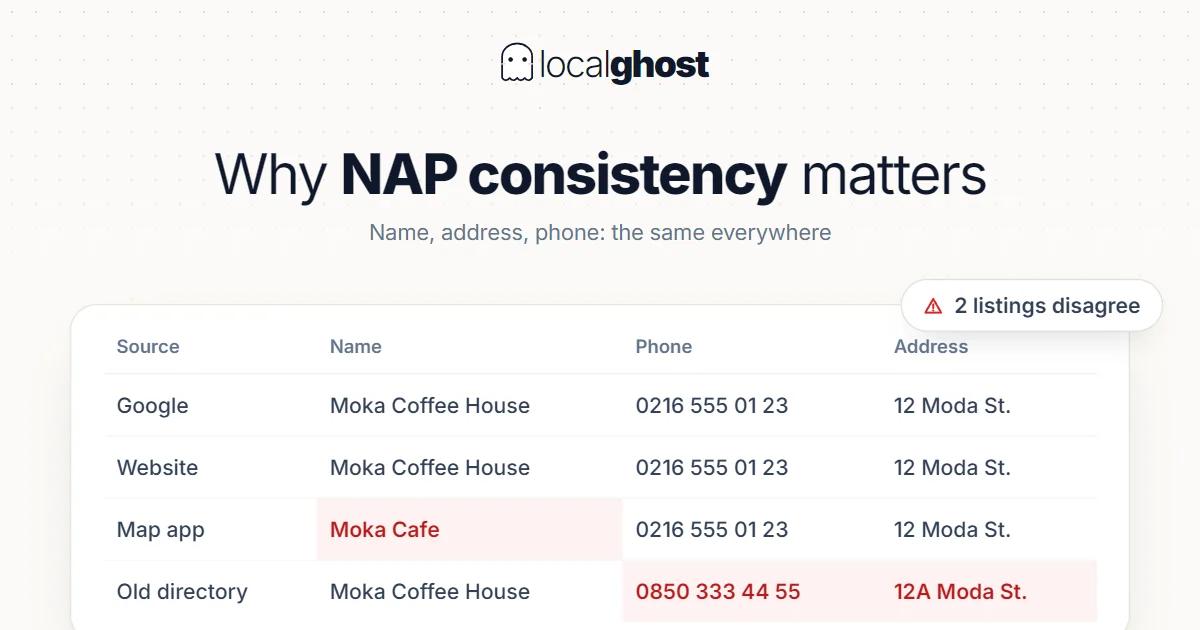
NAP stands for your business name, address and phone. Consistency means those three looking the same across the web. It sounds like administrative housekeeping, but there is a concrete mechanism underneath: conflicting information weakens the trust signal.
The logic runs like this. Google does not decide from a single source that a business exists and where it is. If information across different sources corroborates itself, confidence rises; if it conflicts, which version is correct becomes unclear. This is where prominence, one of the three ranking factors, is fed.
But the real purpose of this guide is a warning: NAP work turns into a job with no end very easily. Knowing which sources actually count is half the work.
Where inconsistency comes from
Nobody publishes conflicting information deliberately. Inconsistency accumulates:
- Moving premises. The old address stays in dozens of places.
- A number change. Landline to mobile, a second line, a call tracking number.
- Format differences. "St." versus "Street", "No: 12" versus "12", floor and unit details present in some places and missing in others.
- Name variations. Registered name, signage name, an abbreviation, a branch suffix.
- Records created by others. Directories harvest business data automatically; records you never created can exist.
These are not equally harmful. A conflict in address or phone hits the trust signal directly; the difference between "St." and "Street" is immaterial in practice. Starting work without making that distinction leads to time spent fixing the most harmless differences while never seeing the real conflict.
Which sources actually count
This is where most time gets wasted: trying to correct records across hundreds of low-quality directories.
The rough order of priority:
1. Your Google Business Profile. The reference point. Everywhere else aligns to it, not the other way round. So settle this first.
2. The major maps and platforms. Apple Maps, Bing Places, Facebook. These both generate traffic and feed data to other services.
3. Your sector's main platforms. Ordering and reservation platforms in restaurants, booking sites in accommodation, appointment platforms in healthcare. These are the records most seen and most clicked in your sector.
4. Your own website. The address and phone on the site have to match the profile — the most commonly skipped place, because the site is "ours" and therefore assumed correct.
5. Your country's major directories and trade registries.
The long tail outside these five groups — hundreds of auto-generated directories nobody uses — makes no measurable difference in practice. Time spent there returns more if spent on review flow or photo coverage instead.
The business name: consistency's most critical field
The name field carries a rule beyond consistency: Google asks you to represent the business as it is recognised in the real world — signage, stationery, branding.
The practical consequence is that a common tactic is an outright violation: adding services and districts into the name. Turning a business called "Smith Autos" into "Smith Autos Best Inspection Centre" looks like it works short-term, but it is one of the most reported forms of local spam and a suspension cause.
For the same reason name consistency is critical: one name on the profile, another on the site and a third variation in directories makes it unclear which is real. The test is simple — whatever is on the signage.
Phone: the call tracking trap
Call tracking numbers are common on the marketing side and they clash with NAP consistency: because the tracking number differs everywhere, the information looks conflicting.
The practical approach: keep your real number on the profile. If you want call tracking, adding it as an additional rather than the primary number is the way to preserve the real number's consistency. That way the measurement need is met without putting the core information into conflict.
The second frequent mistake: a mobile on the profile, a landline on the site, an old line in directories. Collapsing all three into one number is the fastest win available.
Address: the hardest but most important alignment
Three situations need separating on the address side.
A fixed-address business. The address has to be written identically everywhere, particularly details like floor, unit and block. Present in one place and missing in another can point to a different spot on the map.
A service-area business. The address can be hidden, but the address you register must be a real place you operate from. Using a virtual office or a mailbox is a guidelines violation and a common suspension cause. Setting that structure up is its own topic: local SEO for home-based service businesses.
Moving premises. The event that produces the most inconsistency. The order is: update the profile address and complete verification first, then the website, then the major platforms, then sector platforms. Leaving the old address behind is not just confusing — it means appearing to exist in two places.
In a multi-branch structure each branch needs its own record with branch names separated consistently — multi-location management.
Auditing: how to check
No complex tooling is needed; a spreadsheet does it:
- Write down the reference. The name, address and phone from the profile, exactly.
- List the sources. Whichever of the five groups above apply to you.
- Compare each source one by one and note the difference.
- Fix address and phone differences first, leave format differences for later.
- Search your own business name and check the records appearing on the first two pages — records you did not know about usually surface there.
- Look for duplicates. If two profiles show the same business your reviews are split; that is a more serious problem than inconsistency.
Repeating the audit once a year is enough — but moving premises, a number change and a new branch opening should trigger it without waiting for the calendar. Those three events produce almost all inconsistency; half an hour of checking straight after the event is far easier than gathering scattered information months later.
The concept of citations and how they are built is a separate topic: what are local citations.
Which inconsistency is expensive, by sector
NAP hygiene is the same for everyone, but which field is expensive to get wrong varies.
In trades where the address is actually visited, the costly mistake is the address: the customer sets off and arrives at the wrong point. In wholesale and market halls this is sharper still, because the registered address usually corresponds to a block and stall number inside a facility; when the map pin and the directions do not match, the buyer never finds you — wholesale food suppliers.
In trades where the phone is the only conversion channel, the costly mistake is the number. In taxi and transfer the customer does not write, they call; if an old line survives somewhere the conversion is lost outright — taxi and airport transfer.
For businesses that hide the address and work by area, the critical field is the service-area definition: in trades like removals, area setup decides more than address consistency — moving company SEO.
In healthcare name consistency moves ahead, because patients often search by practitioner name and the relationship between the practice name and the clinician's name has to be clear — Google Business for doctors and clinics.
Setting the expectation correctly
NAP consistency is not a lever that lifts ranking; its absence is an obstacle. Fixing it usually does not deliver a "three places up" gain, but leaving conflicting information creates friction on top of all your other work.
So it is more realistic to attach ranking expectations to the profile's other fields: category, hours, review flow. The mechanism: how the 3-pack works and how to choose the right category.
Frequently asked questions
Will NAP inconsistency lower my ranking? It does not work like a direct penalty, but it weakens the prominence signal. The effect is more indirect than a gap on the category or review side; it is still basic hygiene.
How many directories should I be listed in? A count target is the wrong framing. If the five priority groups are correct (profile, major maps, sector platforms, your own site, your country's major directories) the job is largely done. Hundreds of low-quality directories make no measurable difference.
Does the address format have to be identical? Format differences like "St." versus "Street" are immaterial in practice. What matters is that it points to the same physical spot and that details like floor and unit do not conflict.
Can I use a call tracking number? You can, but keeping your real number as the core information is safer; adding the tracking number as an additional number does not break consistency.
I have moved. In what order should I update? The Google profile first (and re-verification if required), then your own site, then the major and sector platforms. Leaving the old address behind means appearing to exist in two places.
There are records I did not create. What should I do? A common situation: directories harvest data automatically. The move is to claim and correct the records on the priority sources; chasing the rest is a waste of time.
Written by
Yunus Akan
Related tools: Local SEO Audit · Local Grid Scan · All local SEO tools