How to Track Rankings
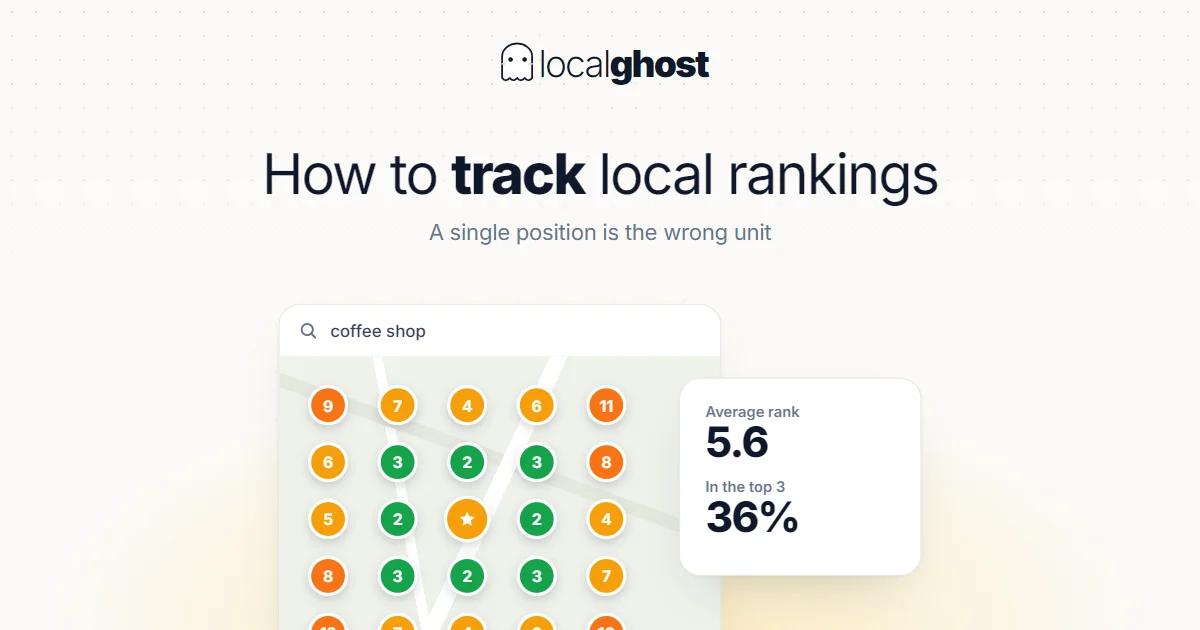
Local rankings change with the searcher's location, so a single position number is close to meaningless. Here is how to track them in a way you can act on.
In this article
Summarize with AI
Most local rank tracking produces numbers that feel informative and are not. Someone searches their service, sees themselves near the top, and concludes things are fine — while customers a kilometre away never see them at all. Both observations are accurate. Only one of them describes the business.
This is a guide to tracking local rankings in a way that survives contact with reality: what unit to measure in, what to track, how often, and which of the popular metrics are actively misleading.
Why a single position number is the wrong unit
In classic web search a keyword has roughly one ranking. In local search it does not, because the distance between the searcher and the business is a ranking input. Google assembles the result set relative to where the search happened, so your position changes with the physical location of the person searching. The same query, typed two streets apart, can return two different orders.
That has an immediate consequence: "we rank fourth" is an incomplete sentence. Fourth from where? Outside your own door you might be second; three kilometres out you might not appear at all. Both are true simultaneously, and only one of them affects the customer who is actually searching.
Two more distortions stack on top of distance:
Personalisation. Being signed in, your search history, and whether you have visited or reviewed a business before all shape what you see. Your own view of your own ranking is the least representative sample available.
Incognito is not neutral. A private window removes account history but not your IP-derived location. It is cleaner than a normal session, not clean.
The useful question is not "what position am I" but "across the area I actually serve, in what share of places do I appear at all, and how strongly."
What to track
The keyword list decides whether the whole exercise is useful.
Track what a stranger would type. Service plus place, in the words a customer uses: "emergency plumber", "boiler repair near me", "hair salon old town". If someone has never heard of you, they type this.
Do not track your business name. Branded queries rank well almost everywhere, they tell you nothing about acquisition, and they inflate any average you calculate. If you want to watch branded terms, keep them in a separate list so they do not contaminate the picture.
Keep the list small and honest. Ten to twenty queries that map to real services beat a hundred variations of the same phrase. Long tracked lists mostly generate work, not insight.
Track the phrases you can actually serve. Adding a city you do not operate in gives you a number that will never improve and cannot be acted on.
How often, and why daily checking misleads
The profile changes that move local rankings — category corrections, review accumulation, completeness, activity — register over weeks. Local results also shift naturally by time of day and with competitor activity.
So daily checking produces a stream of movement that is mostly noise, and reacting to noise is how people end up making five profile edits at once and losing the ability to attribute any result to any change.
A cadence that works:
- Take a baseline before you change anything, using a consistent method.
- Make one change — the primary category, or a review routine, or completing the profile.
- Wait weeks, not days.
- Re-measure the same way and compare against the baseline.
Consistency of method matters more than frequency. A measurement taken from a different place, a different device or a different account is not comparable to the previous one, and the difference you see may be entirely measurement artefact.
The metrics worth having
Visibility share. Out of every point you measured across your service area, in what fraction did you appear at all? This is the most honest single number in local tracking, and the one most tools bury.
Top-three share. How many of those points put you in the local pack. This is where clicks concentrate; being eleventh and being thirtieth are commercially similar.
Average position — with a warning. Averages can only include points where you were found. If you rank third in two places and are absent everywhere else, your average looks excellent while your actual visibility is poor. The average improved *because* the bad points were excluded. Never read it without visibility share next to it.
Trend, not snapshot. One measurement is an anecdote. The shape across several is the signal.
Organic position, ads excluded. Google mixes paid placements into local results. If your measurement counts a sponsored listing as position one, every organic result below it reads one place worse than it is. When a competitor starts advertising in your area, an ads-blind method will show you "dropping" while your organic position never moved.
Manual checking versus tools
Manual checking is free and fine for a rough read, with limits worth knowing: you can only realistically check from where you are, your session is never fully neutral, and repeating it consistently every few weeks is more discipline than most people sustain.
If you use a tool, the questions that matter are:
- Does it measure from multiple points, or report one number for a whole city?
- Does it separate ads from organic results?
- Does it identify your business by its Google place identifier rather than by matching the name? Name matching breaks exactly where it matters — chains sharing a name, branch suffixes written differently, a competitor with a near-identical name. Text matching will occasionally credit you with someone else's position, or report you missing while you sit in third.
- Does it measure the same places on each run? If sample points move between runs, differences between runs are partly measurement noise and cannot be compared point to point.
Bear in mind Google's own position on this: no third-party tool has access to its internal ranking data, and no tool can guarantee rankings. Tools are measurement instruments, not oracles.
What Search Console can and cannot tell you
Search Console is first-party data and worth having, but its position metric is an average across every impression — different users, neighbourhoods, devices and histories collapsed into one figure.
For broad organic SEO that average is useful. For local visibility it hides exactly the variation you need to act on, because it averages away the geography that is doing the ranking. Use Search Console for what it is uniquely good at: which queries you appear for at all, impressions and clicks over time, and which pages earn them. Use location-aware measurement for local position.
Common mistakes
- Comparing measurements taken different ways. Different location, device, account or method means the numbers are not comparable.
- Tracking branded keywords and feeling good. Your name ranks. That is not acquisition.
- Reading average position alone. It rises when you disappear from bad points. Always pair it with visibility share.
- Counting ads as organic results. Produces phantom drops when a competitor starts advertising.
- Checking from your own premises. The most biased sample there is: closest possible searcher, richest history.
- Expecting movement in days. Profile edits, review growth and activity take weeks to register.
- Chasing the far edges of the map. Distance is a ranking input you cannot edit. If a distant area matters commercially, that is an argument for a second location or paid coverage, not more keywords.
Frequently asked questions
How often should I check local rankings? Set a baseline, change one thing, and re-measure after a few weeks using the same method. Daily checking mostly measures noise and makes it impossible to attribute changes.
Why do I rank first on my phone but not for my customers? Distance is a ranking input and results are personalised. Searching from your own premises, signed into your own account, is the least representative measurement available.
Is incognito mode enough for a clean check? It removes account history but not your location, which is the strongest distortion in local results. Better than a normal session, not neutral.
Should I track my business name? Only in a separate list. Branded queries rank well almost everywhere and inflate any average, telling you nothing about whether new customers can find you.
Why did my ranking drop when nothing changed? The usual answer is that a competitor improved — the pack has three slots, so you can be passed without getting worse. Ads appearing above the results, natural time-of-day variation, and broader Google updates also produce apparent drops. Check whether your organic position actually moved before acting.
Does Search Console show my Maps ranking? Not usefully. Its position figure is an average across all impressions and locations, which averages away the geographic variation that defines local ranking.
Written by
Yunus Akan
Related tools: Grid rank tracking · AI review responses · Photo GPS tagging · All local SEO tools