Turning Negative Reviews into Opportunities
Negative reviews are not all the same thing. Reacting before working out which type you are dealing with usually makes it worse.
In this article
Summarize with AI
When a negative review lands, the first reaction is usually one of two extremes: hunting for a way to get it deleted, or firing off a defensive reply. Both come from the same mistake — acting before working out which type of review it is.
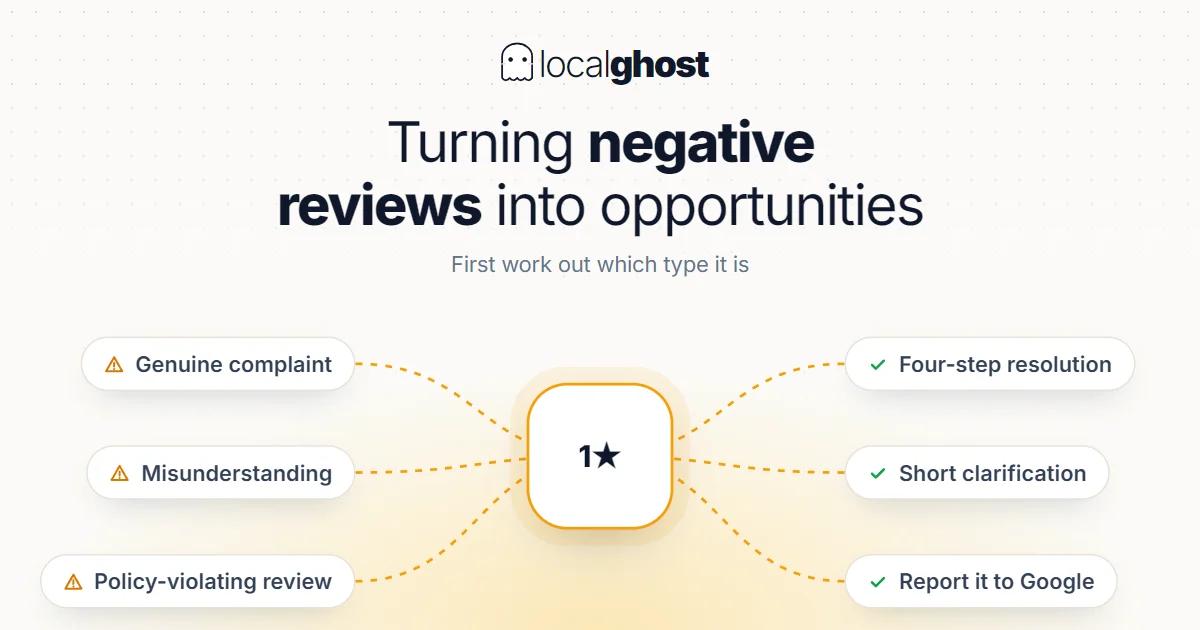
There are five distinct types, and each calls for a different action. Reacting without making the distinction usually enlarges the problem: a reportable review gets a long public answer, while a genuine complaint gets reported as "fake" and rejected.
If what you need is the reply wording, that lives in its own article: review response templates. This one is the part where you decide what to do.
Five types of negative review
1. A genuine complaint. Your customer is describing a problem they really had. It will not be removed, and it should not be. The only effective tools are a reply and, where possible, making it right.
2. A misunderstanding. What happened is accurate but the reason has been misread: the scope of an offer, a delivery time, the limits of a service. A reply genuinely works here, because the reader sees the explanation.
3. The wrong business. The review belongs to another branch, another company, or a similarly named business. Both answer it and report it.
4. A policy violation. Abuse, discriminatory language, irrelevant content, advertising, personal data, subject matter unrelated to the service. Reportable.
5. A fake competitive review. Someone who was never a customer, or accounts created by a competitor. Reportable, but it needs evidence and the process is slow.
The practical way to make the distinction is one question: could what this review describes have happened at our place? If yes, it is type 1 or 2 and the work is in the reply. If no, it is type 3, 4 or 5 and the work is in the report — though you still write a reply.
Four steps for a genuine complaint
Reply fast. Same day, two at most. Readers look at the date and read delay as indifference.
Move it to private. Phone or email. Offering compensation or a refund in public creates an expectation that comes back at you as "me too" in later reviews.
Name a concrete fix. "We are sorry" alone is weak; "we have reviewed our appointment planning" is a readable signal. Do not write a fix you have not made — when the same complaint arrives a second time, your first reply becomes evidence against you.
Close it. If the matter was resolved privately you can ask them to update the review — asking is fine, pressing is not. Some update it, some do not; both are normal.
Does recovery actually happen
It does, but the expectation needs setting correctly. A customer raising their review after a problem is resolved is possible, and the most common condition for it is this: noticing the problem and calling before the customer complains — that is, removing the reason to write the review at all.
Recovery rates after the review is written are low. So the real gain is not after the review but before it: asking about satisfaction the moment the job ends and catching the problem there. That same moment is also the moment to ask for a review — increasing Google reviews.
There is also the arithmetic of the average: if your review count is high, a single negative barely moves it. On a profile with few reviews the same review drops the average sharply. Which means the best protection against negative reviews is not negative-review management, it is a steady review flow.
A crisis and a single review are not the same thing
One negative review and a wave arriving in a short period do not take the same handling, and confusing them is expensive.
A single review is operational work: reply, take it private, fix it. No extra organisation needed.
A wave is a different situation: several reviews about the same issue in quick succession is not a review problem, it is an operations problem. It cannot be closed by replying, because the source is still running. The order is: stop the cause rather than the reviews first (staffing, supply, process), then write the replies one by one, then review your profile information — because some waves originate in wrong hours or a missing explanation.
In practice the distinction shows up here: if the reviews are about different things, handle them individually; if they all say the same thing, stop replying and fix that thing.
The reporting process and a realistic expectation
Reviews that breach policy can be reported through the profile. What to know:
- A report is a request, not a decision. The assessment is Google's, and the outcome can go against you.
- Choose the right reason. "This review is unfair" is not a reason. Show which rule was broken: irrelevant content, abuse, personal data, advertising, fake engagement.
- Collect evidence. In a fake-review claim what helps is concrete traces: screenshots, the absence of any record, the same text appearing on other profiles.
- The process is slow. Days, sometimes weeks. Meanwhile you still need a reply, because the review is live.
- Do not report in bulk. Reporting every negative review does not convince the system, it only reduces the weight of your reports.
For spam patterns on the competitor side (businesses with keywords stuffed into the name, fake addresses, purchased reviews) there is a separate reporting route; documented reports do sometimes result in action, but the process takes patience.
What not to do
Threatening legal action. Implying a lawsuit in a reply leaves the reader with the impression that you are the party who needs defending. If legal action is coming, the reply field is not where it belongs.
Trying to identify the customer. "You are the person who came in on the 14th" is sharing private information, and in fields like healthcare it is a serious problem.
Piling on reviews to bury it. Rapidly collecting reviews to push a negative one down creates a pile pattern, and the spam filter removes it. The result: the new reviews go and the profile gets flagged.
Writing angry and deleting later. Assume a screenshot already exists.
Staying silent. An unanswered negative review is worse than the review: the reader sees the complaint and the indifference.
What the complaint is about, by sector
What the complaint concerns varies, and the right preparation follows from it.
In removals it is damage and delay, that is, concrete loss. Because wording that accepts liability can have insurance implications, moving the resolution to private is a necessity here — moving company SEO.
In vehicle inspection the most common negative review comes from the customer who walked away from the car: the report came back bad and they may have written that up as bad service. The job of the reply here is to explain independence — vehicle inspection.
In scrap buying the argument runs through the scale and the payment; a reply that describes the measurement process concretely works best — scrap metal and recycling.
In healthcare the reply is most constrained: privacy means no detail can be shared, even confirming the person was a patient can be a problem, and professional regulation applies on top. You have to check your own regulator's rules — Google Maps SEO for dental clinics.
In restaurants and accommodation volume is high and sensitivity is high: here a routine is mandatory rather than case-by-case replies — Google Business guide for restaurants and local SEO for hotels.
Frequently asked questions
Can I get a negative review deleted? A review describing a genuine experience is not removed. Only reviews that breach policy (abuse, irrelevant content, personal data, advertising, fake engagement) can be taken down after a report.
How long does a report take? Days, sometimes weeks, and the outcome can go against you. Since the review is live throughout, you still need to reply.
Do customers update their review once the problem is fixed? Some do. Asking is fine, insisting is not. The recovery rate is low compared with catching the problem before the review is written.
Will one negative review drop my ranking? The weight of a single review depends on how many you have. On a profile with few reviews it drops the average sharply; on one with a steady flow the effect stays limited.
Someone who was never a customer left a review. What now? Write a short, non-argumentative reply noting that no record could be found, and report it as fake engagement. Collecting evidence strengthens the case.
Can I collect reviews quickly to bury a negative one? That works against you: a sudden pile is an unnatural pattern and the spam filter removes those reviews. The right route is keeping the flow steady, not running a campaign.
Written by
Yunus Akan
Related tools: Review Management · Local SEO Audit · Post Management · All local SEO tools