How to Conduct Local Keyword Research
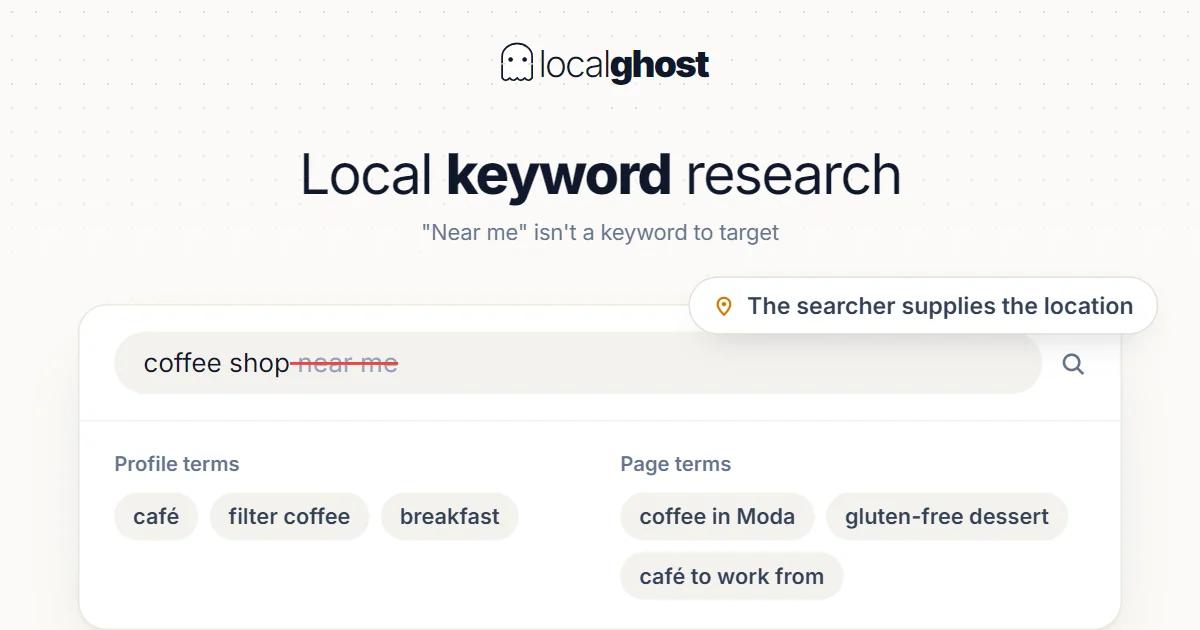
In local search “near me” is not a keyword to target; the searcher supplies the location. The list has to be built on that assumption.
In this article
Summarize with AI
Local keyword research is not a smaller version of classic research. The one thing that makes it different: the searcher supplies the location. A customer types "hairdresser" and Google interprets it against where they are, which means your keyword list does not need a city name in it — and usually should not have one.
When that is not accepted, two common mistakes follow: adding the city to the end of every term, and treating "near me" as a keyword to target. Both waste effort.
"Near me" is not a keyword to target
When someone searches "hairdresser near me", Google does not answer by matching "near me" as a phrase; it uses the user's location. So writing "near me" into your profile or your page does not get you into that search.
What does get you seen there: the right category, the right service naming, distance and prominence. The mechanism: how the 3-pack works.
Largely the same applies to city names. Mentioning where you operate once, naturally, is reasonable; adding it to every sentence is both unreadable and looks like keyword stuffing.
Two separate lists: profile terms and page terms
This is the distinction that makes the work easiest. Local search has two surfaces and each wants a different kind of term.
Profile terms. Short phrases used in the category and service list, exactly as customers type them: "paint thickness measurement", "balayage", "boiler servicing", "scrap copper buying". These are service names, not sentences. The category side is a separate topic: how to choose the right category.
Page terms. What pages on your website target: longer phrases, often questions — "what does an inspection report cover", "what makes removal prices vary". These do not fit profile fields; they need content.
Without that distinction the typical mistake appears: long question sentences in the profile description while the service list sits empty. The result is weak matching on both surfaces.
Where the terms come from
Paid tools are not required; the best sources are already in your hands.
1. Your profile's search-queries report. First-party data: it shows directly which phrases people used to find you. Setting brand queries aside and looking at the remaining service phrases gives you the core of the list — reading the statistics.
2. Autocomplete and related searches. Typing your service into the search box and reading the suggestions is the fastest access to real search language.
3. The customer's own words. What do they say on the phone? Which phrases appear in your reviews? Review text is a free source that shows the gap between industry jargon and customer language.
4. A competitor's service list. Profiles are public; seeing which words a competitor used provides validation — how to do competitor analysis.
5. The questions you get asked. Every "do you also do X" is a service name that belongs on the list.
Intent types: which term belongs where
Sorting terms by intent rather than volume turns the list straight into action. Local search has three intent types and each one goes somewhere different.
Purchase intent. The person is about to buy: "who buys scrap copper", "emergency plumber", "inspection appointment today". These belong on the profile — the category and service list. The most valuable group, and usually the lowest volume.
Comparison intent. The person is choosing: "which inspection centre is trustworthy", "hairdresser or barber", "what removal insurance covers". These do not fit profile fields; they need content — page terms.
Information intent. The person is not a buyer yet: "why is copper valuable", "how many microns should paint thickness be". These bring traffic but do not convert. For a local business they come third; with limited time they can be skipped.
So the order is clear: place purchase-intent phrases on the profile first, then turn comparison-intent ones into content. Information-intent content comes last. Working in reverse means producing blog posts while the service list sits empty — the most common waste of effort in local search.
The synonym trap: different names for the same service
Several words can describe the same job, and on Google's side they can be different pools. "Hairdresser", "barber" and "beauty salon" are not the same thing; "removals", "moving company" and "haulage" do not pull the same searches; "inspection" and "vehicle test" carry different intent.
Two practical rules follow.
First, test synonyms separately. Typing each variation into autocomplete and reading the suggestions shows which one is actually used. The word that feels natural to you may not be the one customers use.
Second, do not dump them all into the service list. Adding five variations of the same job does not strengthen matching, it blurs the list. Two or three genuine usages are enough; the rest is repetition.
There is a regional dimension too: different words settle for the same service in different areas. The word your own customers use comes before the generally accepted one.
Why volume data misleads
The search volume keyword tools report misleads at local level for two reasons.
First, volume is usually national or broad-region. The national volume for "hairdresser" says nothing about demand in your neighbourhood. The number that matters to you is demand inside your service area, and tools do not give that reliably.
Second, low-volume phrases are the most valuable ones in local trades. A phrase like "paint thickness measurement" looks low-volume, but the person searching it is about to buy exactly that service. Filtering by volume removes those phrases from the list.
The practical approach: use volume to get a rough sense, not as a ranking criterion. The real criterion is intent — how close is the phrase to a purchase?
What to do with the list
A list does nothing by itself; each term has to be written somewhere.
- Put them in the service list. The most direct matching comes from here. Each service as its own entry, in the words customers use.
- Use them once or twice in the description, naturally. The description is a weak ranking field but a strong conversion one — how to write the description.
- Turn frequently asked ones into content. Page terms do their work here.
- Do not write them into the business name. Adding services and districts to the name is a guidelines violation and a suspension cause.
- Measure. Which phrases you are found for changes over time; reading the query report quarterly keeps the list current.
Keyword logic by sector
Which kind of phrase brings the work varies by sector.
Trades where a material name is the search. In scrap the customer searches by material — "copper price", "who buys scrap steel"; the service list has to be effectively a materials list — scrap metal and recycling.
Trades where a product name is the search. In wholesale food very specific phrases arrive like "wholesale avocado"; low volume, high intent — wholesale food suppliers.
Trades where the cuisine name matters as much as the category. In restaurants phrases like "kebab shop" or "breakfast place" do more work than the venue type — Google Business guide for restaurants.
Trades where nobody searches the procedure name. In healthcare patients usually type the complaint rather than the clinical term, and searching by practitioner name dominates — Google Business for doctors and clinics.
Trades where timing phrases lead. In inspection "appointment today", in taxi "airport transfer" — phrases describing the situation more than the service — vehicle inspection.
Frequently asked questions
Should I add my city to my keywords? In local search the searcher supplies the location, so it is not required. Mentioning where you operate once, naturally, is reasonable; repeating it looks like keyword stuffing.
Can I target "near me"? No, that is a location signal rather than a phrase match. What gets you seen in those searches is category, service naming, distance and prominence.
Which tool do I need? None is mandatory. The most valuable source is your profile's search-queries report, because it is first-party. Autocomplete and customer language complete it.
Are low-volume keywords a waste of time? The opposite. In local trades specific low-volume phrases are the closest to a purchase. Filtering by volume removes them unnecessarily.
Can I put keywords in the business name? No. Adding services and districts to the name is a guidelines violation, one of the most reported forms of local spam, and a suspension cause.
How often should I update the list? Reading the query report quarterly is enough. Which phrases you are found for shifts with the season and with competitor activity.
Written by
Yunus Akan
Related tools: Map rank tracking · All local SEO tools