Local SEO for Franchise Businesses
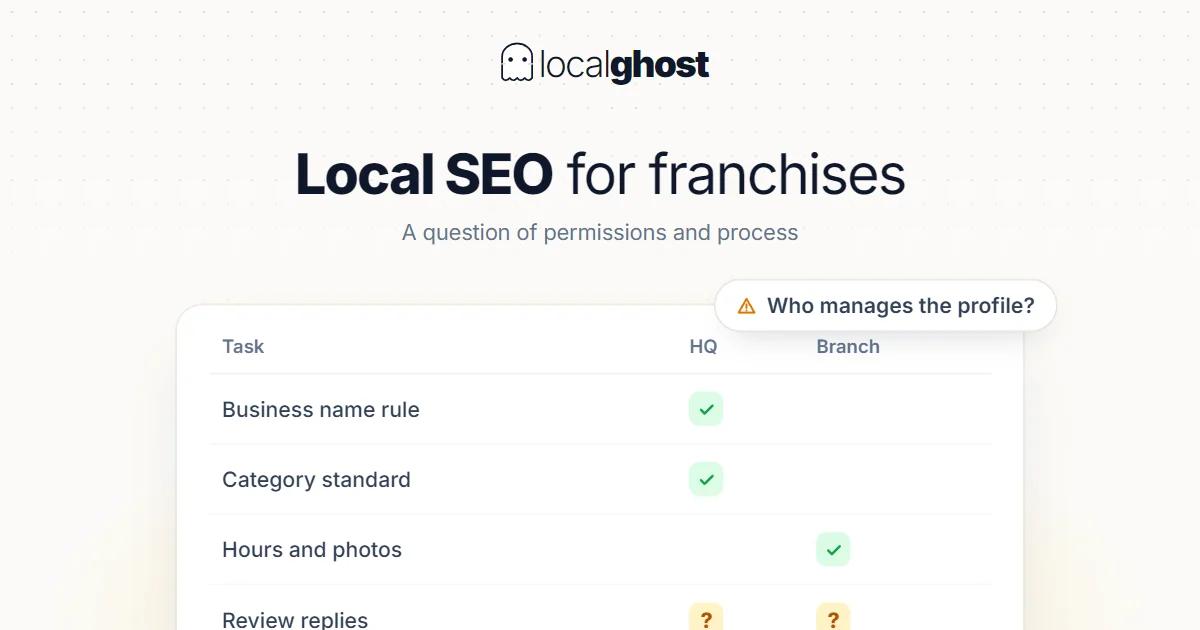
In franchising, local SEO is not a technical job but a question of permissions and process. The real question: who manages the profile, who replies?
In this article
Summarize with AI
The real difficulty of local SEO in a franchise structure is not technical. The profile settings are almost identical to a single-location business; the difficulty starts when who does what stays unclear.
The most common picture: the brand wants central consistency, the branch knows its own customers, and the jobs in between — review replies, hour updates, photos — get done by nobody. Work everyone is responsible for is work nobody does.
This piece describes the structure that closes that gap.
Who owns the profile: the access structure
This is the most important decision in a franchise, and it is a contractual matter more than a technical setting.
A healthy structure runs like this: ownership of the profile sits with the brand, day-to-day management rights sit with the branch. The brand account is the primary owner; the branch operator holds manager rights for their own location.
The reason shows up in a single scenario: when a franchisee leaves. If the profile was claimed in the branch operator's personal account, the departing operator takes that address's profile — with its years of accumulated reviews — with them. The new operator continuing at the same address starts from zero or enters an access dispute.
The reverse is also a problem: in a structure where everything is locked centrally, a branch cannot even update its own hours; the update becomes a ticket to head office and arrives late. Wrong hours are among the most expensive mistakes: hours optimization.
For structures with dozens of locations there is a flow for managing profiles in groups; when permissions are distributed through the group, staff changes do not require editing profiles one by one: multi-location management.
The business name: the most frequently broken rule
The name field is constantly abused in franchising, because "brand + neighbourhood" is believed to bring rankings.
The rule: the name on the profile must be the business's real-world name — whatever is on the sign, the invoice, the door. Adding keywords, a district or a service to the brand name breaches the naming rules and is open to a correction request.
If the district genuinely is part of the sign — in many chains the branch really is called "Brand Baker Street" — it can be written. The test is the signage, not your imagination.
The cost of a breach is not just being corrected: when branches of the same brand use different name formats, brand coherence breaks down too. Writing the name identically on every surface is the underlying rule: NAP consistency.
Category and services: where the standard ends
Instinct in a franchise says "make every branch identical". The correct answer is partly that.
What should be identical: the primary category, the brand name format, the brand's visual identity, core service naming. If the primary category differs between branches, the brand is describing the same work in different ways: how to choose the primary category.
What should differ: hours, photos, attributes, secondary categories, branch-specific services. One branch has parking and another does not; one stays open late and the other does not. Erasing those differences in the name of a central standard means giving customers wrong information.
The test is simple: if the information varies by branch, it is managed at the branch; if it defines the brand, at the centre.
Who replies to reviews
This is the ball most often dropped in a franchise. Picking either extreme causes problems.
Fully centralised replies are consistent but generic; a reply written by someone who does not know the incident the customer described reads like a template, and template replies do not build trust.
Leaving it entirely to branches creates a quality spread: some branches reply, some never do. An unanswered negative review also shows up when the brand name is searched.
The middle path that works: the frame from the centre, the content from the branch. The centre sets the tone, the boundaries and the red lines (what must never be written, which topics escalate); the branch writes knowing the incident. Ready-made patterns work as a starting point, not as the final text: review response templates.
The topics that must escalate need to be explicit too: legal claims, health and safety complaints, incidents with potential to reach the press. Having a branch answer those alone is risky: turning negative reviews into opportunities.
The chain average hides the weak branch
This is the structural flaw in franchise reporting. Total review count and average rating look fine on the brand dashboard, while a branch-by-branch view reveals one location sitting at 3.4.
What the total hides is not what the customer sees. The customer does not see the chain average; they see the branch in their own neighbourhood.
So the report has to be read at branch level: for each branch, review count, average, date of the newest review, and reply rate. Those four columns show immediately which branch has been left unmaintained: reading the statistics.
The same issue affects competitor comparison: competition happens at branch level. Being strong as a brand does not mean being strong in that district: how to do competitor analysis.
Duplicate listings: the classic franchise problem
A second listing for the same address happens far more often in franchising than in single-location businesses, because more people can create one: the former operator, the new operator, the regional manager, the agency.
The cost of a duplicate is direct: reviews split in two, which listing shows becomes uncertain, and customers reach the wrong phone number.
Prevention is a process matter: tie profile creation for a new branch to a single authority, and put "sweep for existing listings" on the branch opening checklist. Searching the same address and phone number to see whether a listing already exists takes five minutes.
Handovers need the same sweep: a closed listing left live, or a new operator opening a second one, most often happens at that moment.
Do nearby branches eat each other's demand
This is a frequent franchise question and the answer runs counter to instinct.
Distance is a decisive input in whether you appear in the local pack. If two of your branches are close together, they do not both appear high for the same search; the user is shown the one nearest them. So branches do not "eat" each other's rankings — they share territory: how the 3-pack works.
The real problem sits elsewhere: when two nearby branches' profiles become indistinguishable. Same photos, same description, same service copy. The user then cannot tell which one suits them, and both profiles stay weak.
The fix is not drawing territory lines but each branch writing its own reality: parking, transport, capacity, hours, which services that branch does and does not offer. Photos should be taken at that branch; a central photo pool distributes the same image to every location: photo optimization.
There is also the closed-branch case: a closed branch's profile must be marked permanently closed. A shut branch left open both sends customers nowhere and captures then loses the nearby branch's demand.
Branch opening checklist
What to do in order when opening a new branch — order matters, because verification takes time.
- Sweep for existing listings. Search by address and phone; is there a duplicate?
- Create and verify the profile. Start weeks before opening so the verification wait does not land on opening week.
- Access structure. Ownership at the brand, manager rights at the branch.
- Core details. Name (as on the sign), address, phone, primary category, hours.
- Branch-specific content. Photos, attributes, parking and transport notes.
- The site side. The branch page is live and the profile link points to it.
- Review flow. A request process in place from day one: strategies for increasing reviews.
- Opening announcement. A post with the date and hours: how to schedule posts.
Visibility is low in a new branch's first months; that is not a fault but accumulation that has not formed yet: 30-day plan for a new business.
The brand site and the branch profiles
On the site side the franchise job is clear: one page per branch, with the profile's website field pointing at that page.
Sending all five branches to a single "contact" page leaves the visitor to find their own location. A branch page stands with that branch's address, hours, phone, photos and directions: website SEO for local businesses.
Branch pages must not be the same text duplicated with the address swapped. The test: does the page contain at least three facts that are not true of the other one? On the structured data side, each branch carries its own block: schema markup setup.
Separate link tagging per branch earns its place here too: it is the only way to separate how many clicks each profile sends to the site.
Frequently asked questions
Should the profile belong to the brand or the branch? Ownership with the brand, day-to-day management rights with the branch. If ownership sits in the branch's personal account, the profile and its reviews leave when the franchisee does.
Can I add the district to the business name? Only if it genuinely appears on the sign. A district or service phrase added for ranking purposes breaches the naming rules.
Should all branches use the same category? The primary category should match. Hours, photos, attributes and branch-specific services should differ.
Does the centre or the branch reply to reviews? Frame from the centre, content from the branch. The centre sets tone and red lines; the branch that knows the incident writes it.
If the chain average is good, is everything fine? The average hides the weak branch. Read the report per branch: review count, average, newest review date, reply rate.
Does each branch need its own web page? Yes. The profile's website link should point to that branch's page; a single contact page forces the visitor to hunt for their own location.
Written by
Yunus Akan
Related tools: Review Management · Local SEO Audit · Free Photo Geotag Tool · All local SEO tools