Google Business Optimization for Doctors and Clinics
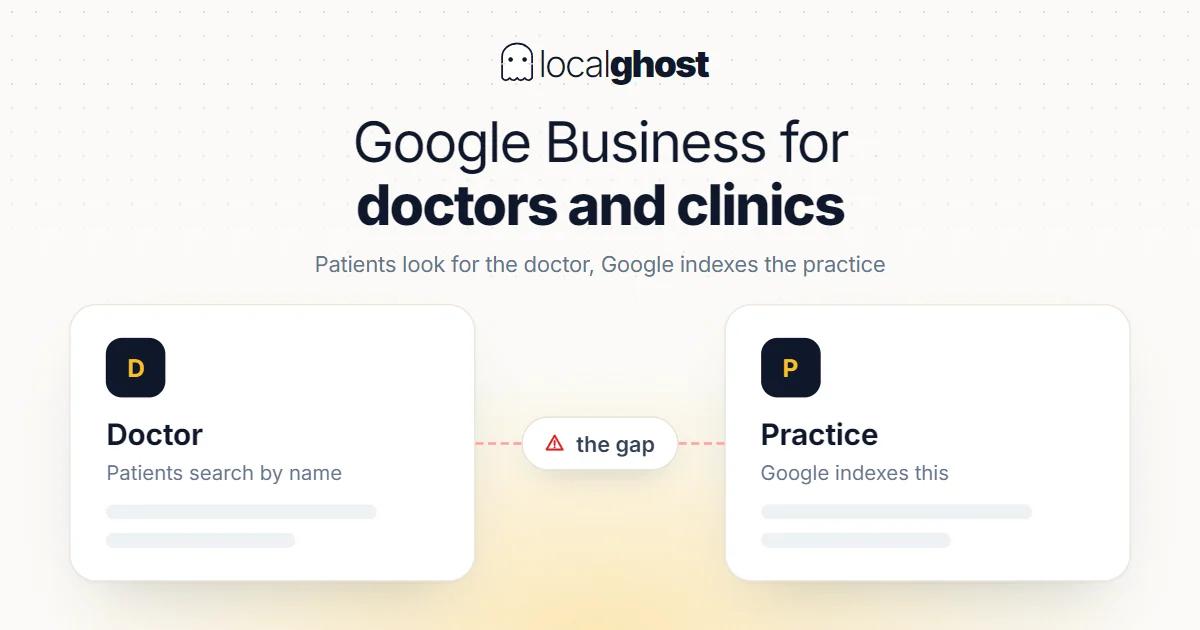
There is a mismatch at the centre of healthcare search: patients look for the doctor, Google indexes the practice. Your profile structure has to manage that gap.
In this article
Summarize with AI
At the centre of local search in healthcare sits a mismatch that is not this sharp in any other sector: patients search for the doctor, Google knows the practice.
A patient arriving on a recommendation types "Dr Sarah Mitchell" into Google, not "Riverside Medical Centre". But the profile is registered under the practice name, and the doctor's name appears maybe on a subpage of the website. The result: the reward for that search does not go to you — it goes to the third-party booking directory that happened to put that doctor's name on a page.
This guide is about managing that gap. Dentistry-specific dynamics (the split between emergency pain and planned treatment) are a separate topic; this covers general practice, multi-specialty clinics and specialist consultants.
Patients search by name
Healthcare search has three distinct patterns and your profile has to serve all three:
Doctor-name searches. This is the behaviour of a patient arriving on a recommendation. Highest intent, highest conversion, lowest competition — because someone searching that name has already decided and only wants contact details and reviews. Being invisible for this search means losing the easiest patient you will ever get.
Specialty plus location searches. "Cardiologist near me", "physiotherapy in Camden". High competition, and category accuracy plus proximity decide it.
Symptom searches. "Which doctor for neck pain", "constant fatigue causes". These generally land on content pages rather than clinic profiles; not demand you can chase at profile level.
In practice the first is the most neglected. If doctor names are not consistent across your profile, website and service descriptions, those searches cannot find you.
The simplest fix: put doctor names and specialties in the services list. Entries like "Dr Sarah Mitchell – Internal Medicine" or "Dr James Okafor – Endocrinology" create a search match and answer the patient's question at the same time. Naming the clinical team in the business description does the same job.
Practitioner listing or practice listing
The answer is more nuanced than it looks, and a badly built structure splits your reviews.
What is certain: Google's rules allow one profile per business. The official documentation is explicit — multiple profiles for the same business mislead customers and are against policy. So opening a second *practice* profile at the same address in the same category counts as a duplicate, splits your reviews, and is far harder to undo than to avoid.
Alongside that, Google recognises a separate framework for individual practitioners: under certain conditions a clinician can hold a profile in their own name while the organisation keeps its own, separate profile. But the conditions depend on circumstances — a self-employed consultant and an employed associate are not in the same position, and a clinician working across several locations is different again.
So a blanket recommendation would be wrong here. Read Google's guidelines for individual practitioners before setting anything up, because the answer depends on the legal structure of the practice and how the clinician works.
The practical question that helps you decide: is there real search demand for that doctor's name? In a single-clinician practice the doctor and the practice are the same thing, and a second profile means competing with yourself for the same terms. In a multi-specialty clinic with clinicians who have their own reputation, name searches carry real volume and serving that volume makes sense.
What happens when a clinician leaves
The thing nobody plans for and everybody deals with later. If a profile was created in a doctor's name and that doctor leaves:
- The profile goes with them. A profile in someone's name is their professional presence; the practice cannot inherit it.
- The reviews on it go too. Years of accumulated patient reviews do not stay with the organisation.
- The practice profile is unaffected — if it exists separately and was built properly. If it was not, the entire reputation walks out with one person.
The practical consequence: the practice profile should always be primary. Practitioner profiles are an addition, not a replacement. The weight of your review-gathering effort belongs on the practice profile, because the organisation's reputation is the only transferable asset.
There is also cleanup after a departure: update the doctor's name in the services list, correct the team page on the website, and accept that searches for that name will now go nowhere.
Specialty categories beat a generic "Doctor"
Healthcare is not one category in Google Business Profile: "Doctor", "Internist", "Cardiologist", "Ophthalmologist", "Physiotherapy Centre", "Obstetrician-Gynaecologist", "Pediatrician", "Medical Clinic", "Medical Centre", "Psychologist", "Dietitian".
Your primary category determines which query pools you are eligible for. A physiotherapy-led centre setting generic "Doctor" as primary gives up its strongest signal for physiotherapy searches — and "doctor" is both very broad and very competitive.
In a multi-specialty clinic the decision is harder. The approach that works: make the primary category the specialty that brings the most patients, and add the others as secondary categories. "Medical Clinic" and "Medical Centre" describe the corporate structure but are weak in specialty searches; left alone, they miss specific demand.
Google's own guidance is to choose the fewest categories that describe your core business. The goal is accuracy on the main work, not filling the field.
General category rules: how to choose the right category.
Insurance and pricing are the first question
In private healthcare a patient's first question is almost never about quality: "do you take my insurance, and what does it cost."
If that information is not on the profile, two things happen: unsuitable patients call and occupy reception, and suitable patients never call because of the uncertainty.
What the profile can answer:
- Accepted insurers — in service descriptions or the business description
- Consultation fee range — an exact price may not be possible, but a range cuts unnecessary calls
- Payment methods — card, instalments; also markable as attributes
- Whether appointments are required, and whether walk-ins are accepted — directly shapes patient flow
- Turnaround time for results — one of the most-asked questions in any practice doing diagnostics
Writing these down lowers call volume and raises call quality.
Booking: phone still dominates, but should not be the only channel
Phone is still the dominant channel in healthcare and that is genuinely sector-specific — patients want to speak to someone, especially in older patient groups.
But leaving phone as the only channel loses younger patients. The profile has a booking-link field and it should be used: your own booking system, a messaging channel, or at minimum an appointment-request form.
Two things to check: the link should go to your own page rather than a third-party marketplace that also lists your competitors, and it should work on mobile — nearly all of this traffic is mobile.
Whether the phone is answered is a separate matter. In healthcare a "called, nobody answered" review does damage faster than a service-quality complaint, because the patient goes somewhere else in that moment.
Patient privacy in review replies
Replying to reviews helps in every sector; in healthcare it comes with one additional constraint: do not disclose anything about the patient's care, or confirm that they were a patient at all.
This principle is internationally accepted and the logic is simple: even if the reviewer described their own treatment, your confirming it on a public page is a separate act. "We're sorry the pain persisted after your physiotherapy sessions" may be written with good intentions, but it confirms which treatment that person received.
The pattern that works: acknowledge the dissatisfaction, disclose no clinical detail, move the conversation off the platform.
"Thank you for the feedback and we're sorry about your experience. Please contact the practice directly so we can look into this properly."
The same rule applies to positive reviews. "Glad your treatment went well" becomes "Thank you for the kind words" — sufficient and safe.
Also: never offer anything in exchange for a review. It violates Google's policy, and in healthcare a damaged reputation is the hardest kind to rebuild.
General reply patterns are in review response templates; the difference here is that you must cut anything clinical out of them.
Profile structure in a multi-specialty practice
A common mistake in clinics and medical centres is opening a separate profile per specialty. Two profiles at the same address — "Riverside Internal Medicine" and "Riverside Cardiology" — are two profiles for one business, which falls under the duplicate rule.
The correct structure is usually: one practice profile, multiple categories, specialties in the services list. Specialties are represented by secondary categories; clinicians and their areas of expertise by service entries.
A genuinely separate branch at a different address is its own profile — but the branch must be a real location with its own staff seeing its own patients. A virtual office, or an address with only a sign on the door, is a suspension risk.
Running several locations from one place is an operational problem of its own: multi-location management.
Frequently asked questions
Patients search for the doctor's name. What should I do? Put doctor names and specialties in the services list and business description, and keep them consistent with the team page on your website. A separate profile in a clinician's name is possible in some situations but depends on conditions; read Google's individual-practitioner guidelines before setting one up.
Should every doctor have their own profile? It depends. In a single-clinician practice the doctor and the practice are the same thing, and a second profile means competing with yourself for the same terms. In a multi-clinician practice with individually known names, name searches carry real volume. What is certain: a second *practice* profile at the same address and category is a duplicate.
What happens to the profile if a clinician leaves? A profile in their name goes with them, and so do its reviews. This is why the practice profile should always be primary and carry the weight of your review-gathering — the organisation's reputation is the only transferable asset.
Can I create a separate profile for each specialty? Not at the same address; that is multiple profiles for one business and falls under the duplicate rule. The correct structure is one practice profile with specialties as secondary categories and service entries.
How should I reply to a patient review? Acknowledge the dissatisfaction, disclose no clinical detail, and move the conversation to the practice. Even if the reviewer mentioned their treatment, your confirming it is a separate act. The real reader of your reply is the next patient.
What should the primary category be? The specialty that brings the most patients. Generic "Doctor" is both broad and highly competitive; a specialty category is measurably stronger for specific searches. Other specialties go in as secondary categories.
Will publishing consultation fees drive patients away? It drives away unsuitable patients, which is the point. Omitting them means unsuitable patients occupy reception while suitable ones never call because of the uncertainty.
Written by
Yunus Akan
Related tools: Profile analysis · AI review responses · Photo GPS tagging · All local SEO tools