SEO for Seasonal Businesses
The costliest mistake in a seasonal business is closing the profile the wrong way. The mechanics of getting through the off-season and opening ready.
In this article
Summarize with AI
A seasonal business's local search problem is not spread across the year. It concentrates in two transitions: closing the season and opening it. The decisions made at those two moments either protect everything the season earned or reset it.
And the costliest mistake lives right there: closing the profile the wrong way.
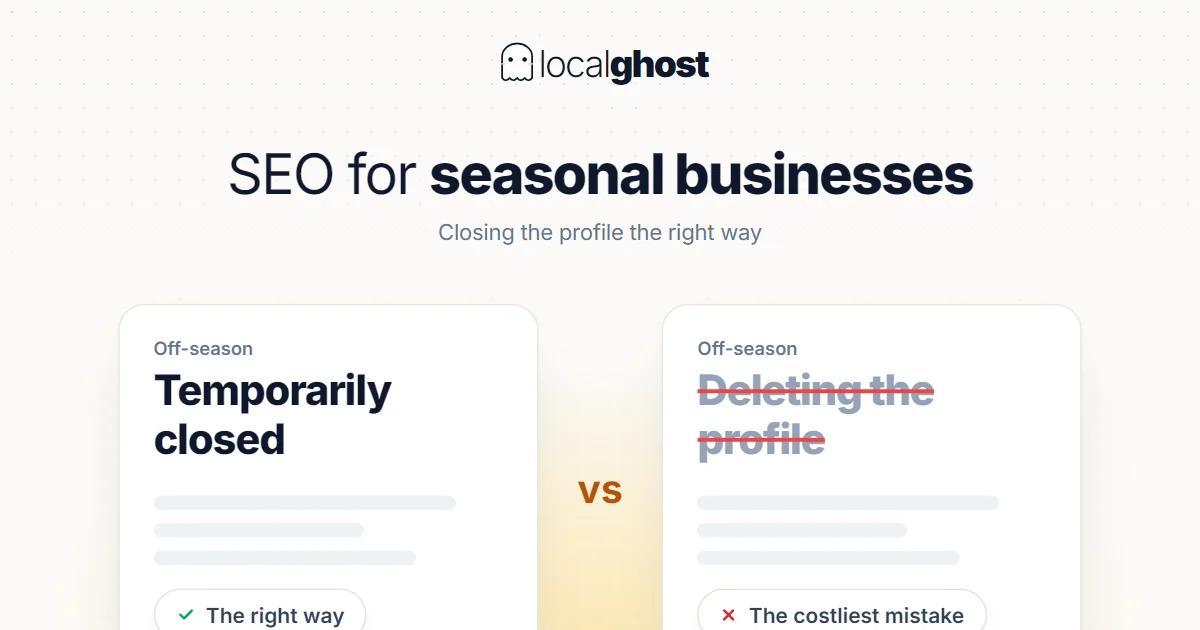
Temporarily closed and permanently closed are not the same
The profile has two distinct closure states, and their consequences are opposites.
Temporarily closed. Says the business is not currently trading but will return. The profile stays standing; reviews, photos and history remain in place. When the season arrives, reopening is a single action.
Permanently closed. Says the business has ended. This marker sharply reduces visibility in search results, and reversing it takes time and does not always go smoothly. For a seasonal business it is the wrong option.
The rule is plain: do not mark permanently closed for the off-season. There is also a third mistake, more common than either: doing nothing. The profile appears open, customers arrive, find the door locked, and write about it in a review.
It is worth knowing that temporary closure carries a cost too: a closed profile does not surface in filters like "open now" or in immediate-need searches. But that cost is smaller than the cost of appearing open with wrong information. Losing visibility while closed is temporary and reversible; the review left by a customer who came for nothing is permanent.
Why deleting the profile off-season is a bad idea
The "we're not trading anyway, let's delete it and start fresh next season" approach means starting from zero every year.
Deleting the profile takes the reviews with it. Review count and average rating accumulate over years; in an account reset every season that accumulation never forms.
A new profile also needs verification, and when that process lands on your opening date you spend your most valuable weeks waiting on it.
There is a duplicate-listing risk as well: if the old record was not fully removed, two listings exist for one address, which splits the reviews. Sweeping for duplicates belongs in annual maintenance: weekly and annual maintenance calendar.
Off-season: what closes, what stays open
The off-season task list is short but not empty.
Make the hours reflect reality. Fully closed means temporarily closed; trading in a limited way means updating hours. The "open now" filter reads this information: hours optimization.
State the return date. Writing "reopening in March" in the description or a post turns a visitor who finds you closed into a customer who waits instead of one you lose.
Keep replying to reviews. Reviews do not stop arriving because the season ended. Unanswered end-of-season reviews become the first impression you meet at opening: review response templates.
Watch the questions section. The most-asked off-season question is "are you open", and other people can answer it incorrectly.
What should not be switched off: the profile itself, replies to reviews, and call forwarding.
The review flow stopping: the real cost
This is the structural disadvantage of a seasonal business. Review recency is a signal that answers "when was the last time", and off-season that signal naturally ages.
The answer is not manufacturing reviews out of season — that does not work and gets caught by the filter. The answer is widening the base during the season.
Two practical behaviours help. First, spreading review requests across the season: some every week rather than a bulk send two weeks before closing. Reviews piled into a short window create an unnatural pattern and get caught: strategies for increasing reviews.
Second, asking the moment the service ends. In seasonal trades the customer leaves town; a request sent two weeks later goes unanswered. Asking on the spot with a QR code works particularly well here: collecting reviews with QR codes.
Closing week: what to do, in order
The end of the season usually arrives tired, and profile work drops to last place. Yet fifteen minutes during closing week stops wrong information circulating for the whole off-season.
Ask your last customers for reviews. The customers around closing are the ones who will leave the most recent reviews that keep the profile fresh through the off-season. Ask as the service ends.
Announce the closing date in a post. "Season closed, see you in March" informs whoever finds you shut.
Change the hours. The evening of closing day, next morning at the latest. A week's delay means customers arriving for nothing and a negative review.
Review the description. If it carries season information, update it: how to write the description.
Forward the phone. To wherever the phone keeps ringing off-season. An unanswered phone creates a worse impression than being closed.
Enter next season's special days now. A job doable in one sitting that nobody will remember next season.
Category and name do not change with the season
A common error is rotating the category by season: one category in winter, another in summer.
The category defines the body of your revenue, and changing it often does not produce a consistent signal. If the business genuinely does two different things, the right route is not rotation but picking the primary category by the revenue body and adding the other as a secondary: how to choose the primary category.
Adding season information to the business name is wrong for the same reason. The name has to be the real name on the sign; adding a campaign or season phrase breaches the naming rules: NAP consistency.
Preparing to open ready
Work done during opening week is late. The search side does not react instantly, and demand forms before the season starts.
Enter hours before you open. Putting correct hours in a few weeks ahead answers "are they open" at the moment of the search.
Refresh the photos. An empty-venue shot taken off-season and an in-season photo say different things. The date of the newest photo does more work than the total count: photo optimization.
Review the service and attribute lists. If a service was added or dropped this season, the list needs updating. Seasonal attributes like outdoor seating belong here too.
Announce the opening with a post. Date, hours and a booking link: how to schedule posts.
Test the booking and appointment link. A link that changed or expired off-season produces the most wasteful loss at opening.
Measuring when demand starts
The most valuable piece of information in a seasonal trade is which week demand begins. That date comes from data rather than guesswork, and it differs by sector.
Search views and direction requests in the profile data, read week by week, show where demand lifts off. Comparing against the same period last year tells you how far forward to pull this year's preparation: reading the statistics.
The practical rule that follows: finish preparation before the week demand lifts. Looking at which phrases the search queries arrive in also shapes your season messaging: local keyword research.
One caveat: a single year's data is not enough for seasonality. Once you have a second year to compare against, the decisions become noticeably better aimed.
Seasonal behaviour by sector
Accommodation. Hours and closure information must stay current off-season; booking demand forms months ahead of the season: local SEO for hotels.
Food and drink. Outdoor areas, seasonal menus and break hours change often; the "open now" filter directly affects decisions in this category: Google Business guide for restaurants.
Trades with moving peaks. Removals demand clusters in particular periods; when capacity fills during the peak, managing hours and response time comes to the front: moving companies.
Transfer and transport. Demand multiplies over holidays and drops between them; a phone answered under all conditions is the only decider: taxi ranks and airport transfer.
Multi-branch seasonal structures. If branches run different season calendars, each must carry its own hours; one central set of hours produces wrong information: multi-location management.
Frequently asked questions
Should I close my profile off-season? Mark it temporarily closed. Do not mark it permanently closed — that says the business has ended and sharply reduces visibility.
Can I delete the profile off-season and recreate it? No. Reviews and rating accumulation go with it, a new listing needs verification, and you create a duplicate risk.
Can I change category by season? Better not to. Pick the primary category by the body of your revenue and add the other work as a secondary category.
Can I collect reviews off-season? Trying to generate reviews while you are not trading creates an unnatural pattern. The right route is spreading requests across weeks during the season.
When should I start opening preparation? Early enough to finish before the week demand lifts. You find that week by looking at the same period last year in your profile data.
Can I add a season or campaign phrase to the business name? No. The name must be the real business name; added phrases breach the naming rules.
Written by
Yunus Akan
Related tools: Review replies · Add GPS to photos · All local SEO tools