What Is Google Maps Local Pack (3-Pack)?
The local 3-pack shows three businesses, changes with the searcher's location, and drops you without notice. Here is how it is assembled and what you can actually influence.
In this article
Summarize with AI
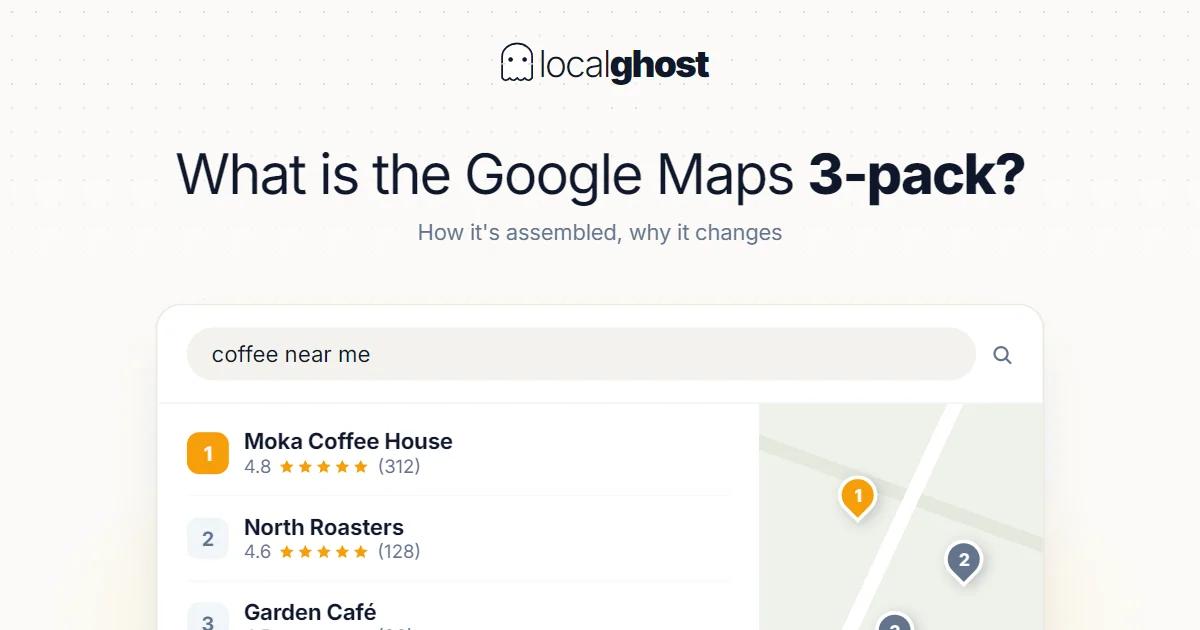
When someone searches for a service near them, Google usually shows a map with three business listings above the regular results. That block is the local pack — commonly called the 3-pack — and for most local businesses it is the single most valuable piece of real estate in search. It sits above the organic results, it carries a map, and it answers the searcher's question without them clicking anything.
It is also the least stable thing in local search. The same query returns a different 3-pack from two streets apart, businesses drop out overnight without any change on their end, and the block itself sometimes shows two results instead of three. Understanding why is the difference between reacting to noise and acting on signal.
What the local pack is, and what it is not
The local pack is a block of business listings drawn from Google Business Profile data, shown inside Search with a map. Three things about it are commonly misunderstood:
It is not the same as Google Maps results. The Maps app and maps.google.com show a longer list — often twenty or more businesses, scrollable. The 3-pack is a truncated view of a much larger ranked set. Being tenth in Maps and invisible in the 3-pack are the same underlying position, presented differently.
It is not always three. Google shows two listings for some queries, three for most, and occasionally a larger "local finder" style block for broad commercial searches. Paid placements can also appear inside or above it, labelled as sponsored, which pushes organic listings down without changing their organic rank.
It is not driven by your website. The listings come from your Business Profile. Your website matters — Google reads it to understand relevance, and it powers some of the "justification" snippets you see under listings — but the entity being ranked is the profile, not the page.
Below the three results there is a More places link. That leads to the local finder, where the full ranked list lives. It is worth checking your position there: if you are fourth or fifth, you are close, and the levers below are worth pulling. If you are thirtieth, the fundamentals need work first.
The three inputs Google states it uses
Google documents three factors for local ranking, and it is worth taking them at face value because they are unusually explicit for Google:
Relevance — how well your profile matches what was searched. This is where your primary category, your service list and your description do their work. A profile categorised as "Restaurant" is less relevant to "pizza delivery" than one categorised as "Pizza Delivery", regardless of what the menu says.
Distance — how far you are from the searcher, or from the location implied by the query. This is an input you cannot edit, and it is weighted heavily. It is the reason results shift block by block.
Prominence — how well known the business is. Review count and rating feed into this, along with mentions across the web, directory listings, and for some categories offline factors like brand recognition.
The practical reading: relevance is the one you control most directly and the one most businesses under-invest in. Prominence is a slower build. Distance is fixed. Most "why am I not ranking" questions turn out to be relevance problems dressed up as mysteries.
Why your 3-pack is not your customer's 3-pack
This trips up almost everyone who checks their own ranking. You search your service, you see yourself first, and you conclude you are ranking first. Then a customer tells you they could not find you.
Both of you are right. Distance is a ranking input, so the result set is assembled relative to where the search happened. Two searches from opposite ends of the same district can return two different 3-packs with only one business in common. Add personalisation — search history, whether you are signed in, whether you have visited the business before — and your own view is the least representative one available.
Two consequences worth internalising:
- Checking your rank from your own shop, on your own phone, tells you almost nothing. You are the closest possible searcher with the most biased history.
- A single position number is the wrong unit. "We rank third" is incomplete without "from where". The useful question is what share of your service area sees you at all.
If you want a defensible read, check from multiple points across the area you actually serve, in a clean session, and treat the pattern rather than any single result as the answer.
How heavily distance weighs changes by sector
Distance is a fixed input, but how heavily it weighs varies by sector, and this is the part of the local pack conversation most often skipped. The same goal — "get into the 3-pack" — means two different jobs for two different businesses.
At the tight end sit daily, repeated, low-ticket services. Someone looking for a salon picks one of three options within walking distance; going two districts over needs a real reason. That is why local SEO for hair salons and barber shops is almost entirely a neighbourhood-level race.
In restaurants the same proximity changes by meal: a few hundred metres at lunch, a fifteen-minute drive at dinner. How that elasticity gets managed on the profile is covered in the Google Business guide for restaurants.
At the other end are trades where distance loosens. People travel further for dental treatment because the decision is one-off and expensive — Google Maps SEO for dental clinics is built on that difference. In accommodation, proximity is narrow for a city hotel and close to meaningless for a resort; local SEO for hotels and accommodation treats that separately.
Then there are services where distance behaves like two different rules at once: tight for a taxi rank, loose for an airport transfer. The profile setup for a business chasing both is in taxi and airport transfer.
The practical consequence: set your target against how distance behaves in your sector. Trying to show up city-wide in a tight-proximity trade burns money; focusing only on your street in a loose one leaves demand on the table.
What actually moves you into the pack
In rough order of impact for a business that is not currently showing:
Primary category. The strongest single lever, and the most common mistake. Your primary category determines which query pools you are eligible for at all. Pick the most accurate specific option, not the broadest one, and add secondaries for the rest of what you do.
Profile completeness. Hours, services with descriptions, attributes, business description, phone, website, address precision. Incomplete profiles rank below complete ones with similar signals, and the gaps are usually five minutes of work each.
Review volume and recency. Both matter, and recency matters more than most owners expect. A profile with two hundred reviews where the newest is a year old reads as a business in decline. Steady arrival beats a burst.
Review replies. Replying is a visible signal of an active business and it is read by the next customer, who is the actual audience for your reply.
Photos, kept current. Recency again. A profile whose newest photo is eighteen months old looks abandoned to both Google and the searcher.
Consistent name, address and phone across the web. Directory listings and citations that disagree with your profile weaken the prominence signal. Fix the big ones — Apple Maps, Bing Places, Facebook, the major national directories for your country — and ignore the long tail of low-quality ones.
Posts and activity. Regular posting is a weaker signal than the items above, but it is a signal of an active profile and it costs little.
Notice what is not on the list: keyword-stuffing your business name. Adding "Best Plumber London" to a business legally called "Smith & Sons" is a guidelines violation, it is one of the most commonly reported forms of local spam, and profiles get suspended for it.
Reading a drop-out
Falling out of the 3-pack is alarming and usually explicable. The common causes, in order of how often they turn out to be the answer:
Someone else improved. The pack has three slots. If a competitor gained forty reviews or fixed their category, you did not get worse — you got passed. Check the businesses now showing above you and compare review counts, categories and completeness.
You changed something. Category edits, name changes, address changes and hours changes all reset signals. If the drop lines up with an edit, that edit is your suspect.
A Google update. Local ranking shifts happen and are not always announced. If the drop is broad, sudden and hits multiple keywords at once with no edit on your side, wait a week before acting; some of these partially revert.
Proximity filtering. Google suppresses listings it considers duplicative — multiple profiles at the same address, or in the same category with overlapping details. Businesses sharing a building with a similar business sometimes get filtered rather than ranked.
A guidelines problem. Suspensions and soft penalties follow name stuffing, fake addresses, virtual offices used as physical locations, and review manipulation. If your profile is suspended you will normally be told; if visibility collapsed without notice, review your recent edits against Google's guidelines.
A spam competitor. If the businesses above you have keyword-stuffed names, addresses that turn out to be residential when you check, or obviously purchased reviews, that is reportable through Google's Business Redressal Complaint Form. Documented reports do sometimes result in action, though the process is slow and unglamorous.
One thing not to do: panic-edit. Making five changes at once means you cannot tell which one helped or hurt. Change one variable, wait, measure.
What you cannot influence
Being clear about this saves money and frustration:
- Distance. You cannot rank well across a whole city from one address in a competitive category. If a distant area matters commercially, that is an argument for a second location or paid coverage, not more keywords.
- How many slots there are. Two, three or a larger block is Google's call per query.
- Whether ads appear above you. A competitor buying ads does not change your organic position, but it does change how far down the page you appear. Trackers that count ads as organic results will show a phantom drop.
- Personalised results. What a returning customer sees is shaped by their own history.
Frequently asked questions
Is it called the 3-pack or the local pack? Both, and they mean the same thing. Google's own documentation says "local results" and "local pack"; the industry says 3 pack, 3-pack or local 3-pack because three listings is the usual count. If you see someone talking about the Google 3 pack and someone else about the local pack, they are describing the same block.
How do I check my real 3-pack position? Check from multiple locations across your service area rather than from your own premises, in a signed-out session. Your own view is the most biased sample available. The More places link shows the fuller ranked list, which is more informative than the three visible slots.
Does having a website help my 3-pack ranking? Indirectly, yes. Google reads your site to understand relevance and uses it for some listing justifications, but the ranked entity is your Business Profile. A great website will not rescue a badly categorised profile.
How long does it take to enter the 3-pack? Profile fixes like category and completeness can register within days. Review and photo signals accumulate over weeks. In a competitive urban category, moving from outside the top ten into the pack is typically a multi-month effort, not a two-week one.
Do Google Posts affect 3-pack ranking? They are a minor signal at best. Post because it keeps the profile active and gives searchers something current, not because it will move you up the pack on its own.
Can I be in the 3-pack without a physical address? Service-area businesses can rank in local results without displaying an address, but they must serve customers at their locations and the address you register must be a real place you operate from. Using a virtual office or a mailbox is a guidelines violation and a common suspension cause.
Written by
Yunus Akan
Related tools: Grid rank tracking · Profile analysis · All local SEO tools