What Are Local Citations? How to Build Them?
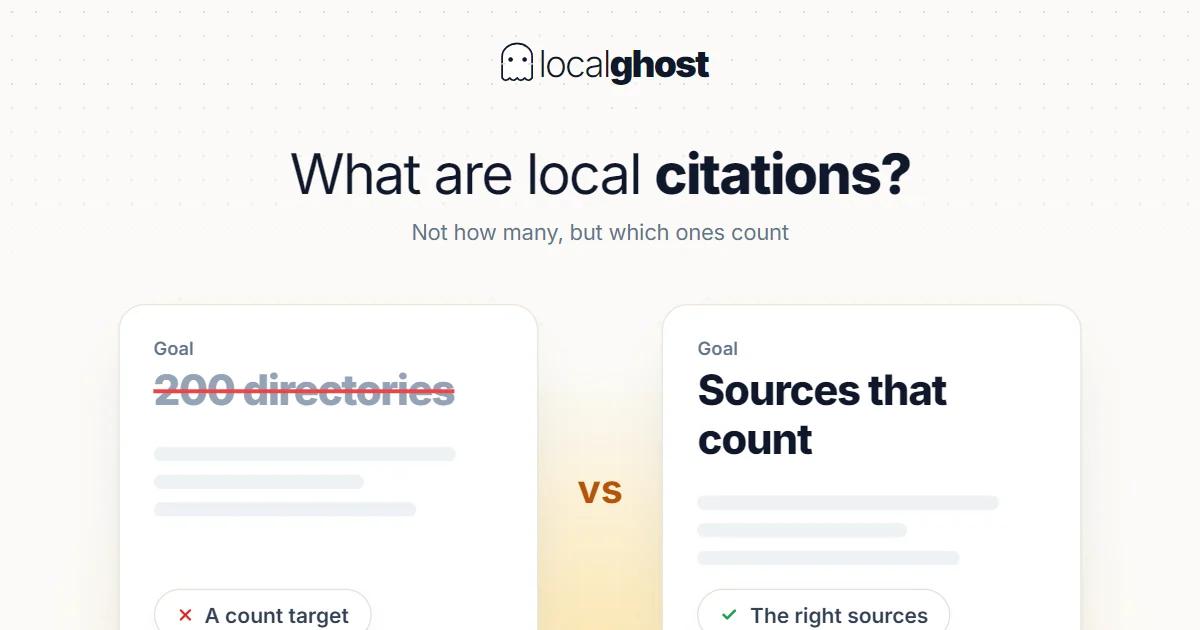
A citation is a mention of your business details somewhere else. Setting a count target breaks this work; which source counts is the real question.
In this article
Summarize with AI
A citation is a mention of your business name, address or phone somewhere on the web. A directory record, a business name in a news article, a trade association listing, an exhibitor entry on an event page — all citations.
Where the concept confuses people: citations get treated as the same thing as backlinks. They are not. A citation is a mention, a backlink is a link. A citation can contain a link, but it does not have to; your business name and phone appearing on a page is a citation even if that page never links to you.
That distinction matters in practice, because running citation work like link work puts the effort in the wrong place.
Structured and unstructured citations
There are two kinds and they are earned differently.
Structured citations are records where business details go into defined fields: directories, map platforms, sector platforms. Name, address and phone sit in separate fields. These are records you — or someone else — can create.
Unstructured citations are your business name appearing in free text: a news piece, a blog post, a forum thread, a local event announcement. No fields, just text.
The balance between them determines the quality of the work. A profile built only from directory records leaves a self-created trail. Unstructured mentions are the external, natural signal — harder to earn, and carrying more meaning.
How it feeds the prominence signal
Google documents three factors for local ranking: relevance, distance and prominence. Citations sit on the prominence side. The logic: if independent sources mention the same business with the same details, that forms a basis for believing the business genuinely exists and is known.
Two consequences follow, and both correct the common expectation:
- A citation is not a lever that lifts ranking. Adding a new directory record does not deliver a "two places up" gain. The effect is cumulative and indirect.
- Its absence, however, is a real disadvantage. A business mentioned nowhere looks weak beside a competitor in the same category mentioned in dozens of places.
For the whole mechanism: how the 3-pack works.
Which citations actually count
This is where most effort is wasted. The rough order of priority:
1. The major maps and platforms. Apple Maps, Bing Places, Facebook. They generate direct traffic and feed data to other services.
2. Your sector's main platforms. Ordering and reservation platforms in restaurants, booking sites in accommodation, appointment platforms in healthcare, listing sites in the motor trade. These are the records most seen and most clicked in your sector — so not only a signal but a real customer source.
3. Local and institutional sources. Chamber of commerce, trade bodies, professional associations, a chain or franchise listing you belong to, the directory of the industrial estate or shopping centre you sit in. These are valuable because they are hard to fake.
4. Your country's major general directories.
5. Local media and community pages. A local news site, a neighbourhood group, an events calendar. This is where unstructured citations come from.
The long tail outside these five groups — hundreds of auto-generated directories nobody uses — makes no measurable difference in practice.
How to earn them
The order matters, because work done in the wrong order creates correction work later.
- Settle the reference first. The name, address and phone on your Google profile should be final. Every other record opens against it. The consistency side is its own topic: why NAP consistency matters.
- Search for existing records. Your name is probably already in several directories; they harvest data automatically. Before creating a new record you have to find and claim the existing one, otherwise you are creating duplicates.
- Claim and correct. A claimed record both stays accurate and can be updated later.
- Then open the missing ones. In priority order, a few records in one sitting.
- Chase local sources by hand. Chamber membership, sponsorship, local event participation. These do not arrive automatically but they are the hardest to imitate.
None of this finishes in a week, and it does not need to: once the five priority groups are covered, the return on chasing the rest falls away quickly.
There is also an unusual route with the highest return: enriching the records where you already exist. Most businesses have a sector-platform record opened years ago and left half-finished — no photos, an incomplete service list, an empty description. Completing those half-records is faster and more effective than opening a new directory listing, because those platforms already carry real user traffic. Reviewing what you already have before hunting new sources is the most productive item on the list.
What does not work
Purchased citation packages. "We will add your listing to 500 directories" services target exactly the long tail that makes no measurable difference. Worse, those records are not under your control: when you move or change your number, hundreds of uncorrectable conflicting records remain.
Bulk automated submission. The same text stamped across hundreds of places both accumulates in low-quality sources and raises the inconsistency risk.
Setting a count target. A goal of "50 citations this month" pulls the work away from quality. The measure should be source quality, not quantity.
Listing in directories for work you do not do. Opening records in unrelated categories for reach produces demand that does not convert and a signal that confuses.
Cleaning up duplicates and conflicts
The most skipped half of citation work is the cleanup. Opening a new record is easy; finding the existing wrong one is hard.
The check is simple: search your business name and your phone number separately and open every record on the first two pages. You are looking for three things — an old address, an old phone number, and a second listing.
The third is the critical one: if two records exist for the same business, reviews and signals are split. That is a more serious problem than conflicting information, and it needs merging or closing.
How to measure citation work
This is one of the hardest kinds of work to show a return for, and the reason is choosing the wrong unit. Tracking citation count does not work; as the number rises it looks like nothing is happening.
Three things are measurable:
Direct traffic and calls from the source. When a sector-platform record is enriched, contact from it is directly visible. This is the most concrete return.
The number of inconsistencies. A falling count of conflicting records found in the audit is measurable progress, independent of ranking.
The number of duplicates. Getting to zero is the target; it is measurable and its effect is clear.
Trying to measure ranking against citations is the wrong setup: if the category, review and hours sides also moved in the same period, you cannot separate which one acted. The method side: how to track rankings.
Which sources lead, by sector
The priority order is general, but which group weighs most varies.
In restaurants and accommodation, sector platforms come almost before directories, because being there is not only a signal but bookings and orders directly — Google Business guide for restaurants and local SEO for hotels.
On the wholesale and B2B side, chamber, association and facility directories lead; the buyer is a professional and trusts those sources — wholesale food suppliers.
In healthcare, appointment platforms and professional body records are decisive; because promotion rules also apply, source selection depends on your own regulator — Google Business for doctors and clinics.
For businesses working by service area, records that require an address cause problems; in trades like removals, sources carrying an area definition and service list do more work — moving company SEO.
Frequently asked questions
Are citations and backlinks the same thing? No. A citation is a mention: your name, address or phone appearing somewhere. A backlink is a link to your site. A citation can include a link, but it does not have to.
How many citations do I need? A count target is the wrong framing. If the five priority groups are covered (major maps, sector platforms, local and institutional sources, your country's major directories, local media) the job is largely done.
Do purchased citation packages work? They target the long tail that makes no measurable difference, and they are not under your control. When you move or change a number they leave conflicting records you cannot correct.
There are records I did not create. Is that a problem? A common situation; directories harvest data automatically. The move is to claim and correct records on the priority sources and not chase the rest.
How much will citations lift my ranking? Not as a direct lever; the effect is cumulative and indirect. Its absence creates a disadvantage. It is more realistic to attach ranking expectations to category, hours and review flow.
I have two records for the same business. What should I do? This is more serious than conflicting information: reviews and signals are split. The records need merging, or the surplus one closing — not managing in parallel.
Written by
Yunus Akan
Related tools: Local SEO Audit · Post Management · Local Grid Scan · All local SEO tools