Effective Digital Marketing Strategies for Your Business
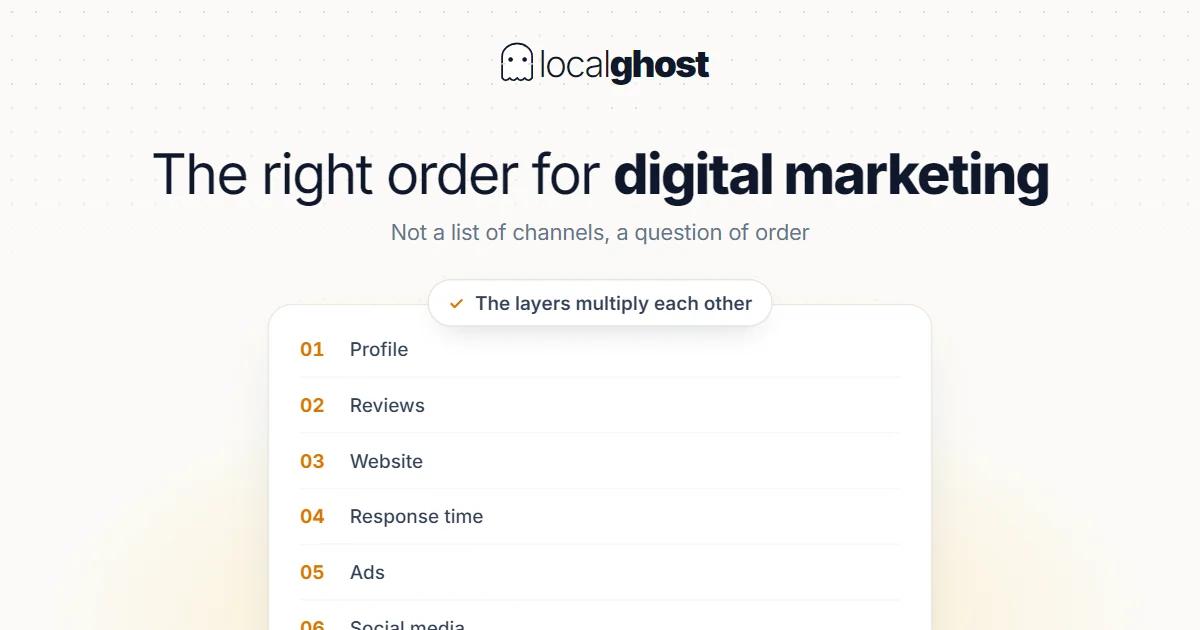
For a local business, digital marketing is not a list of channels but a question of order. Starting in the wrong order lowers the return on every later step.
In this article
Summarize with AI
The most common mistake in local business digital marketing is not choosing the wrong channel: it is doing a bit of every channel.
The result is familiar. There is an Instagram account, but posting is erratic. There is a site, but no pricing page. There is a profile, but the hours are out of date. Advertising was tried and switched off. None of it works fully and all of it eats time.
The problem is not missing channels but a missing order. Because these channels are not independent: the lower layer determines the return on the one above it.
The logic of the order: layers multiply each other
We are not picking the order arbitrarily; we are following where local demand actually forms.
Someone searching locally sees the result that arrives with a map, opens the profile, checks the rating, checks the hours, and calls. Most of the decision happens on that screen.
The order that follows:
1. Profile. The surface where demand forms. 2. Reviews. The signal the decision turns on. 3. Site. The home for what does not fit on the profile. 4. Messaging and response time. The point where demand becomes work. 5. Advertising. The lever that accelerates volume. 6. Social media. The channel feeding repeat business and referral.
The logic: advertising multiplies your existing conversion rate, it does not create one. A business with a weak rating and wrong hours gets clicks that do not convert. In the same way, social media does not work without something to show.
So money spent on an upper layer while the lower ones are incomplete multiplies the loss too.
1. Profile: highest return and most neglected
This is the first thing to build in a local business, and it usually gets skipped with "we already have one".
Existing and working are different things. The checklist is short: correct primary category, complete information, accurate hours, real photographs, a clear description.
Among those, the single highest-impact setting is the category: how to choose the primary category. The most expensive mistake is wrong opening hours: hours optimization.
For a consolidated checklist: 10 golden rules. How ranking is determined and what can actually be controlled: Google Maps ranking.
This layer takes days rather than weeks. Which is why it comes first.
2. Reviews: where the decision gets made
The second layer, and the highest-return one after the first.
Reviews work on two sides: they contribute to the prominence signal and they directly affect the decision. Choosing between two businesses, a customer looks at the rating and at the date of the most recent reviews.
Continuity matters more than count here. A batch every three months is weaker than a few every week: strategies for increasing reviews.
Replying is part of the flow too; an unanswered negative review reads as indifference to whoever sees it: review response templates and turning negative reviews into opportunities.
One boundary is firm: buying reviews or collecting them with incentives breaches policy and risks resetting your accumulation. There is no shortcut in this layer.
3. Site: the home for what does not fit
The third layer earns its meaning once the first two work.
The site's job is not competing on the map — the profile competes there. Its job is housing what does not fit on a profile, like pricing logic, process explanation and scope, and being a second door on the search side: website SEO for local businesses.
A small number of real pages does more work than dozens of thin ones. Pages duplicated with the district name swapped weaken each other.
On the technical side the items that genuinely matter for a local business are few and nearly all of them are mobile: mobile-first SEO. If you want to state the information precisely for machines: schema markup setup.
4. Response time: the quietest loss
This layer is a habit rather than a channel, and it usually never gets built.
Local demand is present-tense. The value of "is there space today", "are you open now" and "how much would it cost" decays within hours. A perfect answer two days later does less work than a short answer within the hour.
There is a change worth knowing here: the chat feature on the profile was removed, so inbound messages now shift to the phone or the site. The practical consequence is that the phone and the contact route on your site matter more than before: WhatsApp Business and the Google profile.
Regularly checking that booking and appointment links work is part of this layer too: booking platform links.
Not opening a channel you cannot answer is also a strategy; an unanswered message creates a worse impression than a channel that never existed.
5. Advertising: the lever that accelerates volume
The fifth layer is most efficient once the four beneath it work.
What advertising buys is clear: immediate presence, query control, time-bound campaigns and distance flexibility. In organic local results you have no control over distance; in advertising you draw the targeting yourself.
Two points are critical in setup: location assets, and counting calls as conversions. Skip both and advertising optimises the wrong thing for a local business: Google Ads and local businesses.
What advertising cannot fix is equally clear: a low rating, wrong hours, an unanswered phone. Which is why it sits fifth rather than first.
6. Social media: the channel feeding repeat business
The last layer, the most overhyped and the one whose local effect gets described most wrongly.
The honest frame: social media does not change map ranking. What it does is show the quality of your work, retain existing customers and accelerate referral: Instagram strategies for local businesses.
Its payoff varies sharply by sector. In trades with visual output it is a meaningful investment; in immediate-need trades the same hour spent on the profile returns far more.
Visual production follows the same distinction: real photographs win in the profile's permanent photo set, while designed graphics work for time-bound announcements: designing post visuals.
Wasted effort: work to cut
As important as the order is the list of things not to do.
Submitting to hundreds of directories. Beyond a handful of priority sources, the long tail makes no measurable difference: what local citations are.
Calculating keyword density. It damages readability and returns nothing.
Producing a page per neighbourhood. The pages weaken each other.
Buying followers or reviews. One does not work, the other breaches policy.
Aiming to go viral. Reaching people who cannot come does not change the appointment book.
Perfecting site speed. After the obvious problems are fixed the remaining gain is small.
Measurement and routine
Keeping this structure standing depends on a routine, because campaigns end and routines remain.
On measurement, two things need separating: profile data shows actions, not revenue. You have to build the chain between them from your own records — and the most valuable data source is free: "How did you find us?": how to calculate the return on local SEO and reading the statistics.
On the routine, ten minutes weekly and half an hour monthly is enough: weekly maintenance calendar.
If you are starting from zero, the first thirty days are already mapped: 30-day plan for a new business.
Frequently asked questions
Which channel should I start with? The profile. Local demand forms there and this layer takes days. Money spent on an upper layer while lower ones are incomplete multiplies the loss.
Would advertising not produce faster results? It produces fast results but multiplies your existing conversion rate rather than creating one. With a weak rating and wrong hours, ads get clicks that do not convert.
Will social media lift my local SEO? No. Map ranking is computed through relevance, distance and prominence; follower count is not in that calculation.
Can I manage without a website? You can. The profile is what appears on the map; the site is a supporting layer. But in sectors where price and scope need writing down it makes a real difference.
Is budget or time the scarcer resource? Usually time in a local business. Which is why putting the owner's hours into the return calculation shows which work should be delegated.
Can I skip this order and do everything at once? You can, but inefficiently. The layers multiply each other; while a lower one is incomplete, the return on the one above stays low.
Written by
Localghost Team
Related tools: Review Management · Local SEO Audit · Free Photo Geotag Tool · All local SEO tools