Google Business Profile SEO Guide: 10 Golden Rules
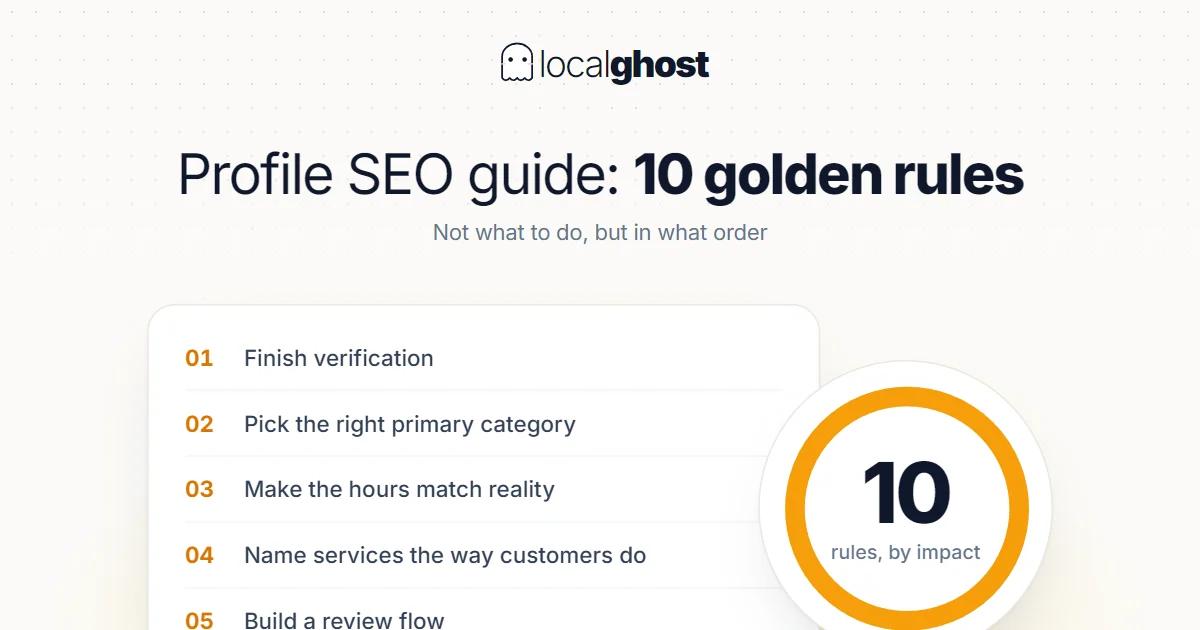
The problem in profile optimisation is not knowing what to do, it is knowing in what order. Ten rules, ordered by impact.
In this article
Summarize with AI
The real problem in profile optimisation is not knowing what to do. The to-do list is already circulating: pick a category, upload photos, collect reviews, publish posts. The problem is order. Two businesses working the same list in different sequences do not get the same result, because some jobs sit on top of others, and if the bottom is wrong the top is wasted.
This guide gives ten rules ordered by impact. Each one says why it sits where it does, because a list applied without understanding the order gets scrambled again.
What the profile is and which surfaces it feeds is a separate topic: what is Google Business Profile.
1. Complete verification
This comes before everything, because on an unverified profile most of the fields you fill in do not run. Photos do not appear, some fields never go live.
Optimising a profile with verification half-finished is like decorating a closed shop. This is the first thing to check.
2. Get the primary category right
The strongest single field, and it sits second for this reason: the category does not rank you, it makes you eligible to rank. A business in the wrong category is outside the race for that query; how good it is never gets asked.
The measure is not the business's history but its revenue body. Pick the most accurate and narrowest option rather than the broadest, and use secondaries for the rest: how to choose the right category.
This rule is second because everything below accumulates inside the pool the category defines. If the category is wrong, reviews and photos accumulate in the wrong pool.
3. Make the hours match reality
Hours are not an information field but a filter: an "open now" search eliminates a business whose hours are wrong. Showing as closed while open means losing the most motivated demand there is.
Special days, break hours and ranges crossing midnight are the technical work here: hours optimization.
Third, because after the category this is the fastest and cheapest gain — and left unfixed it eats the return on all the other effort.
4. Fill the service list in the customer's language
After the category, the most direct relevance signal. Each service as its own entry, in the words customers use rather than your industry terminology.
Filling this list is also how you move the output of keyword research onto the profile: local keyword research.
5. Build a review flow, not a target
Reviews are the most visible prominence signal and the thing customers look at hardest when deciding. But planning it as "let's collect fifty reviews" is wrong: that target completes once, the field freezes, and six months later the profile looks stale.
The right setup is a flow: one or two a week beats thirty in a month. The methods and the prohibited tactics: increasing Google reviews.
Fifth because it takes time; it needs to start early but it does not close a category mistake on its own.
6. Reply to reviews
Replying does two jobs: it signals an active business and it is text read at the moment of decision. The real audience is not the reviewer but the next customer reading it.
Ready patterns and writing rules: review response templates. Triaging a negative review is a separate topic: turning negative reviews into opportunities.
7. Complete photo coverage, then keep it fresh
A coverage target rather than a count target: exterior, interior, the result of the work, the team, products or menu where relevant. Once coverage is complete, what matters is the date of the newest photo.
You also do not choose the cover photo — Google chooses from the pool, so the job is keeping the whole pool good: photo optimization.
8. Write the description for conversion
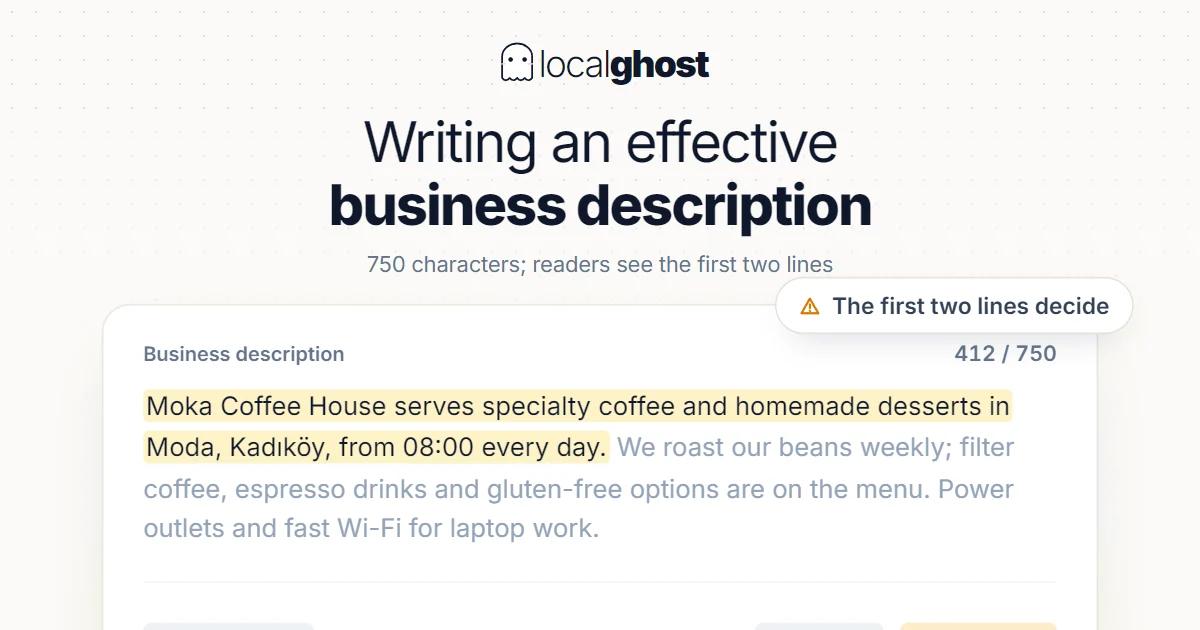
750 characters is a weak ranking signal but a strong conversion surface: the person comparing you with two competitors reads it. The first sentence has to carry the message alone, because most readers never tap "more": how to write the description.
Eighth because its ranking contribution is limited; but its conversion contribution is high enough that it should not be skipped.
9. Get consistency across the web
Conflicts in name, address and phone weaken the prominence signal. But this work turns into a job with no end very easily: chasing hundreds of low-quality directories makes no measurable difference.
Five priority groups are enough: the profile, the major maps, sector platforms, your own site, your country's major directories. Detail: NAP consistency and what are local citations.
10. Use posts only if you have something to say
Posts come last because they are the weakest signal — but in some sectors they bring work directly. The distinction: a post works when it carries information that does not fit the profile's fixed fields. Today's price, this week's produce, Saturday's availability fit none of them.
In a business whose service is stable all year, forcing a weekly post produces empty content: how to schedule posts.
What is not on the list, and should not be
Stuffing keywords into the business name. Turning a business called "Smith Autos" into "Smith Autos Best Inspection" is a guidelines violation, one of the most reported forms of local spam, and a suspension cause. That it appears to work short-term does not change it.
There is one more thing not on the list: distance. One of the three factors Google documents, and it cannot be edited. In a competitive category you do not cover a whole city from one address; if a distant area matters commercially, the answer is a second location or paid coverage. The mechanism: how the 3-pack works.
The one situation that changes the order
The order above is for a new or neglected profile. The single exception: if the profile was already working and then dropped, the order changes. In that case the first place to look is the most recent edit, then competitor activity, then whether the review flow has stopped.
Reading a drop is its own topic, and panic-changing five things at once is the most expensive mistake: change one variable, wait weeks, measure the same way.
How to measure
After each rule, the answer to "did it work" sits in two different places:
The profile report gives contacts that happened — calls, directions, clicks. Impressions mislead on their own and have to be read next to actions: reading the statistics.
Ranking measurement is a separate job and is not in the report. A single position number is the wrong unit; how much of your service area sees you is the right question: how to track rankings.
Frequently asked questions
How long does it take to work through these ten rules? The first four are a few hours of work. Review and photo flow spread over weeks. In a competitive category a visible difference is measured in months.
Which one makes the most difference? The primary category. If it is wrong, everything else accumulates in the wrong pool.
Can I do them all at once? You can, but then you cannot attribute the result to any of them. On a new profile filling everything is right; when improving an existing one, changing a single variable is more informative.
Why are posts last? They are the weakest contributor to ranking. In some sectors they bring work directly, but posting while the other nine are incomplete is an ordering error.
A competitor outranks me. Which rule should I look at? Compare their category and review count first. If the gap is reviews it is a flow problem; if it is the category it is a matching problem; if both match it is probably distance — how to do competitor analysis.
My profile is good but the phone is not ringing. What is missing? If impressions are there and actions are not, the problem is not visibility but what is on the profile: the description, photo coverage and review replies are what get read at the moment of decision.
Written by
Yunus Akan
Related tools: Review replies · Map rank tracking · Add GPS to photos · All local SEO tools