Mobile-First SEO Strategies
Mobile is not a design preference, it is the basis of indexing. But in a local business most of the mobile job finishes on the profile, not the site.
In this article
Summarize with AI
The most common misunderstanding about mobile is treating it as a design matter. It is not: it is the basis of indexing.
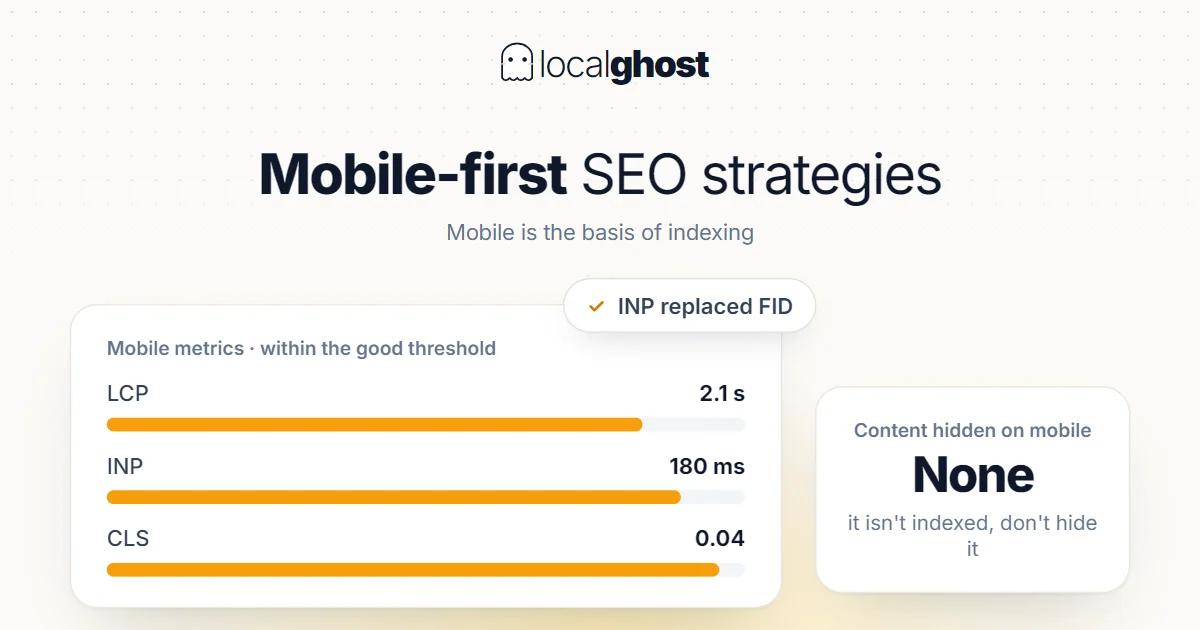
Google now crawls and indexes pages with the mobile crawler. What gets evaluated on the search side is your site's mobile version. Content visible on desktop but hidden on mobile becomes, in practice, content that does not exist.
But in a local business there is another layer, and it sets the priority: most of the local journey finishes without ever touching your site. The user searches from the map, gets directions, checks hours. The mobile form of that surface is not your design, it is your profile: what Google Business Profile is.
Content hidden on mobile does not get indexed
This is the most concrete practical consequence of mobile-first indexing, and it remains a frequent mistake.
In responsive design, hiding content on small screens is easy. A section removed "to reduce clutter on mobile" — a service explanation, an FAQ, a price table — can be disregarded on the search side if it is absent from the mobile version.
Checking is simple: open the page on a phone and compare it against desktop. If there is a difference, the mobile side should not be the one missing something.
Content inside tabs and accordions is a different case: as long as it is in the source, it is not a problem. The real issue is content that never loads on mobile.
This connects to why service pages need to be complete on mobile: website SEO for local businesses.
Core Web Vitals and the INP change
An important change happened in page experience measurement in 2024, and older content still describes it wrongly.
Core Web Vitals consist of three measurements: LCP (how long the largest content element takes to load), INP (the time from an interaction to the next paint) and CLS (visual shifting).
The critical change: INP replaced FID on 12 March 2024. Chrome dropped support for FID with that transition, giving developers until September 2024 to move over. So if you are reading a report that still measures FID, you are looking at a metric that no longer applies.
The difference matters: FID measured only the delay of the first interaction. INP evaluates responsiveness to interactions throughout the session. That is a harder bar for sites running heavy JavaScript.
One more distinction: these metrics are assessed using field data — collected from real Chrome users, typically at the 75th percentile across a window spanning weeks. Which is why a page scoring well in a lab test can fail in the field, and the reverse.
Being honest about how much these weigh
Core Web Vitals are a page experience signal, but not the deciding lever in local search.
Whether you appear in the local pack is decided largely on the profile side and through location. Perfecting site speed does not change your visibility on the map: how the 3-pack works.
That means prioritisation: fixing the obvious problems is essential, perfecting them is not. Shrinking heavy images and removing unnecessary scripts delivers most of the gain on the majority of local sites. After that, remaining time returns more when spent on review flow: strategies for increasing reviews.
What genuinely matters on mobile for a local business
Technical checklists get long, but the items that pay off for a local business are few.
A tappable phone number. Calling is the highest-intent action in local search. The number being one tap away and not baked into an image is a baseline requirement.
A working directions link. Having the address wired to a map answers "where" in a single tap.
Touch targets big enough. Small links sitting side by side produce wrong taps.
A form usable on a small screen. Long forms do not get completed on mobile. Name, phone and one message field is enough for most local trades.
No interrupting overlays. A newsletter or cookie layer covering the screen sends the arriving user back.
Hours on the first screen. "Are they open now" is the most frequent question in mobile local search: hours optimization.
The mobile form of the profile side
In a local business the profile carries most of the mobile experience, so these checks come before the site.
Do the photos read on a small screen? A distant, busy photo says nothing on a phone. Close and clear imagery is needed: photo optimization.
Does the first line of the description work? The full text is not visible on mobile; the first sentence decides: how to write the description.
Do the action links work? Appointment, booking and ordering links need testing on mobile; an engine that works on desktop may not let you pick a date on a phone.
Are review replies readable on mobile? Long paragraphs do not get read on a phone. Short, direct replies do more work: review response templates.
Measurement: separating mobile from desktop
Looking at totals hides the mobile problem, because mobile and desktop behaviour differ markedly.
Checking the device breakdown in Search Console is the first step. Queries taking impressions but no clicks on mobile can point to titles and descriptions being cut off on small screens.
On the page experience side you need field data; a lab test alone is not enough. Improvements also take time to appear in the report, because the measurement is calculated over a window spanning weeks. Do not expect today's fix to show tomorrow.
Profile-side data is a separate world again and does not appear in site reports: reading the statistics.
How much mobile weighs by sector
Immediate-need trades. In taxi and transfer work nearly all traffic is mobile and the single action is calling; the phone being answered decides more than site speed: taxi ranks and airport transfer.
Food and drink. "Open now" and the menu are the two most-sought things on mobile: Google Business guide for restaurants.
Accommodation. The booking engine working on mobile touches revenue directly: local SEO for hotels.
Trades where price gets asked. In removals the mobile user sends photos; a form that accepts files speeds the job up: moving companies.
Appointment trades. In healthcare the mobile appointment flow needs to be short; long forms get abandoned: Google Maps SEO for dental clinics.
Frequently asked questions
What does mobile-first indexing mean? Google crawls and indexes pages with the mobile crawler; the version evaluated is the mobile one. Content that does not load on mobile can be disregarded in practice.
Is FID still measured? No. INP replaced FID on 12 March 2024 and Chrome dropped FID support. A report showing FID is out of date.
What is the difference between INP and FID? FID measured only the delay of the first interaction; INP evaluates responsiveness to interactions across the session. It is a harder bar for JavaScript-heavy sites.
Will site speed improve my local rankings? It is not the deciding lever. Local pack visibility is decided largely through the profile and location. Fix the obvious problems; perfecting them is unnecessary.
Can I hide content on mobile? Better not to. Content that never loads on mobile may not be indexed. Sitting inside a tab or accordion is fine.
I made improvements, so why has the report not changed? Page experience metrics are calculated from real user data over a window spanning weeks. It takes time to show.
Written by
Yunus Akan
Related tools: Profile analysis · All local SEO tools