Booking Platform and Google Business Integration
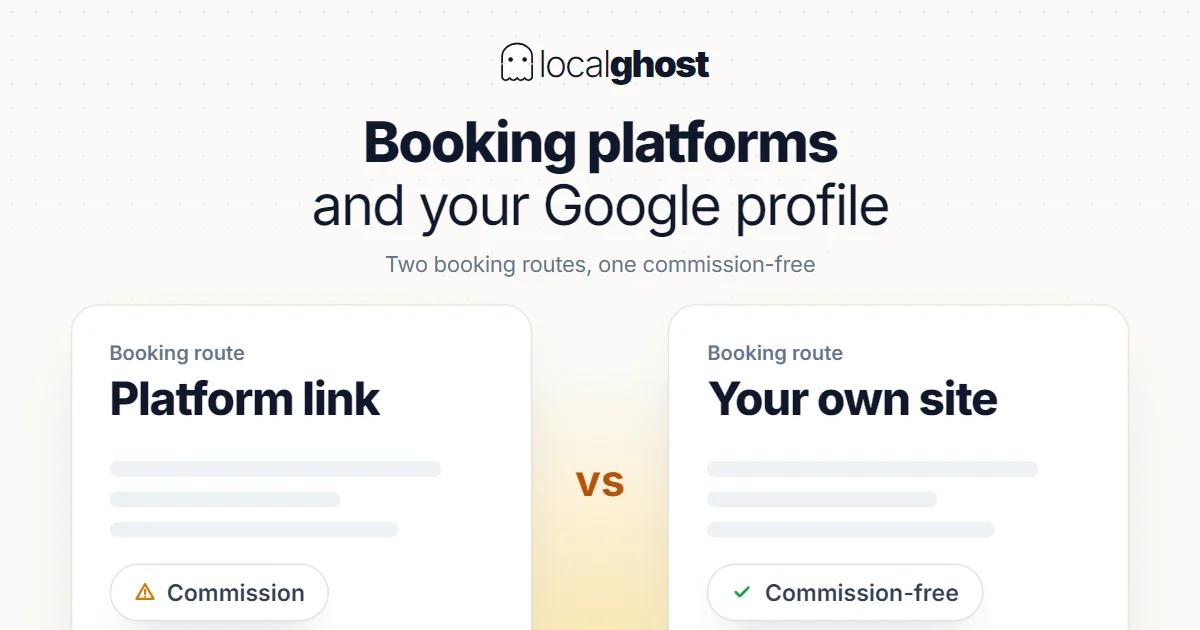
There are two separate booking routes on a hotel's Google profile, and one carries commission while the other does not. Knowing the difference touches revenue directly.
In this article
Summarize with AI
Hoteliers usually ask this as one question: "how do I connect Booking.com to my Google profile?" But there are two different mechanisms inside that question, and conflating them costs money.
First, OTAs appearing on Google. Platforms like Booking.com are among the partners that show prices and availability in Google's hotel results. You do not set that visibility up; the platform arrives there with its own inventory. If you have a contract listing your hotel with them, you appear.
Second, your own booking link. On Google's hotel side there is a link field that takes the guest directly to your own site. And here Google's documentation sets a very clear condition: that link must take a guest who clicks through to your own website to book directly with you, not to a third party.
That single sentence determines the whole economics of the topic.
The economics of the two routes
Same guest, same search, two different outcomes.
A booking arriving through an OTA carries commission. The platform provides visibility and takes a share of the room revenue in return.
A booking arriving through your direct link carries none. The guest books on your own site.
The critical point: these two are not alternatives to each other, they sit side by side on the same screen. Being listed on an OTA does not block your direct link, and setting up your direct link does not mean cancelling the OTA.
The practical consequence: not setting up the direct link means handing a booking that could have arrived commission-free to a commissioned channel. It is the most concrete financial improvement available on a hotel's Google profile.
The conditions for your own link
Because Google's condition is clear, applying it is clear too: the page the link goes to must be on your site, and a booking must be completable there.
Common mistakes that break those two conditions:
Linking to the homepage. The guest arrives ready to pick dates and a room, lands on a homepage, and goes back to the search engine.
Redirecting to an OTA. Putting a third-party address in your own link field is against the condition.
Linking to a page where no booking happens. A "contact us" or "ask for a price" page is not a page where a booking completes.
Linking to an engine that fails on mobile. The overwhelming share of traffic is on phones; an engine where dates cannot be picked on a small screen makes the link useless: website SEO for local businesses.
Room rates and availability need keeping current as well. If the price shown on the site differs from the price in the engine, the guest loses trust.
Beyond hotels: appointment and ordering links
The topic is not limited to hotels. Google's business links are fields that let customers book appointments or place orders online.
But there is an important boundary, and Google states it plainly: not every business is eligible for every link type. Google's own example is illustrative — hair salons can offer appointment booking but are not eligible for online ordering links.
Which means: if a link field does not appear on your profile, that is not necessarily a fault; your category may not be eligible for that link type. This is one of the places where category choice determines which fields open up: how to choose the primary category.
Another boundary is technical: you cannot enter any address you like into the link fields. For certain attributes, addresses outside a supported platform list can be rejected. So "I have a booking system" is not always enough; the system may need to be a supported provider.
Provider integration versus a plain link
There are two setup routes, and what the customer sees differs.
A plain link. You enter an address, the customer clicks, they go to your site. Simple, fast, entirely under your control.
Provider integration. If your booking system is a provider integrated with Google, availability can appear on the profile itself. On the restaurant side this means a deep link to availability being shown from the profile — the customer sees a suitable time without leaving the search screen.
When you set up through a provider, do not expect it to appear immediately: per Google's documentation, booking providers show up on your profile within about a week. That delay matters for anyone planning an opening or a season start: profile management for seasonal businesses.
Dropping a provider or replacing it with your own link is also possible; the setup is not a permanent commitment.
Measuring where a booking came from
This is the measurement problem hoteliers complain about most: separating a booking that came from Google from one that arrived directly.
Google provides a mechanism for it. The action links Google generates carry a unique query parameter marking that click. By storing that token and returning it when a booking completes, the conversion can be tied back to its source.
In practice: if your booking engine or your developer captures and records that parameter, you can answer "how many bookings came from the Google profile" with a number rather than a guess.
Without that measurement, the only data you hold is the click count on the profile — which does not tell you whether the click became a booking: reading the statistics.
The most common loss: a broken link
The thing that single-handedly wastes all this work is the link breaking quietly.
When the booking engine changes, when the system provider is updated, or when a subscription lapses out of season, the link on the profile carries on pointing at the old address. Nobody gets an error message; only your most intent-driven user disappears.
The only way to check is to click it. That needs tying to a habit: weekly and monthly maintenance calendar.
Two further checks are worth more. First, confirming the link works on mobile. Second, comparing the click count on the profile against session counts in the engine; a large gap means the link either goes to the wrong page or is broken.
OTA reviews and Google reviews are separate worlds
A question hoteliers ask often: does my Booking.com score carry over to Google?
It does not. The two platforms' reviews accumulate and display separately. A high score on an OTA does not change the average on your Google profile.
The practical consequence is a gap most hotels have not noticed: a hotel with hundreds of OTA reviews sits on Google with a few dozen. Yet the average shown on the map and in search is the Google one.
The fix is directing the post-stay review request to the Google side as well: strategies for increasing reviews.
One caution: OTA contracts can contain restrictions on guest contact. You need to check the terms of your own agreement.
The equivalent in non-accommodation sectors
Food and drink. A reservation link and table availability; availability appearing on the profile lets people decide without leaving the search screen: Google Business guide for restaurants.
Healthcare. The appointment link is the highest-return field, though the system may need to be a supported provider: Google Maps SEO for dental clinics.
Personal services. In a salon an appointment link is eligible and online ordering is not — that is Google's own example: local SEO for hair salons.
Quote-based trades. In work like removals there is a quote form rather than a standard booking; the page the link leads to has to be genuinely capable of taking a quote request: moving companies.
Multi-property structures. Each property should carry its own booking link; one central link leaves the guest to pick a property themselves: multi-location management.
Frequently asked questions
Can I connect Booking.com to my Google profile? Putting a third-party address in your own booking link field is against the conditions: Google requires that link to take the guest to your own site to book directly with you. OTAs appear separately in Google's hotel results through their own partnerships.
Does setting up a direct link mean cancelling the OTA? No. The two can sit side by side on the same screen. Not setting up the direct link means handing a commission-free booking to a commissioned channel.
Why is there no appointment link field on my profile? Not every business is eligible for every link type. In Google's example hair salons can take appointments but are not eligible for online ordering links. Your category can be the deciding factor.
I added my booking provider but it is not showing. Per Google's documentation, providers appear on the profile within about a week. Factor that delay into any opening plan.
How do I see how many bookings came from Google? Google's generated action links carry a parameter marking the conversion; if your engine records it, you can tie the booking to its source. Without that setup you are left with click counts only.
Does my Booking.com score carry over to Google? It does not. The two platforms' reviews accumulate separately. The average shown on the map is the Google one, so review requests need directing there too.
Written by
Yunus Akan
Related tools: SEO audit tool · All local SEO tools