Google Maps SEO for Moving Companies
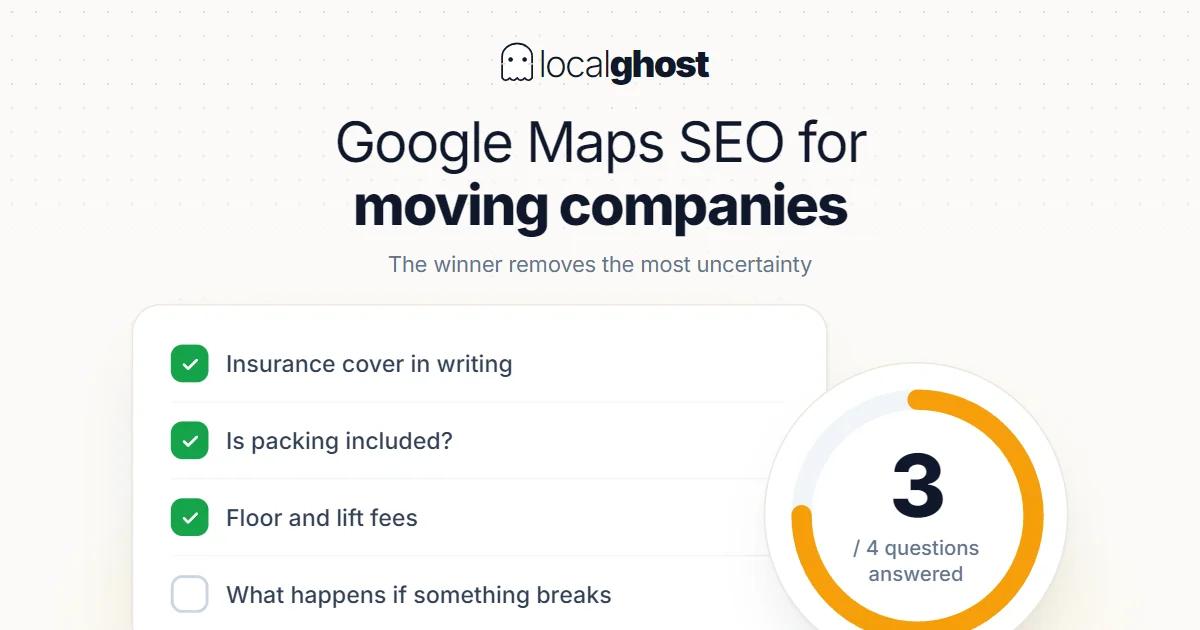
In moving, customers request three quotes at once. The winner is rarely the cheapest — it is the one that removed the most uncertainty before the call.
In this article
Summarize with AI
In the moving business, customer search behaviour looks like no other local sector: they search without knowing the price, and they contact three companies at once.
Someone relocating types "moving company near me", opens the first three or four results, asks all of them for a quote and compares. So appearing in Maps is only the start of the race; the real contest happens at the quote stage.
And what decides it is rarely the lowest price. Customers in this sector carry two specific fears:
- Surprise charges. "The lift is extra", "there's a floor surcharge", "packing materials aren't included" — line items that were not mentioned on the phone.
- Damage to belongings. Who is liable, and whether insurance actually covers it.
The company that wins is usually not the cheapest but the one that removes those two uncertainties most convincingly. Your profile can do that before the quote stage even begins.
Removing uncertainty on the profile
Most moving-company profiles amount to a phone number and a line about years of experience. Yet everything the customer would ask on the phone can be answered on the profile — and when it is, two things happen: unsuitable customers stop calling, and suitable ones arrive focused on the service rather than haggling.
What belongs in the services list and business description:
What the price includes. Packing materials, disassembly and reassembly, lift or hoist use, floor surcharges, weekend rates. Listing what is included *and what is not* closes off this sector's single biggest complaint before it happens.
Whether you survey. A free pre-move survey is both a trust signal and the route to accurate pricing. If you offer it, say so plainly; if you do not, explain how the price is determined instead (room count, floor area, inventory list).
Insurance position. Whether goods are insured in transit, what the cover includes and what the limits are. This is the most-asked and least-published piece of information in the sector.
Equipment. External hoist or lift service, carpentry, specialist items (piano, safe, aquarium). These are niche searches with low competition.
Service area and long distance. Local only or long distance, and which routes. Customers search their own route.
Category choice decides which of these jobs reaches you: how to choose the right category.
Local and long-distance moves are two different businesses
This distinction directly shapes your profile setup, and confusing the two brings the wrong customers.
Local moves are a genuinely local service and proximity is a real ranking input here. Customers look for a company near their own area because it feels right on both trust and cost. In this demand, defining your service area realistically and being specific at district level pays off.
Long-distance moves are not geographically local at all. The customer is moving from one city to another and does not care which district your yard is in; they care about the route, the date and the price. Proximity is nearly meaningless here, and what decides it is reviews and route information.
Practical consequence: if you do both, list them separately in your services. If you only do long distance, do not spend effort on proximity-focused optimisation — put it into reviews and route content instead.
Service-area setup and the common mistake
Most moving companies do not have an office that receives customers; they have a yard or a depot. In that case the profile should be set up as a service-area business: the address is hidden and the areas served are defined.
The most common mistake is presenting a depot address as a normal business address. Google's rules expect a real business location, and if it is not somewhere customers can visit, the service-area setup is the correct one. A virtual office, or an address with nothing but a sign, is a suspension risk.
Be realistic when defining the area, too. Marking an entire country as your service area does not create visibility; Google reads it as a coverage statement, not a ranking guarantee. Worse, taking on demand you cannot serve turns into negative reviews.
Businesses that hide the address and work by service area only have their own setup: local SEO for home-based service businesses.
Reviews: the highest-risk area in this sector
Moving is one of the sectors where a negative review does the most damage. The reason is simple: the customer is living through one of the more stressful days of their life, and when something goes wrong they write about it in detail.
Reviews are almost always about one of four things:
- Surprise charges — the most common and the most damaging
- Damage and the liability argument that follows
- Lateness — the crew not arriving when promised
- Crew conduct — communication during the move
The first is entirely preventable, and the way to prevent it is transparent pricing on the profile. The other three are operational, but your reply changes what the next reader concludes.
The approach that works in replies: be concrete. "We apologise" does nothing in this sector, because the person reading already heard about the damage and the extra charge. A reply that says what changed — "packing is now shown as a separate line in every quote", "we've introduced a 48-hour damage claims process" — is what builds confidence with the next customer.
On collecting reviews, this sector has one advantage: when the move is done, the customer is relieved, and that is the most effective moment to ask. A request made as the crew carries in the last box converts far better than an email a week later.
Do not offer discounts in exchange. It violates Google's policy, and enforcement risk is higher here precisely because the practice is widespread.
How a reply to a damage or delay complaint becomes a recovery tool: turning negative reviews into opportunities.
Photos: trust is built visually in this sector
In moving, the only physical things a customer will see are the vehicle and the crew. Profile photos therefore touch trust directly.
- Vehicles, with plates and branding visible. A branded truck is the most concrete evidence that you are a real operation.
- Packing materials and process. Bubble wrap, boxes, furniture covers — customers want to see how their things will be protected.
- Hoist or external lift, if you have one. This single image pulls niche demand on its own.
- The crew, in uniform. Seeing the people who will enter the house is a deciding factor, especially for customers living alone.
- The depot — if you offer interim storage.
Do not use stock moving photography. It is the easiest thing to spot in this sector and it reads as a company without its own trucks.
Season and capacity management
Moving is seasonal work: summer months, tenancy cycles and month-ends are busy. That affects profile management in two ways.
Capacity signalling in peak season. If your calendar is full, saying so beats collecting "called, never heard back" reviews. A post saying "we're fully booked for the next two weeks, taking bookings for later dates" reads as professional and pushes demand forward rather than losing it.
Visibility in the off season. Keeping the profile active during slow periods — photos, posts, review replies — pays off when the season opens, because activity signals accumulate rather than switching on instantly.
Keep hours honest as well. Moving starts early, but customers research and call in the evening. A profile showing 09:00-18:00 greets the customer researching at 19:00 with "closed".
Frequently asked questions
I have no office, only a depot and vehicles. Can I have a profile? Yes, as a service-area business. The address is hidden and the areas you serve are defined. Presenting a depot that does not receive customers as a normal business address breaks the rules, and a virtual office is a suspension risk.
Do I have to publish prices? An exact price is not possible, since it depends on volume and distance. But you can publish what is included, and doing so closes off this sector's biggest complaint in advance: packing, hoist, floor surcharge, disassembly — what is in and what is not, listed separately.
Will adding the whole country as my service area make me more visible? No. The service area is a coverage statement, not a ranking guarantee. Taking demand you cannot serve turns into negative reviews, and an inflated area weakens your credibility.
I only do long-distance moves. Does proximity matter? Barely. A long-distance customer does not care which district you operate from; they look at route, date and price. Review volume and route information decide it. Proximity is a genuine ranking input for local moves only.
There is a damage complaint in my reviews. How should I reply? Be concrete. "We apologise" is not enough, because the reader has already heard about the damage. A reply that explains your claims and compensation process builds confidence with the next customer. Do not argue liability under the review — move that conversation off the platform.
When is the best moment to ask for a review? When the move is finished, as the crew brings in the last box. The customer is relieved and response rates are highest. An email a week later converts far worse.
Written by
Yunus Akan
Related tools: Grid rank tracking · Profile analysis · AI review responses · All local SEO tools