Google Maps SEO for Vehicle Inspection Services
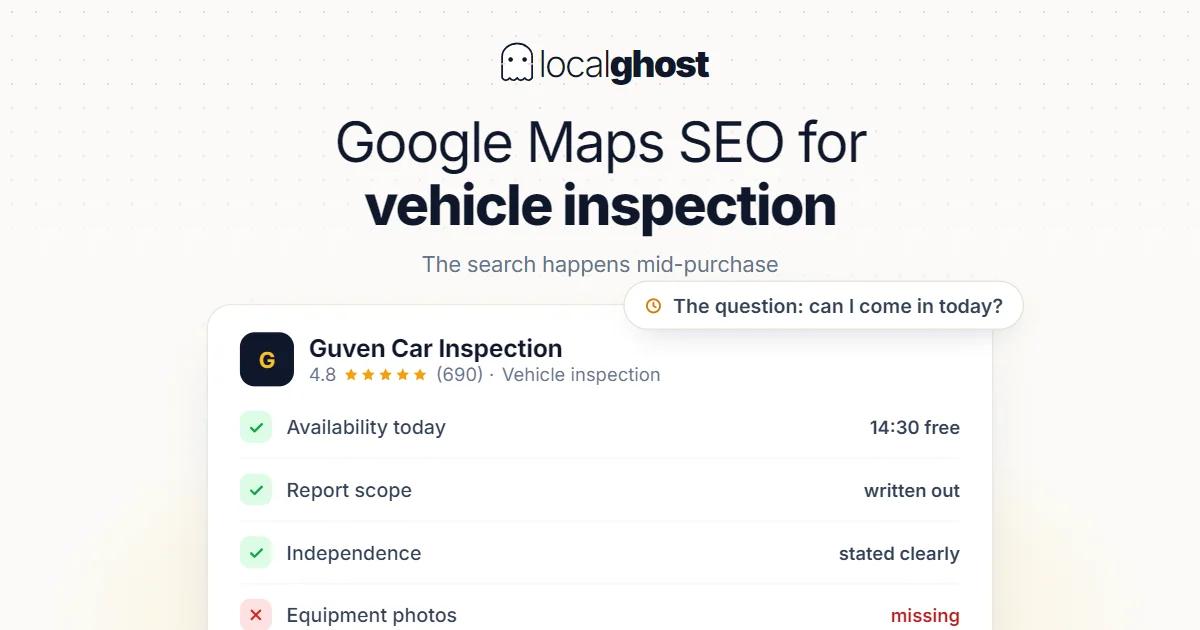
In vehicle inspection the search happens in the middle of a purchase decision. Which is why the question before ranking is: can I come in today?
In this article
Summarize with AI
In the vehicle inspection business the timing of the search separates this sector from every other local trade: when the customer searches, they are in the middle of a purchase decision.
They have found a car, spoken to the seller, and are close to agreeing a price. One thing is left: whether the car is what it was described as. And they have no time to find out — the seller is showing the same car to other buyers, no deposit has been paid, and within a few days the deal either happens or collapses.
The practical consequence of that timing: in this sector the question that comes before ranking is "is there an appointment today". An inspection centre ranking first that says "Wednesday at the earliest" loses the job to the one ranking third that says "come in two hours". The real job of profile optimisation here is to give that answer before the customer picks up the phone.
The same service, two opposite customers
The most overlooked structural feature of this sector: two customers buy the identical inspection service with completely opposing motivations.
The buyer wants you to find faults. To them a good report is one that surfaces problems. They are looking for negotiating leverage, or a reason to walk away. The words they search are inspection, vehicle check, paint check, accident history.
The seller wants a clean report. They are looking for a document the buyer can trust, so the car sells faster and higher. The words they search are pre-sale inspection, vehicle appraisal, condition report.
These two are not persuaded by the same sentence on the same page. Writing them as separate service items puts you in both query pools and tells each customer they are in the right place. Most inspection profiles carry a single generic "inspection" entry, and all of the seller-side demand slips past.
The seller side is also less contested. Buyer demand is large but crowded; pre-sale inspection searches are smaller in volume and close to empty in competition.
Independence here is not marketing, it is the product
Vehicle inspection carries a specific suspicion that exists in no other local sector: that the inspector might be working with the seller.
A customer buying from a dealer does not want to use the inspection centre the dealer recommends, because they assume the report was written to sell the car. That suspicion cuts against the whole reason the sector exists: what they are buying is not the condition of the vehicle but an impartial third pair of eyes.
There are ways to establish that on the profile, and most go unused:
State plainly who you are independent of. A sentence saying you have no dealer, seller or fleet affiliation can be the most valuable line in your business description.
Say who the report belongs to. Who commissions it and who gets to see it. Stating that a report commissioned by a buyer does not go to the seller is a concrete assurance.
Say that finding faults is the job. A positioning line along the lines of "selling the car is not our business" targets the buyer-side suspicion directly.
If you hold certifications, accreditations or memberships, list them — but only ones you actually hold. In this sector an unverifiable claim of authority does the opposite of building trust.
Appointment availability: the number-one reason work is lost
Back to the opening point. If the customer's transaction is racing a clock and your profile says nothing about availability, they do not phone to find out; they move to the next result.
What can be done on the profile:
- If you take walk-ins, say so. "No appointment needed" is the single strongest sentence in this sector. Most of your competitors work by appointment and the customer does not know it.
- Give the typical duration. "The inspection takes 45 minutes" is a deciding factor for someone thinking about bringing a car over on their lunch break.
- Say when the report is ready. Same day, while they wait, delivered digitally. The buyer will be discussing it with the seller that same evening.
- Add a booking link. More customers than you think would rather not call, especially the person browsing cars during working hours.
- If you open Saturdays, feature it. Most used-car buying happens at the weekend, and Saturday-open inspection centres are scarce.
Keeping hours accurate matters especially here. The customer views cars in the evening, researches at night and wants to come in the morning. A profile with wrong hours turns away a customer who was ready to walk in, and that customer does not come back, because they are buying the car today.
The technical side of hours — special days, breaks, temporary closures: hours optimization.
Categories and service naming
Google Business Profile carries several categories that open onto different demand: vehicle inspection station, car inspection service, vehicle appraisal, auto repair shop, auto electrical service.
The most common mistake is running an inspection business under a general auto repair category. The reason is usually historical — the business started as a garage and the category was never changed. The result: giving up the strongest signal for inspection searches and pulling in repair demand instead, which is the wrong customer.
If you do repairs too, the fix is a secondary category. If inspection is the body of the business, it should be primary.
For service naming, use the items customers actually search for:
- Pre-purchase inspection, pre-sale inspection
- Paint and bodywork check, paint thickness measurement
- Chassis and structural check
- Engine and transmission check, diagnostic fault reading
- Suspension, brake and alignment check
- Mileage and history verification
- Commercial vehicle and heavy vehicle inspection
- Electric and hybrid vehicle checks, battery health report
The last two are particularly valuable: competition is low and demand is rising. If you can inspect electric vehicles, listing it as its own service leaves you nearly alone in that search.
The general rules: how to choose the right category.
Publishing the report scope ends the price argument
Price is comparable in this sector; it is not variable the way a removal quote is. A customer choosing between two inspection centres sees both prices, and if price is the only visible difference they pick the lower one.
Publishing the scope takes the comparison off price. What belongs there:
How many points are checked. A concrete number is far more persuasive than the phrase "detailed inspection".
Which equipment is used. Paint thickness gauge, diagnostic tools, ramp, lifting equipment. Equipment is evidence that the work is actually performed.
What the report contains. Whether it includes photographs, measurement values, how many pages, whether it is shared digitally.
What falls outside the scope. This is the part everyone skips and the part that works hardest. Publishing exclusions is both expectation management and the antidote to "it wasn't in the report" reviews.
Publishing the price also works here, because the price is fixed and the customer asks anyway. Withholding it only generates pointless phone traffic.
Reviews: the subject is whether the report was honest
Reviews in this sector are about something different. The customer does not write about speed or courtesy; they write about whether the report turned out to be right.
The most destructive review type is predictable: "You said it was clean, and it turned out to be resprayed." That review alone is a reason for the next customer to walk away, because it describes the exact failure of the thing they are buying.
What works against it:
- Publishing the scope in advance. A business that has stated its exclusions is markedly less likely to receive that review.
- Being concrete in the reply. Explaining which points were and were not checked gives the reader information about your process. "We're sorry" achieves nothing in this sector.
- Not continuing the argument under the review. Discussing report detail in public drags on and risks disclosing information about the customer's vehicle.
On the positive side, this sector has an advantage: the customer is happy when faults are found. A report they used in negotiation, or that saved them from a bad purchase, is the strongest source of voluntary reviews there is. The most productive moment to ask is when you hand the report over and walk them through it.
Do not offer a discount in exchange. It breaches Google's policy, and here it collapses your claim to impartiality along with it.
Handling the negative review left by someone who walked away from the car: turning negative reviews into opportunities.
Photos: equipment and the report
The job of photography in this sector is to show the work is genuinely done.
- A car on the ramp, inspected from underneath. The most concrete image that the inspection is not superficial.
- Measurement equipment in use. A photo taken while paint thickness is being measured is more persuasive than a list of equipment.
- A sample report. An example page with customer details removed is the most direct way to show what is being bought, and almost none of your competitors do it.
- The station and waiting area. Customers wait during the inspection; seeing where they will wait is a small but real input.
- The team. Who will be checking the car is a trust signal, especially for customers who know nothing about cars.
Do not use stock workshop photography. Customers here want to see the gauge and the ramp; a generic garage image answers no question at all.
Mobile inspection and service areas
If you offer mobile inspection — going to wherever the car is — that is separate demand and should be written separately.
Its customer is usually buying at a distance: they want a car in another city without seeing it, and they are sending you as their eyes. The demand is small, the price is high and competition is very low.
One setup caution: if you have a physical station, the profile stays address-based and mobile work is added as a service item. If you work mobile only, a service-area business is the right structure — the address is hidden and the areas served are defined. Presenting an address that does not receive customers as a normal business address breaks the rules.
Define the area realistically. Demand from a distance you cannot serve is both an operational problem and a source of negative reviews.
Frequently asked questions
I run my inspection business under an auto repair category. Is that a problem? If inspection is the body of the business, yes. A repair category pulls repair demand and costs you the strongest signal in inspection searches. If you also do repairs, make that the secondary category.
Do I have to publish prices? Not required, but useful here, because the price is largely fixed and the customer asks anyway. Publishing it alongside the scope rather than on its own moves the comparison off price and onto content.
I get work through dealer referrals. Should I mention that? You are not obliged to, but this is precisely the buyer's biggest suspicion. If you work independently, saying so plainly is the strongest sentence available to you. If you are not independent, do not write as though you are; the first negative review brings it back.
Should I write services for sellers too? Yes, and this is the most commonly missed demand. Sellers searching for a pre-sale inspection are a separate query pool with almost no competition. Listing it as its own service item is enough.
I received a "you said it was clean and it was resprayed" review. What now? Be concrete in the reply: explain which points were checked and what the scope covers. But the real fix is preventive — publishing the scope and the exclusions in advance markedly lowers the odds of that review being written. Do not continue the argument under the review.
Should I open a separate profile for mobile inspection? No. A second profile for the same business counts as a duplicate, splits your reviews and invites filtering. Add mobile work as a service item on the existing profile. If you work mobile only, your single profile should be set up as a service-area business.
Is electric vehicle inspection worth listing separately? Yes. Demand is rising, competition is close to non-existent, and a customer looking for a battery health report searches for it specifically. If you can do it, a separate service item is the cheapest way to stand out in that search.
Written by
Yunus Akan
Related tools: Map rank tracking · SEO audit tool · All local SEO tools