What Changed in Local SEO and What Did Not
Much local SEO content still describes features that no longer exist. Let us separate what genuinely went away from what never changed.
In this article
Summarize with AI
A significant share of the local SEO content circulating online describes features that no longer exist. You read a guide, go looking for that button on your profile, and it is not there.
This piece separates two lists: what genuinely went away or changed, and what has not moved at all through the noise. Every change comes with its source; there is no "we heard that" item here.
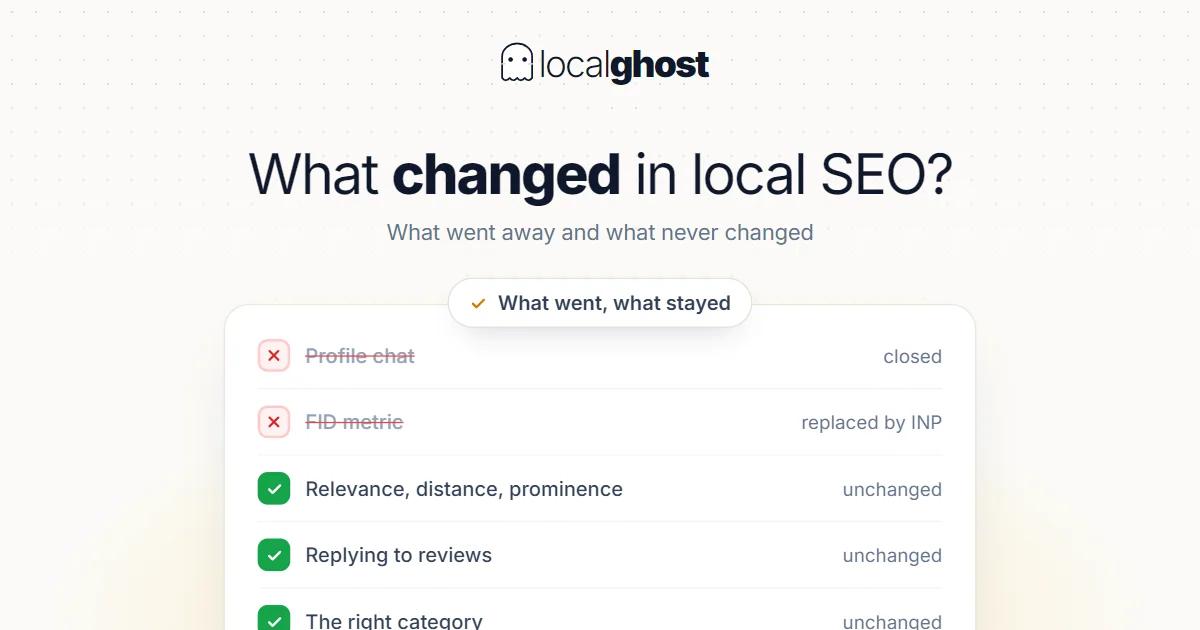
Chat on the profile was shut down
This is the biggest change and the least known.
Per Google's support documentation, as of 31 July 2024 the chat and call history features are no longer available in a Business Profile. The button a customer used to message you from Maps or a search result is gone.
It has two practical consequences. First, the inbound message channel disappeared; that demand now shifts to the phone or the site. Second, the call history report went too — there is no log of individual calls. The call count metric in performance data remains, but the "who called when" breakdown does not.
Which means tracking a missed call through the profile is not possible; the measurement has to be built on the phone side. There is also no official field that connects WhatsApp to the profile: WhatsApp Business and the Google profile.
Three changes on the schema side
Structured data is the area carrying the most out-of-date advice.
HowTo markup was dropped. Step-by-step guide schema no longer produces a rich result. The "add HowTo and stand out" advice online is void.
FAQ visibility narrowed. It decreased over time, and a long-standing condition still applies: the questions and answers in the markup must be visible on the page; a block that exists only in code does not qualify.
Googlebot's JSON extraction tightened. Non-standard formatting, double-escaped HTML text in particular, is no longer auto-corrected. This is rarely a problem in hand-written schema; it surfaces in dynamically generated schema, where a template engine emitting escape characters inside the JSON makes the block silently invalid.
The expectation needs correcting too: Google representatives have described structured data as a very light signal. Schema is not a ranking lever: schema markup setup.
There is also a persistent misconception: reviews a business collects about itself, on its own site, do not produce a rich result. If you want stars, the right surface is your profile, not your site.
In measurement, FID left and INP arrived
There is a concrete date on the page experience side.
INP replaced FID on 12 March 2024, and Chrome dropped FID support with that transition, giving developers until September 2024 to move over. If you are reading a report that still measures FID, you are looking at a metric that no longer applies.
The difference matters: FID measured only the delay of the first interaction, while INP evaluates responsiveness to interactions throughout the session. That is a harder bar for JavaScript-heavy sites.
And how the measurement works: these metrics are calculated from real user data over a window spanning weeks. Which is why a page scoring well in a lab test can fail in the field, and why today's fix does not appear in the report tomorrow: mobile-first SEO.
Link fields got rules
Appointment, booking and ordering links on the profile now work within clearer limits.
Not every business is eligible for every link type. Google's own example is illustrative: hair salons can use an appointment link but are not eligible for online ordering links. If a field does not appear on your profile that is not a fault; your category may not be eligible.
Links get audited. Google regularly checks whether the links you provide comply with its policies and may remove non-compliant ones; those checks run at most daily using a combination of automated tools and manual processes. So putting an unrelated campaign page in the field does not last.
Provider setup takes time. Booking providers appear on the profile within about a week — a delay worth factoring into any opening plan.
Accommodation has an extra condition: a free booking link must take the guest to your own site to book directly with you, not to a third party: booking platform links.
Tightening on the review side
Reviews are the area where the rules are clearest and most often broken.
Incentives are strictly prohibited. Offering free or discounted goods or services in exchange for posting a review, changing one, or removing a negative one is treated as misleading content and is strictly prohibited. Contributions must reflect a genuine experience.
Replies go through moderation. If your reply is not approved you are asked to edit it. Review usually takes up to 10 minutes but can stretch to 30 days. So the "I wrote it, done" assumption is wrong — exactly when speed matters most, on a negative review, a reply sitting in review looks like no reply at all: review response templates.
For anyone considering automation the boundary is clear too: AI helps with triage and drafting, not with writing the reply itself: AI review management.
The API side: the access model
This is where anyone planning automation loses the most time.
The Google Business Profile APIs are not open to the public; access must be requested and those who can demonstrate a legal business reason are approved. If you enabled the API and see a quota of 0, that is not a quota problem — access has not been granted, and you need to submit the basic access request rather than a quota increase.
There is also a version issue: many v4 features were deprecated and users are directed to the Account Management and Notifications APIs. The v4 examples you find online most likely do not work: Google Business Profile API automation.
What did not change
Through all this movement there are things standing exactly where they were — and that is where the substance sits.
Relevance, distance, prominence. The three elements Google names for how local results are determined are unchanged. You cannot change distance; you work on relevance and prominence: Google Maps ranking.
There is no single number one. Results are computed by the searcher's location; two people on the same street can see different orders. This never changed, and services promising "number one" are still being sold.
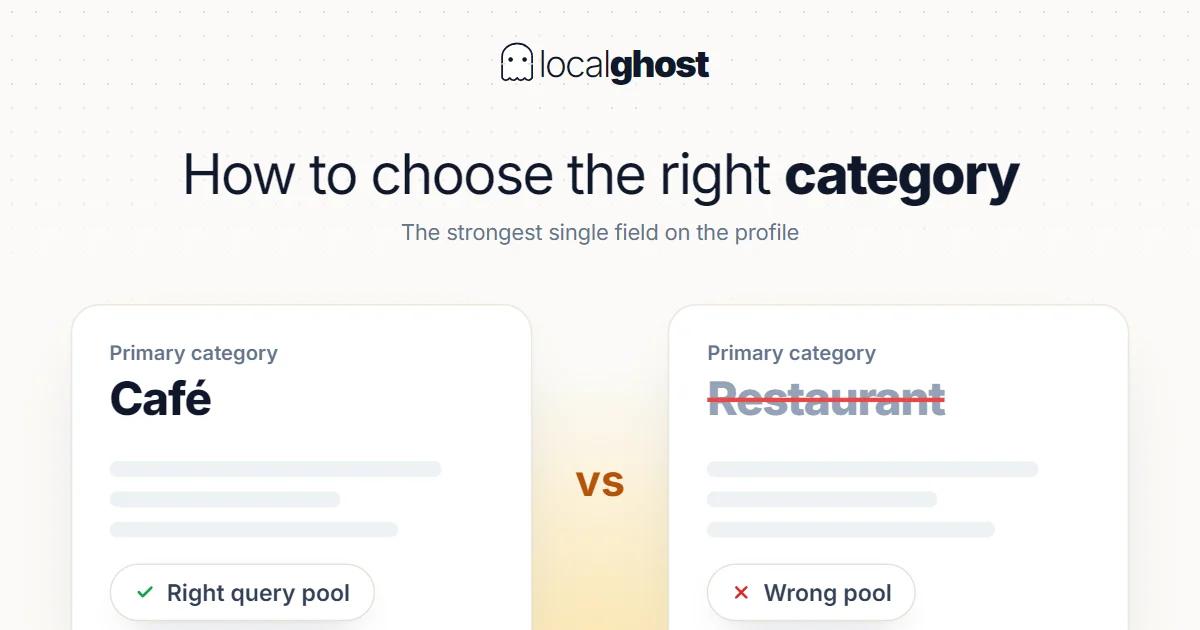
Category is the highest-impact setting. The narrowest accurate category is still the single change that makes the most difference: how to choose the primary category.
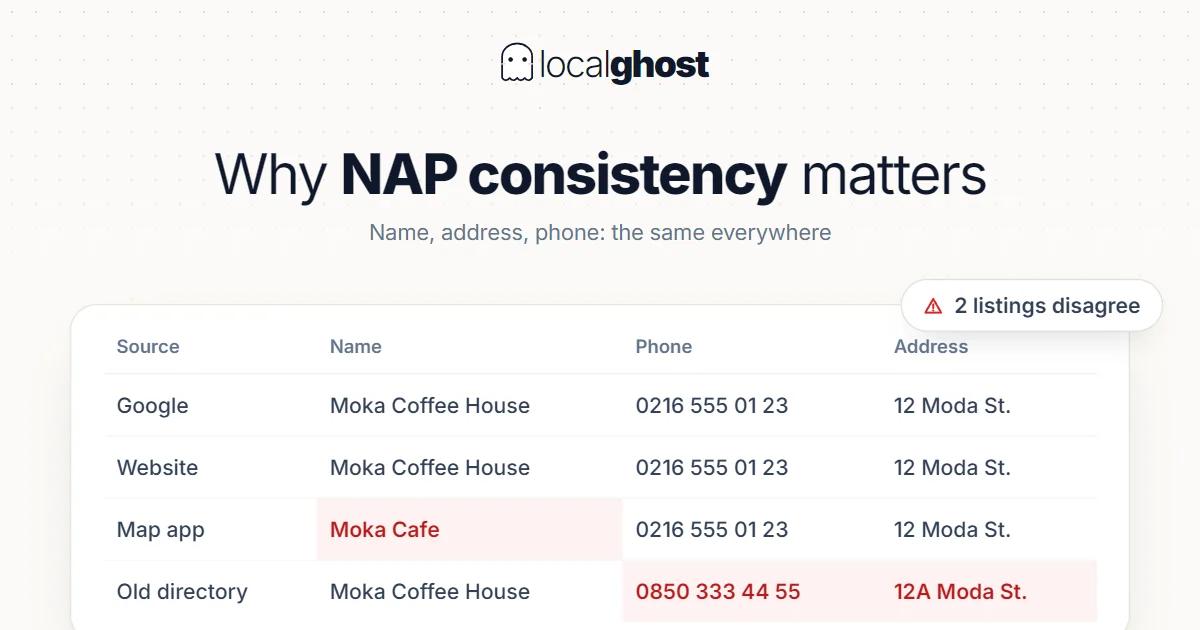
Information consistency. Name, address and phone identical everywhere. Unchanged for years: NAP consistency.
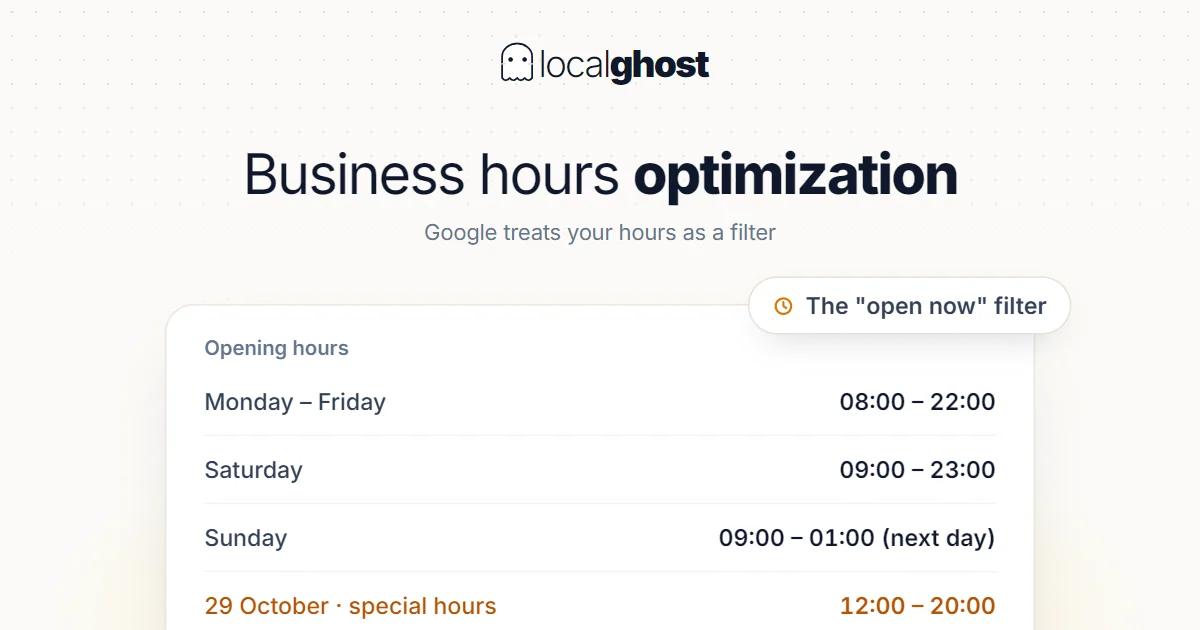
Accurate opening hours. Still the most expensive mistake; the "open now" filter reads this information: hours optimization.
Review recency and continuity. A batch every three months is still weaker than a few every week: strategies for increasing reviews.
Photo recency. The date of the newest photo still carries more meaning than the total count: photo optimization.
That list says something: what changes is mostly surfaces, what stays is the foundation. A business planning around removed features starts over every year; a business investing in the foundation is barely affected by the changes.
How to keep this list current
The most practical advice is not to trust date-stamped "trends" pieces — including this one.
Go to the primary source. If a feature's status is in doubt, the right place is Google's own help and developer documentation. A number in a blog post can be stale; the documentation is not.
Trust mechanisms over figures. Unsourced ratios circulate and cannot be verified. Content explaining a mechanism does not go stale.
Verify on your own profile. The fastest way to learn whether a button exists is to open the profile and look. Some fields vary by category and country.
Tie change detection to a routine. During monthly maintenance you notice when a field has disappeared: weekly maintenance calendar.
Frequently asked questions
Why is chat on my profile not working? It was shut down. Per Google's documentation, chat and call history have not been available in the profile since 31 July 2024.
Does HowTo schema still work? No; support was dropped. Step-by-step guide schema does not produce a rich result.
Is FID or INP measured? INP. It replaced FID on 12 March 2024 and Chrome dropped FID support.
I enabled the API but my quota is 0. What should I do? Do not request a quota increase. A quota of 0 indicates access has not been granted; you need to submit the basic API access request.
Can I offer a discount in exchange for a review? No. Offering free or discounted goods or services in exchange for posting, changing or removing a review is strictly prohibited.
With this much change, what should I focus on? The things that did not change: the right category, complete and consistent information, accurate hours, and a continuing flow of reviews and photos. The changes are mostly surface; these are the foundation.
Written by
Yunus Akan
Related tools: Map rank tracking · SEO audit tool · All local SEO tools