How to Calculate Local SEO ROI
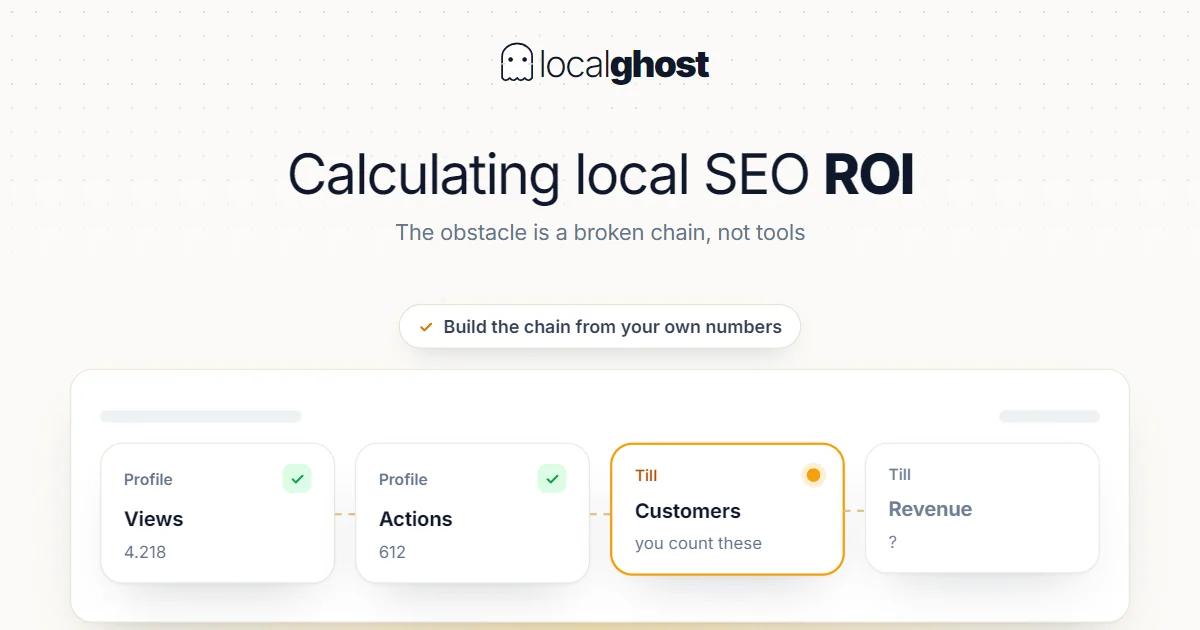
The obstacle to calculating local SEO return is not missing tools, it is a broken chain. Here is how to build that chain from your own numbers.
In this article
Summarize with AI
Calculating the return on local SEO does not work the way it does in e-commerce, and there is a structural reason: the highest-intent actions are the least trackable ones.
Someone calls your phone from your profile, gets directions, arrives, and pays cash. That is the best possible outcome — and it appears in no analytics tool.
So the question is not "which tool should we install". The question is: how do you build the chain between action and revenue from your own records?
What profile data gives you and what it does not
The starting point is the performance data on your profile, and knowing its limit matters.
What it gives: search views, phone calls, direction requests, website clicks. All of those are counts of actions.
What it does not give: how many of those actions became customers, and for how much. A profile is not a sales system; it does not know who paid what.
The rule that follows: profile data alone is not enough for a return calculation, but it does provide the first link in the chain. How to read that data is its own subject: reading the statistics.
There is also a removed feature worth knowing about: the call history report listing individual calls no longer exists. The call count in performance data remains, but the "who called when" breakdown does not. If you want to see missed calls, that measurement has to be built on the phone system side.
The arithmetic of the chain
A return calculation has four links, and each link has its own rate.
Action to enquiry. How many calls became a genuine enquiry? Wrong numbers, information questions and sales calls pull this rate down.
Enquiry to customer. How many enquiries became work?
Customer to revenue. What is the average transaction value?
Customer to repeat. How many times does the same customer return within a year?
Let us put numbers on it. A salon example, with values that must all come from your own records:
20 extra calls arrived through the profile in a month. 16 of them were genuine enquiries. 50% of enquiries became appointments: 8 customers. If the average transaction is 500, the monthly contribution is 4,000.
But the calculation does not stop there. If that customer returns 4 times a year, the annual value of those first 8 people is 16,000. Calculating on a single transaction significantly understates return in repeat trades.
The critical point: none of these rates should be taken from an industry average. A rate drawn from your own appointment book is far more accurate than any benchmark figure online.
Why percentage increases mislead
The phrase "200% increase" says nothing when the base is not stated. A simple comparison shows why.
Business A: went from 3 calls a month to 9. Increase: 200%.
Business B: went from 30 calls a month to 36. Increase: 20%.
Both gained 6 calls. The same absolute result, and one looks three times more impressive. A percentage increase is easy on a small base and hard on a large one.
So the thing to look at, both in your own report and in one someone presents to you, is the absolute number: how many calls, how many direction requests, how many enquiries. A percentage only means something alongside its base.
The same distortion exists on the review side: going from 5 reviews to 15 is 200% and still weak competitively: strategies for increasing reviews.
Subtracting what would have arrived anyway
This is the most skipped part of a return calculation and the part that most inflates the result.
Not everyone calling your profile is a new customer. Someone who already knows you, searched your name and found your number is in that count too. Writing that call's revenue down as "local SEO earned it" breaks the calculation.
There is a way to separate this in profile data: whether the search was branded (they typed your name) or discovery (they searched a service or category). What belongs in a return calculation is predominantly the second group.
The same separation is needed on the query side. Setting brand queries aside and looking at the remaining service phrases shows your genuine discovery volume: local keyword research.
There is also the counterfactual problem: would this customer have found you without the profile? There is no definitive answer. So an honest calculation should present return conservatively rather than generously.
The cost side: the most forgotten line is time
Cost in a return calculation usually gets written down as "what we pay the agency". That is incomplete.
Direct cost. Agency or software fees, photography, ad budget if any.
Time cost. Review replies, uploading photos, updating hours, posting. Whoever does that work, their hours are a cost — especially when the owner does it.
Made concrete: in the example above the monthly contribution is 4,000 and the work takes 10 hours a month, so it returns 400 per hour. The decision clarifies right there: if an hour of the owner's time is worth more than that, the work should be delegated; if not, they should do it themselves.
That calculation also tells you what to drop. A monthly maintenance routine takes few hours and does a lot; submitting to hundreds of directories takes many hours and makes no measurable difference: weekly maintenance calendar and what local citations are.
The most valuable data source is free and already yours
The most practical way to build this whole chain is not a tool but a question: "How did you find us?"
When whoever answers the phone asks that and writes the answer down, you collect data no analytics tool can give: did they come from the map, a recommendation, or seeing the sign.
Three things make it work. Keeping it in one place — a notebook or a simple sheet. Keeping it short — four or five options is enough. Sustaining it — a month of records says nothing, three months says plenty.
That record gives a side benefit too: it shows which services get asked about. A service asked about often with no page of its own produces a direct to-do list: website SEO for local businesses.
Accepting what cannot be measured
An honest return calculation also names the part it cannot measure.
People who never make contact. Those who saw your profile, found your rating low and went to a competitor appear in no data. That loss is unmeasurable but real.
The indirect effect of reviews. Someone who read reviews and then decided to call does not say the call happened "because of the reviews".
Delayed effect. A photo added or a category fixed today does not show its effect the same week. In local SEO there are weeks between cause and effect, which is why reacting to monthly fluctuation produces bad decisions.
Competitor movement. When your numbers fall you may not have broken anything; a competitor may have fixed something: how to do competitor analysis.
What to use instead: payback period
There is a more useful measure than a percentage return: how many months does this spend take to pay for itself?
The calculation is simple. Monthly contribution 4,000, monthly direct cost 1,500, so net contribution 2,500. If setup cost a one-off 5,000, the payback is two months.
The advantage of this measure is that it feeds a decision directly: a two-month payback means carry on, an eighteen-month payback means change the approach.
A second useful measure is cost per action. Monthly cost 1,500 and 20 extra calls means 75 per call. Comparing that against your advertising channel shows where budget should go.
In a new business these numbers being low in the first months is normal; the accumulation has not formed yet: 30-day plan for a new business.
Frequently asked questions
Can I calculate local SEO return precisely? Not precisely, because the highest-intent actions (calls, direction requests, walk-ins) cannot be fully tracked. A conservative and useful calculation can be built from your own records.
Does profile data show revenue? No. It gives action counts: views, calls, direction requests, clicks. Turning that into revenue needs your own conversion rate and average transaction value.
Is a "200% increase" a good result? You cannot tell unless the base is stated. Going from 3 to 9 is 200%, from 30 to 36 is 20% — both are a gain of 6 calls. Look at absolute numbers.
Can I use industry-average conversion rates? Better not to. A rate from your own appointment book beats any benchmark figure.
What should I put on the cost side? Time, alongside agency and software fees. If the owner does the work, the hours spent are a real cost and the decision changes with that line.
What is the most practical measurement method? Whoever answers the phone asking "how did you find us?" and recording the answer. It is free and gives data no tool provides — but it needs sustaining for at least three months.
Written by
Yunus Akan
Related tools: Profile analysis · AI review responses · All local SEO tools