Website SEO for Local Businesses
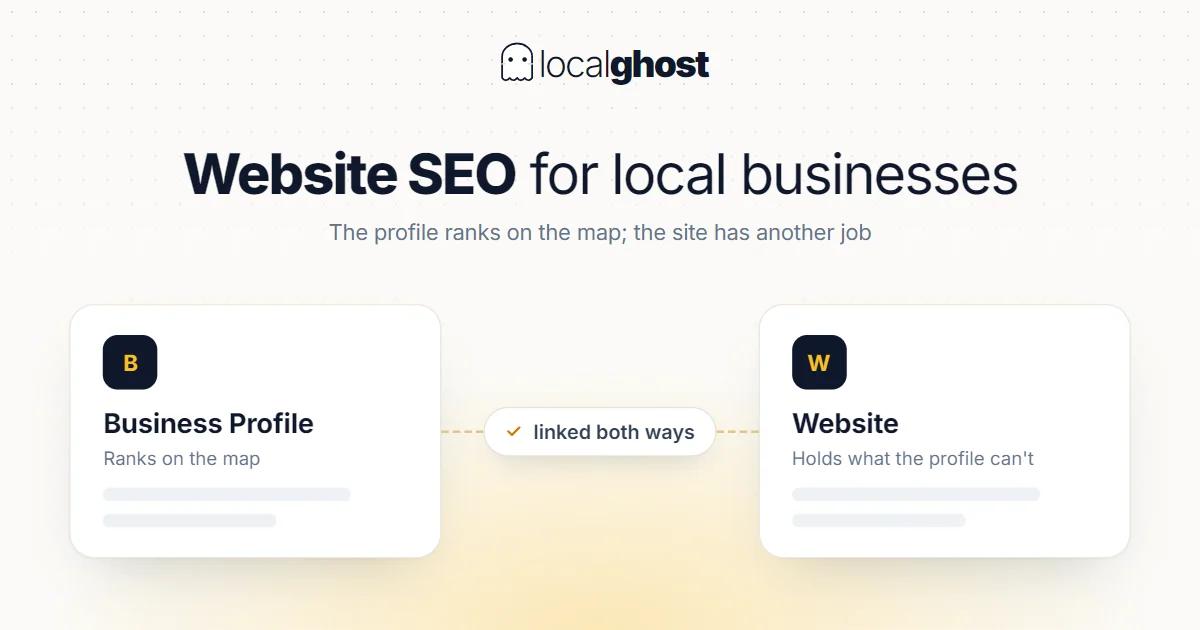
In local search the thing ranking in the map block is the profile, not the site. The site's job is different, and when that is unclear the effort goes to the wrong place.
In this article
Summarize with AI
Two opposing claims circulate about websites for local businesses: "you cannot do without one" and "sites are obsolete, the profile is enough." Both are wrong, because neither defines what the site actually does.
Here is the reality: the entity ranking in the block that comes with a map is the profile. The site is not competing there. But the site has two separate jobs, and neither of them fits on a profile.
Job one: hosting what does not fit on the profile. Pricing logic, how the process runs, common questions, examples of work. None of that fits in a 750-character description: how to write the description.
Job two: being a second door on the search side. Someone searching in the form "service + neighbourhood" sometimes lands on a page rather than the map block. If that page does not exist, the demand goes unanswered.
Order matters: investing in the site while the profile is incomplete is the most common waste of effort. Profile first: 10 golden rules for profile SEO.
Which pages you genuinely need
A short list will do. A small number of real pages does more work than dozens of thin ones.
Homepage. What you do, where you are and how to reach you, in the first screen. For a local business the homepage's job is not telling a brand story; it is making the location and the service unambiguous.
Service pages. One page per main service. These are the long form of the service list on your profile: scope, process, pricing logic, common questions.
Contact page. Address, phone, hours, map, transport and parking notes. The details must match the profile exactly.
Branch pages if you have several locations. Each branch wants its own page: multi-location management.
About page. Team, experience, credentials. This is the page people read at the decision moment, especially for services that enter the home and in healthcare.
There are also pages you do not need: one page per neighbourhood, pages that are the same text with the city name swapped, a blog for the sake of a blog. These generate maintenance load and dilute one another.
Service and area pages: where they work, where they hurt
This is the most abused area in local SEO, so the distinction needs stating plainly.
The version that works: a page that genuinely says something different. A different service, a different audience, a different process. "What a vehicle inspection report covers" and "how an on-site inspection works" can be two pages because their content differs.
The version that hurts: the same text duplicated with the area name changed. Ten near-identical pages for ten neighbourhoods; none of them strong, all of them competing with each other.
The test is a single question: does this page contain at least three facts that are not true of the other one? If not, the page has no reason to exist.
There is also this: launching an area page does not change the distance input. Whether you appear in the local pack is decided on the profile and the location: how the 3-pack works.
The technical baseline the site needs
Rather than a long technical list, the few items that genuinely matter for a local business:
Mobile. The overwhelming majority of local search happens on a phone. A tap-to-call phone number, a working directions link and a form that is usable on a small screen are requirements, not preferences.
Speed. Heavy images and unnecessary scripts are the usual causes. Uploading photos at a sensible size is the single biggest win on most local sites.
Address and phone as text. Contact details baked into an image are neither machine-readable nor copyable.
Structured data. Stating the information for machines precisely: LocalBusiness schema setup.
One canonical address. A mix of www and non-www, http and https splits the signals.
What must not contradict the profile
The site's most commonly skipped job is staying consistent with the profile. Because "the site is ours", it gets assumed correct and never checked.
Four fields to check: address, phone, hours, business name. These have to match the profile exactly, especially after a move or a number change: NAP consistency.
The practical cost of a conflict is twofold: the prominence signal weakens, and customers dial the wrong number.
What to write: the content side
Content for a local business is not a volume exercise the way it is for product sites. Answering a small number of questions well is enough.
Write the questions that delay decisions. What makes the price vary, how long the process takes, what is and is not included. These get asked on the phone anyway; on a page they both reduce calls and bring better-qualified enquiries.
Use the customer's words, not industry terminology. How to find which phrases people actually use: local keyword research.
Do not turn reviews into content. Reviews you collect on your own site do not produce rich results; reviews belong on the profile.
Do not force a blog. Producing a weekly post is usually low-return work for a local business. Strengthening the service pages returns more.
Linking site to profile and profile to site
Connecting the two surfaces does more than running each alone. But direction matters.
Profile to site. The website field on the profile should be filled and should point to the right page. With multiple branches, each branch to its own page; five branches all pointing at one "contact" page leaves the visitor to find their own location. Service links, where available, should go to the relevant service page.
Site to profile. A "review us on Google" link and an embedded map carry the visitor to the profile. There is a side benefit: with the review link permanently on the site, a remote customer can leave a review too.
Bookings and appointments. This is the link that breaks most easily. If the appointment link on the profile is broken or points at an old system, high-intent demand disappears. It belongs on the monthly checklist as its own item: weekly maintenance calendar.
The only way to confirm links work is clicking them. If profile data shows website clicks but the site shows no matching traffic, something in between is broken: reading the statistics.
How to measure whether the site is working
The most common measurement mistake locally is putting profile data and site data in one table and adding them up. They are separate surfaces, measured separately.
The profile side reports its own data: search views, direction requests, calls, website clicks. None of this appears in your site analytics: reading the statistics.
The site side is measured with Search Console and an analytics tool. What to look at is not total traffic but queries carrying intent: service names, service plus area, price and scope questions. A page taking impressions but no clicks on those queries is caught by its title and description.
One thing is pointless to wait for: "near me" style demand arriving through the map block does not appear in site reports. That demand resolves on the profile. So low site numbers alongside strong profile numbers is not a contradiction; it is normal.
The most concrete indicator that your decision-delay pages are working is not traffic but behaviour: the same question being asked less often on the phone, and incoming enquiries being better qualified. That measurement comes from whoever answers the phone, not from a tool.
A caveat: a new site has almost no data in the first weeks, and that is not a failure signal. You need at least a few months before deciding; changes made earlier are shots in the dark: how to do competitor analysis.
Work that wastes time
- A page per neighbourhood. Duplicating text means pages weakening each other.
- Submitting to hundreds of directories. Beyond five priority sources, the long tail makes no measurable difference: what local citations are.
- Chasing stars on your own site. Marking up reviews you collected about yourself produces no rich result.
- Calculating keyword density. It damages readability and returns nothing.
- Perfecting site speed. After the obvious problems are fixed the remaining gain is small; the same hours spent on review flow return more.
How much weight the site carries by sector
How much work the site does varies by sector, and that determines how much to invest.
Trades where a site is barely needed. In taxi and transfer work customers call rather than read; the business runs without a site: taxi ranks and airport transfer.
Trades where the site is the decision organ. In accommodation, rooms, prices and the booking process turn into a decision on the site: local SEO for hotels.
Trades where the site resolves price uncertainty. For movers, a "what makes the price vary" page takes a load the profile cannot carry: moving companies.
Trades where scope has to be written down. Vehicle inspection needs a page for report scope; the profile will not hold it: vehicle inspection.
The B2B side. In wholesale food the buyer looks for minimum order, delivery and documentation on the site: wholesale food suppliers.
Frequently asked questions
I have no website. Can I still do local SEO? Yes. What appears on the map is the profile; the site is a supporting layer, not a prerequisite. But in sectors where price and scope need writing down, a site makes a real difference.
Should I build a separate page for every neighbourhood? Not unless the page genuinely says something different. The test: does it contain at least three facts that are not true of the other page?
Do I need to run a blog? No. For a local business, strengthening service pages usually returns more than producing weekly posts.
Can I get stars from reviews on my site? No; reviews you collect about yourself on your own site cannot be used for that. Reviews belong on the profile.
How important is site speed? Fix the obvious problems (heavy images, unnecessary scripts). After that the remaining gain is small; the same effort spent on reviews and photos returns more.
Do the details on my site have to match the profile? Exactly: address, phone, hours, business name. A conflict both weakens the prominence signal and sends customers to the wrong number.
Written by
Yunus Akan
Related tools: Map rank tracking · All local SEO tools