Google Ads and Local Businesses: A Beginner's Guide
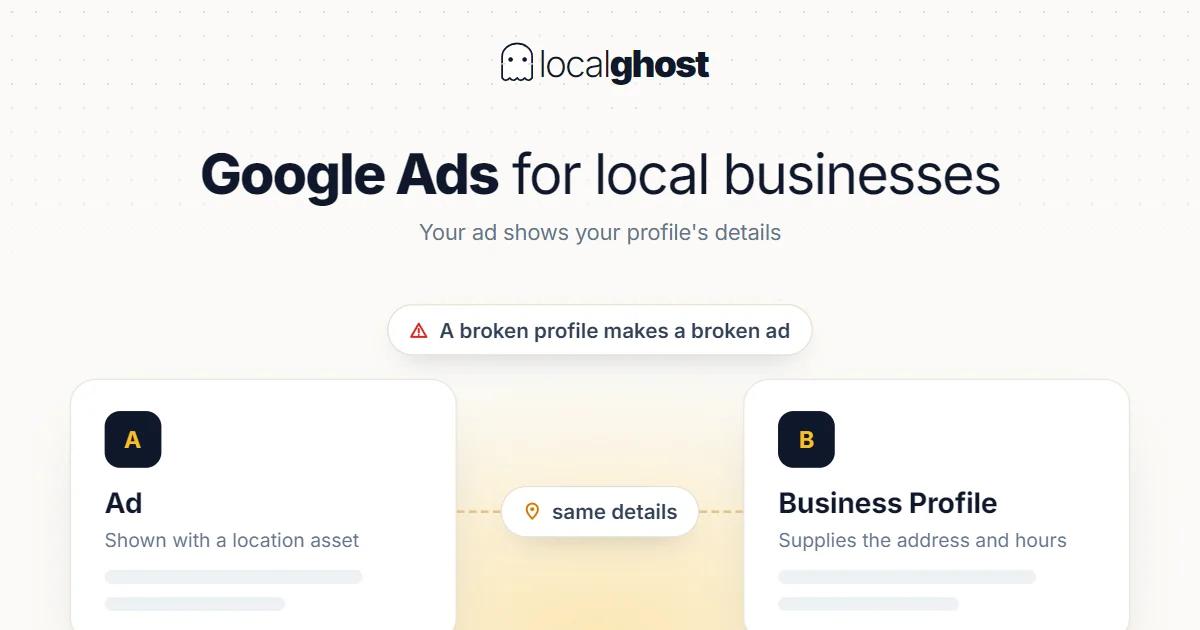
The most skipped fact in local advertising: your ad displays the information on your profile. A broken profile produces a broken ad.
In this article
Summarize with AI
There is a connection usually skipped when Google Ads is explained to local businesses, and it underpins the entire setup: your ads are fed by your business profile.
Google's documentation says so plainly. Local ads help users discover your business and work out how to call it; and the phone number appearing in the ad is either the number you put in the creative or the number from your Business Profile.
The same applies to other details. Location assets show your address in the ad, a map to your location, the distance to your business, your phone number and a call button.
The conclusion is direct: advertising while your profile is incomplete means paying to distribute broken information. Profile first: 10 golden rules.
Location assets: the key to local advertising
This is the first thing to set up in a local business, and the name is unfamiliar to most people.
Location assets are the structure that shows your business information in ads. Per Google's documentation, you need to set up location assets for local search ads to appear. So an ad featuring your business location showing to someone searching "near me" depends on this setup.
These assets do not stay in one place: they can appear in different formats across Search, Display, Performance Max and video campaigns.
If you have several branches, location groups come into play — and using them requires location assets to be enabled on the account. The logic of managing ads per branch matches the logic on the profile side: multi-location management.
So the setup order runs: correct and complete profile, then location assets enabled, then campaign. Starting from the other end means publishing an ad with incomplete information.
Counting calls as conversions
This is the single highest-return setting in local advertising, and it gets skipped often.
Per Google's documentation, when call tracking is enabled, phone calls can be configured as biddable conversions. Which means the system can learn which ad produces calls and shift budget there.
Without that setup, the system optimises for clicks rather than calls. In a local business a click is an intermediate step; the event that matters is the phone ringing.
A measurement caution: calls from ads and free calls from your profile are different things and must not be conflated. Keeping them separate is the only way to see advertising's real contribution: reading the statistics.
What advertising buys
Clarifying how ads differ from SEO makes the budget decision easier.
Immediate presence. Profile accumulation takes weeks or months; an ad starts today. In a newly opened business that difference is decisive: 30-day plan for a new business.
Query control. You choose which phrases you want to appear for. On the organic side you have no such control.
Time-bound campaigns. You can switch them on and off for a season opening, a promotional period or quiet hours: profile management for seasonal businesses.
Distance flexibility. In organic local results you have no control over distance. In advertising you draw the targeting yourself — which is the only way to reach a distant area.
That last point matters: declaring a wide service area on your profile does not change the distance input, but ad targeting genuinely reaches that area: home-based service businesses.
What advertising cannot fix
Honesty here prevents wasted budget.
A low rating. Ads buy visibility, not trust. A business with weak reviews gets clicks that do not convert. The review side comes first: strategies for increasing reviews.
Wrong opening hours. If an ad sends traffic to a closed business, the money is gone: hours optimization.
An unanswered phone. The output of a local ad is a phone call. With nobody answering, the ad budget is lost.
An incomplete profile. Because the ad displays profile information, missing details show up missing in the ad.
A poor landing page. If the ad goes to your site, that page has to work on mobile and complete the action: website SEO for local businesses.
The rule: advertising multiplies your existing conversion rate, it does not create one. If the rate is low, advertising multiplies the loss too.
Automated campaigns: where they fit and where they do not
Google's Performance Max campaigns for store goals are built around growing offline goals: you supply store locations, budget and ad assets, and Google's AI optimises bids, placements and asset combinations.
That implies a trade: you hand over control and get reach in return.
Where it fits: multi-branch structures, a broad budget, and enough data volume for the system to learn from.
Where it does not: a single-location business on a small budget that wants control over which queries it appears for. On a small budget an automated campaign cannot gather enough data to learn.
One technical detail: on the brand assets side your business name needs to match your verified legal name or your domain name, otherwise you get a disapproval. That is the same logic as the naming rule on the profile: NAP consistency.
Controlling where the budget goes
The fastest way a small budget drains is targeting that is broader than it needs to be.
Narrow the geographic targeting. Wherever you genuinely serve. A click from an area you do not serve is pure loss.
Narrow the queries. General and informational searches bring clicks, not customers. Working out which phrases carry intent is its own job: local keyword research.
Set hours and days. Running call-focused ads during hours when nobody answers the phone makes no sense.
Think about brand searches separately. Someone searching your own name already finds you. Paying for that click needs a reason; it should not be accepted as a default.
The frame for measuring return is not the ads dashboard but your own accounting: cost per action and payback period: how to calculate the return on local SEO.
How much advertising weighs by sector
Immediate-need trades. Demand is sudden and competition high; ads provide instant presence: taxi ranks and airport transfer.
Food and drink. Organic local visibility is usually strong, so the marginal contribution of ads is limited; budget spent on reviews and photos returns more: Google Business guide for restaurants.
Accommodation. Meaningful for hotels chasing direct bookings, given the competition and commission balance: booking platform links.
High transaction value trades. In sectors like removals where one job is worth a lot, cost per call is easier to cover: moving companies.
Regulated fields. In healthcare, ad content may be subject to professional regulation; check your own rules: Google Maps SEO for dental clinics.
Frequently asked questions
Does advertising affect my organic ranking? Ads and organic local results are separate surfaces. Ad spend does not buy map ranking.
Can I run local ads without a profile? You can, but it will be incomplete: local ads can use the profile's number and location information, and location assets are required for local search ads to appear.
What do location assets do? They show your address, a map, the distance to your business, your phone and a call button in the ad. They need setting up for local search ads.
Can I count phone calls as conversions? Yes. When call tracking is enabled, calls can be configured as biddable conversions. It is the highest-return setting for a local business.
Is Performance Max suitable for a small business? Usually not. You hand over control, and the system needs data volume to optimise; on a small budget that data does not accumulate.
Will advertising compensate for bad reviews? No. Ads buy visibility, not trust; they multiply your existing conversion rate rather than creating one.
Written by
Yunus Akan
Related tools: Add GPS to photos · All local SEO tools