Google Maps SEO for Taxi and Airport Transfer Services
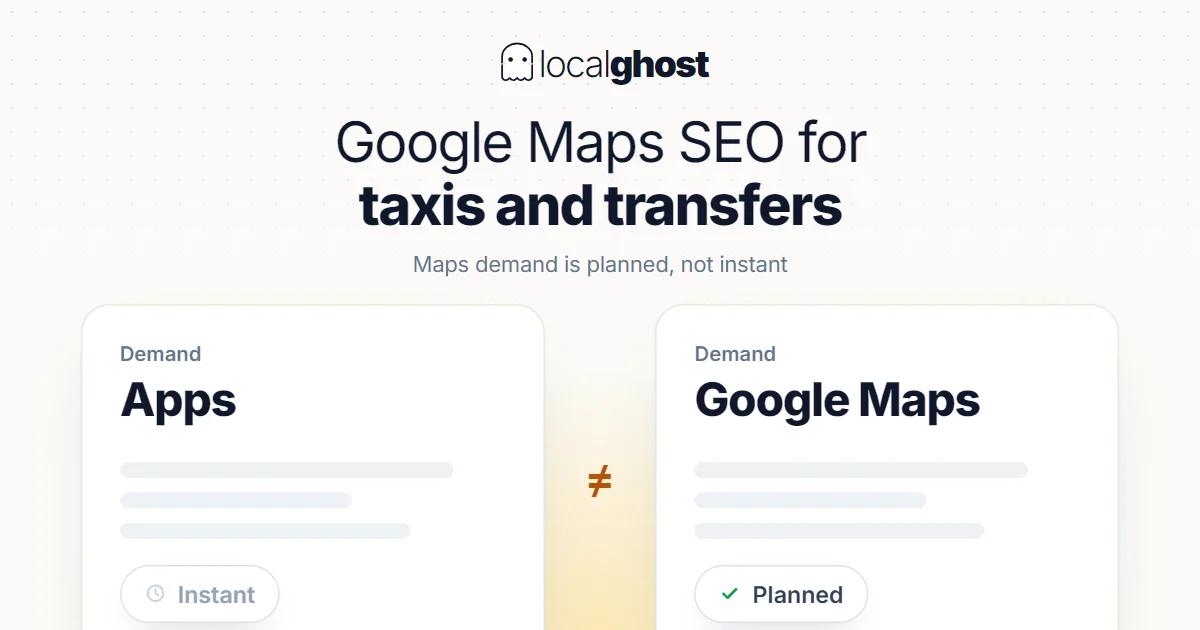
Demand coming from Maps in this sector is not the same demand the apps get: it is planned rather than instant. The profile has to be built for it.
In this article
Summarize with AI
Before talking about Google Maps SEO in the taxi and transfer business, an honest observation is needed: most on-demand taxi demand no longer passes through Maps.
Someone standing on the street who needs a ride takes out their phone and opens a ride-hailing app. Ranking first in Google Maps changes very little for that demand, because that user is not running a search at all.
This does not mean Maps is useless in the sector. It means something more specific: the demand that arrives through Maps is a different kind of demand, and your profile has to be built for it. Where the apps are structurally weak, Maps is still strong:
- Airport and hotel transfers — planned in advance, with a price the customer wants to know beforehand, usually with luggage
- Long-distance journeys — a service the apps either do not offer or price badly
- Corporate and recurring transport — staff shuttles, contract clients
- Special requirements — wheelchair-accessible vehicles, child seats, pet-friendly cars, executive vehicles
- Courier-style taxi work — moving items rather than people
- Visitor demand — international travellers who search rather than install a local app
What these have in common: all of them are planned, all of them convert through a phone call or a message, and in all of them the price is asked in advance. Your profile's job is to serve that demand.
Rank or service: two different profile structures
There are two setups available for this sector in Google Business Profile, and choosing the wrong one directly limits visibility.
If you have a physical rank or office where customers can turn up and take a vehicle, this is a normal business profile with an address. You use a taxi stand category and a real address. The advantage: you appear as a pin on the map, and a "taxi rank near me" search can find you.
If you go to the customer and your office does not receive visitors, this is a service-area business. The address is hidden and the areas you serve are defined instead. Transfer and corporate transport work usually belongs here.
The most common mistake is presenting an office that does not receive customers as a normal business address. Google's rules are clear: the profile must represent a real business location, and if it is not somewhere customers can visit, the service-area setup is the correct one. A virtual office or a mailing address is a suspension risk.
Be realistic when defining the area, too. Adding cities you do not serve does not widen your visibility; Google reads the service area as a coverage statement rather than a ranking guarantee, and inflated definitions weaken your credibility.
Category choice decides which demand pool you enter
There is more than one category in this sector and each opens onto a different pool of queries: taxi rank, taxi service, airport shuttle service, limousine service, minibus and shuttle transport, car hire.
This matters more than usual here, because transfer work and taxi work attract different customers. A business that mostly does airport transfers but sets a generic taxi category as its primary is giving up its strongest signal in transfer searches. The reverse holds as well.
The rule that works: make the primary category the work that brings the most revenue, and add the others as secondary categories. For a rank that also does airport runs, an airport shuttle category can sit as secondary; if transfers are the body of the business, it should be primary.
The general rules: how to choose the right category.
Price transparency is conversion itself here
In taxi and transfer work, the customer's first question is almost always the price, and this sector carries a historic trust problem on exactly that point. "How much from the airport to the city centre" *is* the real subject of the search.
Ways to answer it on the profile:
- List fixed routes in your services, with prices. Entries such as airport-to-city-centre transfer, intercity journey, hourly hire — with a price range where possible.
- State what is included. Luggage, waiting time, night tariff, toll charges. Missing this information produces both unnecessary phone calls and negative reviews.
- Publish your payment methods. Whether you accept cards is one of the most frequent complaints in this sector, and it can also be marked as an attribute.
- Add a booking path. All planned demand is arranged in advance; a messaging or booking link rescues the customer who would rather not phone.
If you operate around the clock, show it correctly
Opening hours in this sector go wrong at both extremes.
If you genuinely work 24 hours, that should be visible on your profile. A profile marked as open 24 hours passes the "open now" filter on night searches, and those hours are valuable precisely because competition drops.
But if you are not a 24-hour operation, showing yourself as one is worse than doing nothing. The customer who calls at night and gets no answer is lost twice: once as a job, once as a review. In this sector "called, nobody picked up" is the review type that drags a rating down fastest.
If night cover rotates, enter your real hours and describe the rota in the service description. Wrong hours cost more than a lost ranking position.
Entering past-midnight and 24-hour setups correctly: hours optimization.
Reviews: few in number, heavy in weight
Review counts in taxi and transfer work sit below most local sectors — people simply do not have the habit of reviewing a taxi ride. That raises the weight of every review you do have.
Points specific to this sector:
- Negative reviews are usually about one of three things: price (higher than expected), waiting (the car never came or came late), and driver conduct. All three need a concrete reply.
- The best answer to a price complaint is preventive. Publishing your tariff and inclusions on the profile stops that review from ever being written.
- Transfer customers are more inclined to leave reviews, because the journey was planned and the experience longer. Asking an airport transfer customer for a review is far more productive than asking someone flagged down in the street.
- Never offer anything in exchange. A discount for a review breaches Google's policy and puts your whole review set at risk.
A comparison of the ways to ask: increasing Google reviews.
Photos are a trust question
What the customer wants to see here is evidence that the business they are about to ride with is real.
- The fleet — clean vehicles, photographs where the model and condition are visible. A transfer customer wants to know which car will arrive.
- The rank or office — if you have a physical location, so customers can find it.
- The team and drivers — a trust signal especially in corporate and transfer work.
- Vehicle interiors — luggage capacity and comfort, a direct deciding factor in transfer demand.
Do not use stock vehicle photography; it is the easiest thing to spot in this sector.
Proximity: tight for a rank, loose for transfers
Proximity is a ranking input in every local search, but the two demand types in this sector behave very differently.
In a "taxi rank near me" search distance is almost the only decider. Your radius is small and you cannot engineer it.
In a transfer search it inverts. Someone looking for an airport transfer does not care where your office sits; what they care about is the route. In that demand your service-area definition, route-based service entries and reviews all do more work than distance.
Practical consequence: fix the fundamentals for rank demand and accept the distance limit. For transfer demand, strengthen routes, prices and the booking path — that is where you can genuinely compete.
Not competing with the apps, filling the gap they leave
Back to the observation this guide opened with: competing with ride-hailing apps for instant demand through Maps is not an efficient strategy. Their distribution channel is different and you do not win that fight with profile optimisation.
Where you can win is the demand the apps are structurally weak at:
- Journeys that need price certainty in advance — apps give dynamic pricing, transfer customers want a fixed figure
- Trips with luggage or larger groups — a guarantee of vehicle type
- Long distance — thin ground for the apps
- Corporate invoicing and contracts — hard to manage through an app
- International visitors — solved through the hotel or a search rather than an app download
Build your profile around that demand and Maps stops delivering volume and starts delivering qualified demand: fewer calls, higher average journey value.
Frequently asked questions
I have no physical rank, I take work by phone only. Can I have a profile? Yes, as a service-area business. The address is hidden and the areas you serve are defined. Presenting an office that does not receive customers as a normal business address breaks the rules, and using a virtual office or a mailing address is a suspension risk.
Which category for airport transfers? If transfers are the body of the business, an airport shuttle category should be primary. Making a generic taxi category primary means giving up your strongest signal in transfer searches.
Do I have to publish prices? It is not required, but it is one of the highest-return things you can do here. Price is the real subject of the search; leaving it out generates both pointless phone traffic and "more expensive than I expected" reviews.
Is showing 24-hour opening an advantage? If you really operate around the clock, yes — night competition is thin and you pass the "open now" filter. If you do not, no. The customer who gets no answer at night is both a lost job and a negative review, and that is the review type that drops a rating fastest in this sector.
Will adding as many cities as possible to my service area help? No. The service area is a coverage statement, not a ranking guarantee. Adding places you do not actually serve brings no visibility, and failing to serve the demand you attract turns into negative reviews.
Can I compete with ride-hailing apps inside Maps? For instant demand, practically no — that user is not searching in Maps. But planned demand (airport transfers, long distance, corporate transport, special vehicle needs) still arrives through search, and there you can compete.
Written by
Yunus Akan
Related tools: Grid rank tracking · Content calendar · All local SEO tools