Local SEO Tactics That Stopped Working
The most expensive work in local SEO is effort spent on a tactic that does nothing. Let us separate them into three groups and say what replaces them.
In this article
Summarize with AI
The most expensive work in local SEO is not doing something wrong but putting effort into something that does nothing. Wrong gets noticed; wasted takes years to spot.
What changed on the platform is a separate subject: what changed in local SEO and what did not. This piece is about tactics — the work still being described, still being sold and still being done without a payoff.
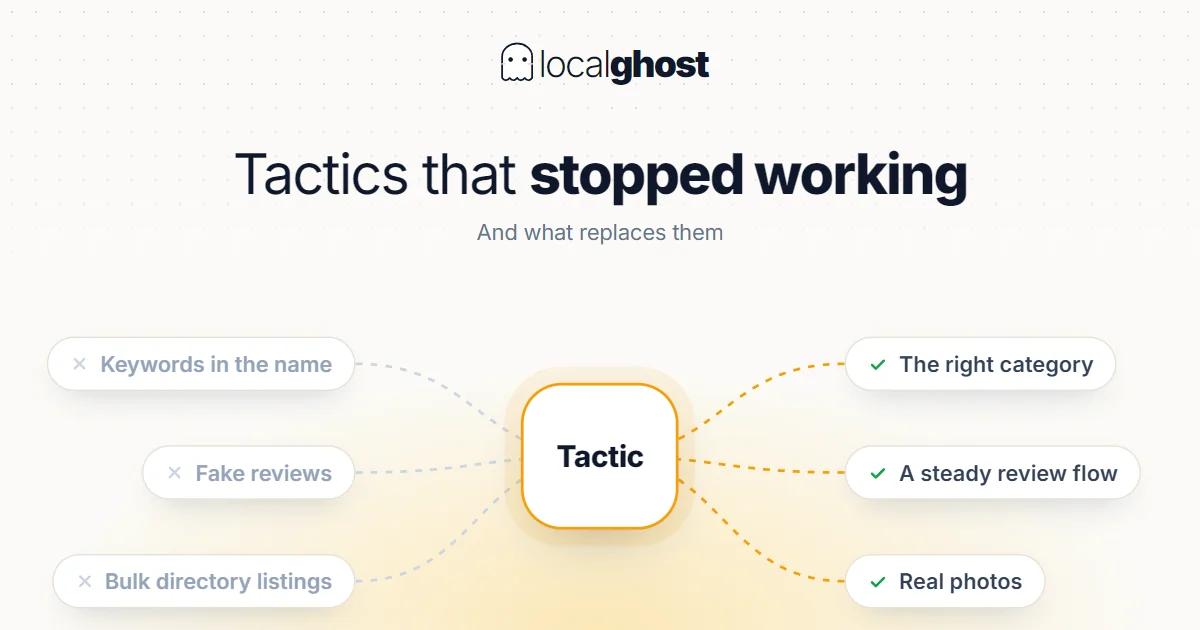
There are three groups, and knowing the difference matters: ones that never worked, ones that stopped because the platform changed, and ones that look like they work while carrying risk.
Ones that never worked
These are jobs believed effective for a while that never had a measurable payoff.
Submitting to hundreds of directories. Beyond a handful of priority sources, the long tail makes no measurable difference. Five important sources is enough; a hundred creates maintenance load: what local citations are.
Calculating keyword density. Targeting a word ratio damages readability and returns nothing. Using the customer's phrasing once, correctly, is enough: local keyword research.
Producing a page per neighbourhood. Duplicating the same text with the district name swapped means the pages weaken each other. The test is one question: does this page contain at least three facts that are not true of the other: website SEO for local businesses.
Declaring a wide service area. A declared area does not change the distance input. Writing a large area is not buying a radius: home-based service businesses.
Growing follower counts. Social followers are not an input in the map ranking calculation. Locally, 400 followers nearby are worth more than 40,000 far away: Instagram strategies for local businesses.
Perfecting site speed. Fixing the obvious problems is essential; past that the gains are small. Local pack visibility is decided largely through the profile and location: mobile-first SEO.
Ones the platform retired
These genuinely worked once and no longer pay off. Much of the content online still describes them.
Adding HowTo schema. Support was dropped; step-by-step guide schema produces no rich result.
Optimising FID. INP replaced FID on 12 March 2024 and Chrome dropped FID support. A report showing FID is out of date.
Setting up chat on the profile. Per Google's documentation, chat and call history have not been available since 31 July 2024. Guides describing that feature are void: WhatsApp Business and the Google profile.
Tracking missed calls through call history. That report was removed. The call count in performance data remains but there is no individual log; the measurement has to be built on the phone side.
Marking up your own site's reviews for stars. Reviews a business collects about itself on its own site cannot be used for that: schema markup setup.
Using old API examples. Many v4 features were deprecated and users are directed to the Account Management and Notifications APIs: Google Business Profile API automation.
Ones that look like they work but carry risk
This group is the most dangerous, because a short-term effect can appear and that effect gets mistaken for a reason to continue.
Adding keywords to the business name. The name must be the real name on the sign. Adding a keyword, district or service breaches the naming rules and is open to correction. One reason a short-term effect appears is that the measurement was taken on your own phone: NAP consistency.
Buying reviews. Contributions must reflect a genuine experience. Fake reviews can be removed and the accumulation reset — and as the crisis arithmetic shows, losing the base costs far more than rebuilding it: review crisis management.
Collecting reviews with incentives. Offering free or discounted goods or services in exchange for posting, changing or removing a review is strictly prohibited and treated as misleading content.
A fake address or virtual office. Caught at verification and can escalate to losing the profile.
Using link fields for campaigns. Google checks the compliance of links you provide at most daily and may remove non-compliant ones.
Producing content at scale. Using automation — including AI — to generate content with the primary purpose of manipulating rankings violates spam policies, and producing many pages without adding value can fall under scaled content abuse: where to use ChatGPT in your business.
Buying a "number one guarantee". There is no single number one that holds for everyone; results are computed by the searcher's location. A service offering a guarantee either does not know or is not being honest: Google Maps ranking.
Ones where the evidence is contested
There is a fourth group: tactics described confidently where the evidence is not clear. The honest position on these is to say it is unknown.
Tagging photos with location data. Independent tests have not shown a consistent effect, and location data in uploaded images is generally not retained. Treat confident sources with caution: photo optimization.
Asking only satisfied customers for reviews. Stating the policy side confidently would be wrong, but the measurement side is clear: your average drifts up while your satisfaction stays the same. You are corrupting your own data: how to measure customer satisfaction.
Increasing posting frequency. A post produced when there is nothing to say is empty content. There is no clear evidence that frequency itself has an effect.
The stance for this group: before spending time on an unsourced claim, ask whether the same time could go to something evidenced.
What replaces them
For this piece to be useful, the space cleared has to be filled. What is known to work is a short list.
The right primary category. The single change that makes the most difference: how to choose the primary category.
Accurate opening hours. Still the most expensive mistake: hours optimization.
A continuing review flow. Continuity and recency as much as count: strategies for increasing reviews.
An answered phone and a fast reply. Local demand is present-tense.
A fresh photo flow. The date of the newest photo carries more meaning than the total count.
Information consistency. Name, address and phone identical everywhere.
A routine. Ten minutes weekly, half an hour monthly: weekly maintenance calendar.
The list being boring is not a flaw but the point. What works in local SEO does not change; the tactics that change are mostly a search for a shortcut.
Frequently asked questions
Does adding a district to the name really not work? It breaches the naming rules and is open to correction. One reason a short-term effect appears is measuring from your own phone.
Does submitting to hundreds of directories cause harm? Not harm, but no measurable benefit either. The cost is maintenance load and the risk of inconsistent information.
Should I add location tags to photos? The evidence is contested: independent tests found no consistent effect and location data is generally not retained. Treat confident sources with caution.
Is asking only happy customers for reviews not sensible? It drifts your average up without changing your satisfaction — so you are corrupting your own measurement.
Should HowTo schema still be added? No; support was dropped and it produces no rich result.
I dropped these tactics. What should I do instead? The right category, accurate hours, a continuing review and photo flow, an answered phone, consistent information and a routine. The list is boring but it does not change.
Written by
Localghost Team
Related tools: Local SEO Audit · All local SEO tools