How to Use ChatGPT for Your Business
AI genuinely speeds up text work. But taking facts from it is the most expensive mistake in local SEO.
In this article
Summarize with AI
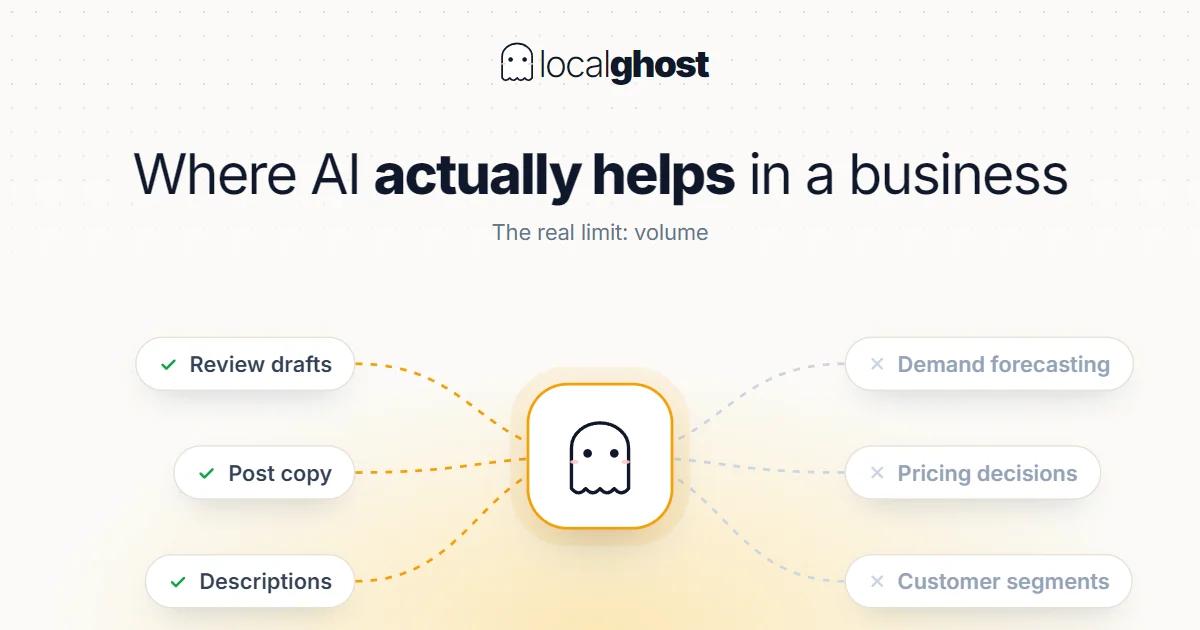
AI assistants genuinely help a local business — just not where people expect.
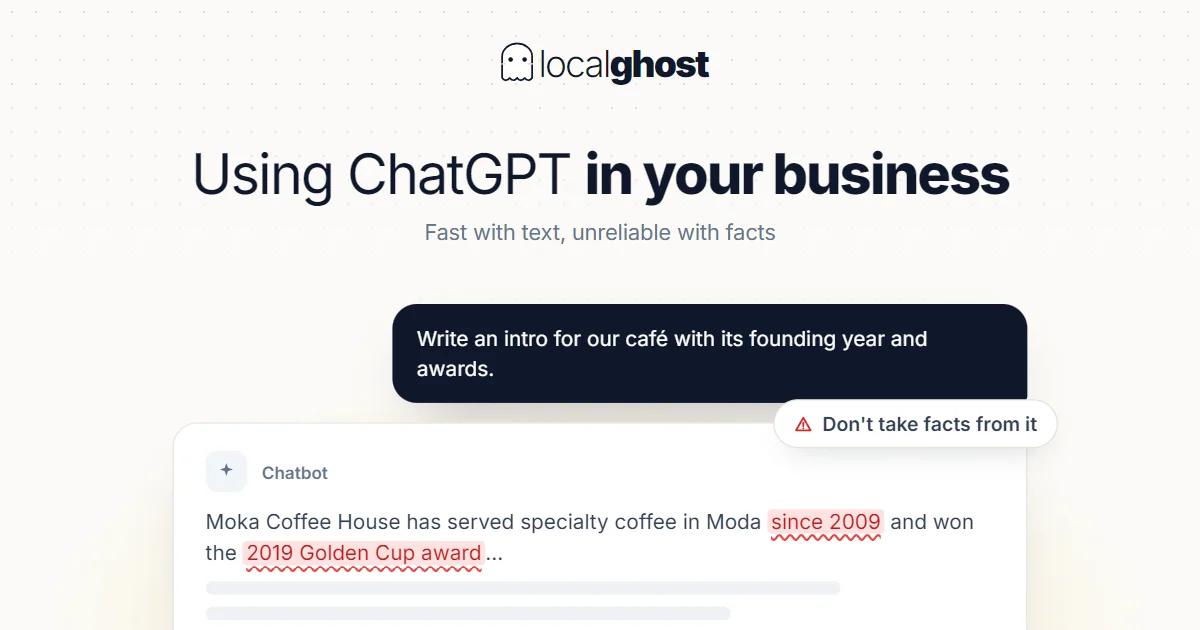
The common use is "write me a blog post about local SEO" or "how do I optimise my Google profile". That use is the riskiest one, because it means taking facts from the model.
The right distinction: AI is good at form and unreliable at fact. Excellent for organising, translating, shortening and structuring information you already hold. Not for producing that information.
Why you cannot take facts from it
To show this is not an abstract warning, examples from local SEO itself are enough.
An AI model carries the knowledge of the period it was trained on. And local SEO has features that were removed in recent years:
Chat on the profile. Per Google's documentation, chat and call history have not been available since 31 July 2024. But a model speaking from earlier knowledge will walk you step by step through switching chat on.
HowTo schema. Support was dropped and it produces no rich result. A model may still tell you to add HowTo.
The FID metric. INP replaced FID on 12 March 2024 and Chrome dropped FID support. A model may suggest optimising FID.
The real problem here is that the model does not say when it does not know. It describes a non-existent feature with confidence, and you lose time hunting for that button on your profile.
The same risk applies to numbers: unsourced ratios get produced confidently and cannot be verified.
For the sourced list of what actually changed: what changed in local SEO and what did not.
Uses that genuinely help
Their common thread: the input comes from you, the form comes from it.
Turning phone questions into copy. Write down the questions that came in over a week, hand them over, and you get an FAQ section or a service page draft. The information is yours, the arrangement is its: website SEO for local businesses.
Translating your service list into customer language. Moving technical service names closer to the phrasing customers use. Which phrasing is actually searched is a separate job and comes from data: local keyword research.
Translation. Understanding a review in another language and preparing a reply in it. A serious convenience in tourist areas.
Shortening long text. The description field is limited; cutting your long promotional copy down so the first sentence does the work: how to write the description.
Grouping review themes. Handing over a hundred reviews and asking how many times each topic appeared is far more useful than having replies written: AI review management.
Reading documents. Summarising a long policy or contract. But you need to read the relevant clause yourself before deciding.
Building structure. A skeleton for post copy, the layout of a checklist, an email draft.
Hard boundaries
This list is not open to debate; breaching it risks the profile.
Generating reviews. Contributions must reflect a genuine experience. Generated reviews are misleading content, and the outcome can be reviews removed and accumulation reset.
Producing pages at scale. Google's guidance states that using automation — including AI — to generate content with the primary purpose of manipulating rankings violates its spam policies, and producing many pages without adding value can fall under scaled content abuse. Locally, that means pages duplicated with the district name swapped.
Having numbers written. The model invents statistics. Every figure you publish needs a source.
Incident-specific review replies. If a customer describes a particular day or person, the reply has to know about it. A generated reply reads like a template: review response templates.
Invented commitments. The model can promise a policy or remedy that does not exist. A published reply becomes a commitment.
Professional advice. Content in health and legal fields may be subject to professional regulation, and the model does not know that regulation: Google Maps SEO for dental clinics.
The customer data question
This is the quietest risk and the easiest mistake to make.
Review text is already public, so handing it to a tool is generally not the issue. The issue is adding information from your own records: a customer's name, phone number, appointment detail, transaction information.
Three rules cover it:
Do not paste personal data. Preparing a reply does not require a customer record; a summary of the incident is enough.
Do not leave personal data in the output. A reply along the lines of "the customer who came last Tuesday for X" makes their information public.
Know where the tool sends data. In fields like healthcare this is a compliance matter, not a preference.
Before publishing
Publishing generated text unchanged is the most common and most visible mistake in AI use.
Delete or verify the numbers. Every ratio and date in the text needs checking.
Check claims about features that may not exist. Open your profile and confirm the field is actually there.
Add your own sentences. The model writes generically; you supply what is specific to the business. The value of the text is in that detail.
Cut the loud claims. Phrases like "guaranteed", "number one" and "certain results" are both wrong and trust-reducing. There is no single number one: Google Maps ranking.
Read it and ask yourself: would I explain it this way to a customer on the phone? If not, it should not be published.
How to ask: supplying input
What determines the quality of the output from the same tool is not the question but the material you provide.
A bad prompt: "Write a service page for a hair salon." The result is generic, true of everyone and says nothing — because the model does not know the business and fills the gaps with general phrasing.
A good prompt: hand over your service list, your price ranges, the five questions asked most on the phone and a real review if you have one, then ask it to produce a service page structure from those. The information is yours, the arrangement is its.
The difference is concrete: the first route gives text you cannot publish, the second gives a draft you can publish after editing.
Three practical habits:
Paste your own material. The more real input you give, the less it invents.
Say what you do not want. Boundaries like "use no statistics", "make no guarantees" and "avoid generic phrasing" reduce the editing burden up front.
Go step by step rather than one long request. Structure first, then section by section. Finding errors in one long generated piece is harder.
This approach alone achieves something: it reduces the model's tendency to fill in where it does not know. The most common cause of invention is not giving it enough input.
The question of scale
Using AI is not free: every piece of text costs reading, editing and verification time.
In a single-location business producing little content, the time it saves is limited. Five service pages get written once and stand for years; writing them by hand can take less time overall.
In a multi-branch or multilingual setup the gain is clear: branch and language variations of the same copy, translation, review triage.
One rule regardless of scale: verification time has to be counted. Text published without verification can produce a worse outcome than never writing it.
Frequently asked questions
Can I ask ChatGPT how to optimise my Google profile? You can, but you have to verify the answer. The model may confidently describe removed features — chat, HowTo schema and FID among them.
Can I generate and publish blog posts with AI? Using automation to generate content with the primary purpose of manipulating rankings violates spam policies, and producing many pages without adding value can fall under scaled content abuse. Text where the input came from you, edited and verified, is a different thing.
Can I generate reviews? No. Contributions must reflect a genuine experience; generated reviews risk resetting your accumulation.
Which use is safest? The ones where the input comes from you: turning phone questions into copy, shortening long text, translation, grouping review themes.
Can I paste customer information? Do not. A summary of the incident is enough; personal data is both unnecessary and creates a storage responsibility.
Can I publish the output as it is? Do not. Verify the numbers, check claims about features that may not exist, and add the detail specific to your business — that detail is where the value sits.
Written by
Yunus Akan
Related tools: Content calendar · All local SEO tools