5 Ways to Measure Customer Satisfaction
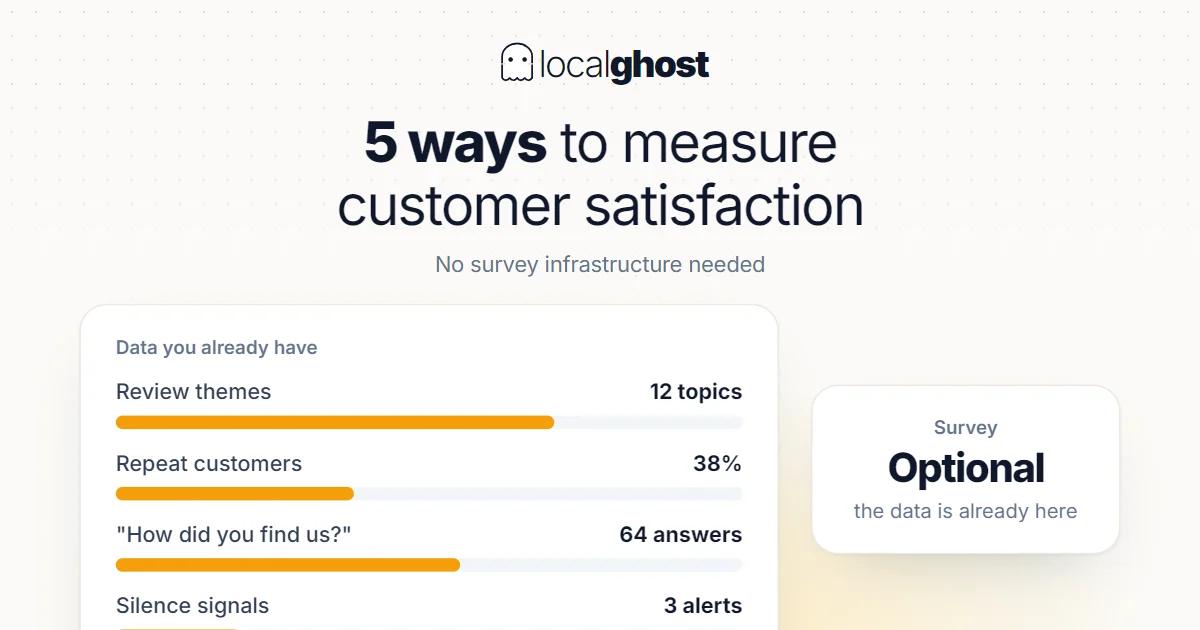
Measuring satisfaction in a local business does not need survey infrastructure. The data you need is mostly already in your hands, just unrecorded.
In this article
Summarize with AI
Customer satisfaction measurement is usually explained through enterprise tooling: survey platforms, scoring systems, dashboards. Most of that does not work in a local business, and the reason is simple — the volume is too low.
In a salon seeing 80 customers a month, survey responses never reach statistical meaning. But that does not mean satisfaction cannot be measured. The data you need is mostly already in your hands; it is just not being recorded.
What a rating average measures
The most common misconception needs correcting first: a rating average does not measure satisfaction.
People who write reviews are not a random sample. Leaving a review requires being either markedly pleased or markedly annoyed. The middle — those who received the service, thought it was fine, and wrote nothing — does not appear in that average.
So a rating average measures the extremes. Important for visibility, insufficient for understanding satisfaction: how restaurants can increase their star rating.
A second distortion: your review-request behaviour changes the average. If you only ask customers who seem happy, the average drifts up while satisfaction stays exactly where it was.
The conclusion: track the rating, but not as a satisfaction measurement.
1. Turning review themes into numbers
This is the most valuable data you hold, and it is free.
Rather than reading reviews one by one, count them by topic: how many times waiting time came up, how many times parking, how many times price, how many times staff.
The resulting list is an operations report. "Our average is 4.3" says nothing; "waiting time came up 14 times in the last 60 reviews" gives you a to-do list.
The counting can be done by hand but a tool speeds it up: AI review management.
One caution: count the themes in positive reviews too. What people praise tells you what to lead with — and that theme belongs in your description: how to write the description.
2. Repeat rate
This is the most honest indicator of satisfaction because it cannot be faked. People do not go back a second time to a place that disappointed them.
Measuring it is simple: of the customers who came in a given period, how many returned in the next one? An appointment book or a simple record gives you this.
Look at the direction rather than the absolute number. If repeat rate is falling, something broke — even while the average rating still reads 4.5.
There is a financial side too: repeat customers are the most valuable line in a return calculation. Calculating on a single transaction significantly understates return in repeat trades: how to calculate the return on local SEO.
This measurement does not work in every sector. Removals, vehicle inspection and other one-off services do not expect repeats; there the equivalent is referral rate.
3. "How did you find us?" and the follow-up
The single question asked by whoever answers the phone collects data no tool provides.
But there is a second question, asked far less often: "have you been here before?" Together these two separate new customers from returning ones and make repeat rate estimable without keeping formal records.
Three things make it work: keeping it in one place, keeping it short (four or five options), and sustaining it for at least three months. A month of records says nothing.
That record has a side benefit: it shows which services get asked about. A service asked about often with no page of its own produces a direct to-do list: website SEO for local businesses.
4. The question at the point of service
Instead of sending a survey, ask as the service ends.
"Was everything alright?" asked face to face gets many times the response rate of an emailed survey, and the answer is honest. The person is still there; if something is wrong they say so.
The real benefit here is not measurement but early warning: you catch the dissatisfied customer before they write a review. Resolved on the spot, you keep both the customer and the absence of a negative review.
One boundary matters: this question is not a review request. A review request is a separate step and cannot be incentivised — offering a discount or free service in exchange for a review is strictly prohibited: strategies for increasing reviews.
5. Signals of silence
This is the hardest measurement and the most skipped.
The customer who does not complain but never returns appears in no data. They leave no review and fill in no survey. Yet they are the group actually pulling your repeat rate down.
There are indirect ways to catch them:
Cancellations and no-shows. If they are rising, something changed.
The same complaint arriving twice. A complaint that arrives twice may have been experienced ten times; only two people wrote.
Comparison against profile data. If search views and call counts hold steady while arriving customers fall, the loss is in conversion rather than visibility: reading the statistics.
Staff feedback. Whoever deals with customers knows before any dashboard does. There needs to be a routine for asking them.
If you do want a survey
If a structured survey is still wanted, the version that works locally is short.
Ask one question. "Would you come back?" or "would you recommend us?" Long surveys get abandoned on mobile.
Ask immediately after the service. A request sent two days later goes unanswered; in a local business the moment has passed.
Do not force a new channel. A channel you already use — a message, a QR code, a card by the till — works better than a new tool: collecting reviews with QR codes.
Tie the result to something. A survey that measures and changes nothing is taking a customer's time for free.
Account for volume. Twenty responses a month is not enough for percentages. Reading those responses beats averaging them.
Turning measurement into decisions
The only purpose of measuring is deciding the next job. In practice three rules cover it.
The same complaint twice means it is a process job. Replying does not close it: turning negative reviews into opportunities.
Separate an incident from a wave. One person's bad experience and forty people's identical complaint need different responses: review crisis management.
Lead with what gets praised. Satisfaction measurement is not only for finding problems; it is also for finding what works and making it visible on your profile.
And an honest limit: measuring satisfaction does not raise it. The measurement tells you what to fix; fixing it is the business's job.
Frequently asked questions
Does my rating average show satisfaction? No. Reviewers are not a random sample; the average measures the extremes. Important for visibility, insufficient as a satisfaction measurement.
What is the best measurement for a local business? Repeat rate. It cannot be faked, because people do not return to a place that disappointed them. For one-off services the equivalent is referral rate.
Should I set up a survey? Not necessarily. If you do: one question, immediately after the service, through a channel you already use. Twenty responses a month is not enough for percentages.
Can I offer something in exchange for completing a survey? Incentives in exchange for reviews are strictly prohibited. A survey and a review request are separate steps and should not be linked.
How do I see dissatisfied customers who never complain? Not directly. Indirectly: cancellation and no-show rates, a complaint repeating, arriving customers falling while profile data holds steady, and staff feedback.
How many months of data do I need? At least three. A single month cannot be told apart from seasonal and random fluctuation.
Written by
Yunus Akan
Related tools: Review replies · All local SEO tools