Crisis Management: What to Do When Negative Reviews Go Viral
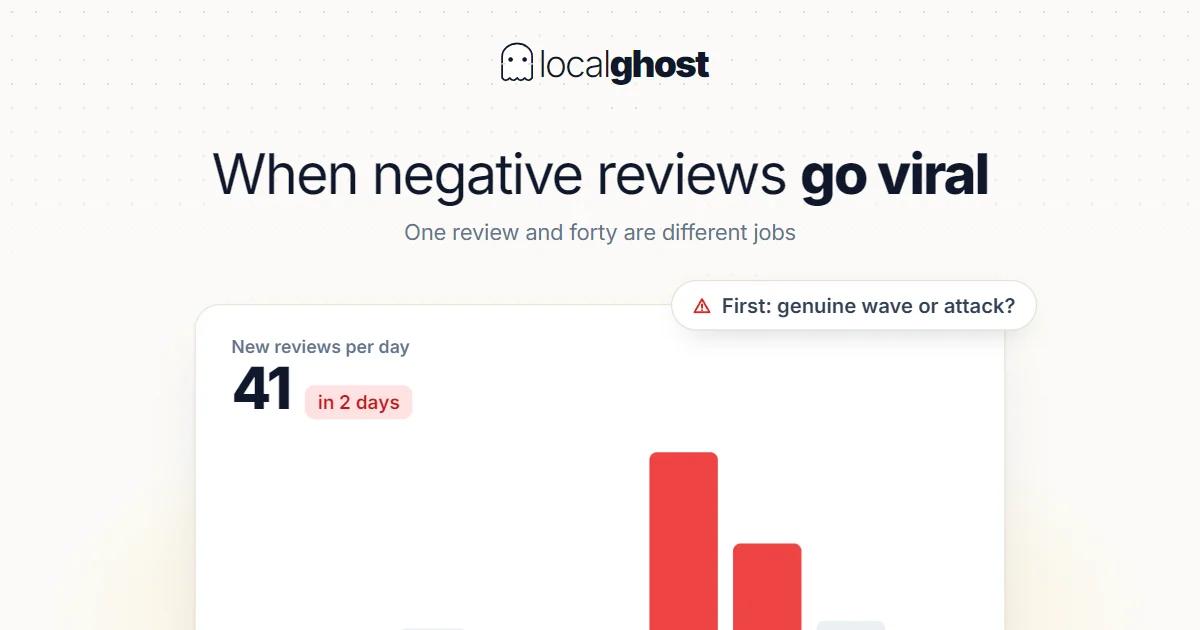
Replying to one negative review and replying to forty are different jobs. In a crisis the first decision is not what to write but what kind of crisis this is.
In this article
Summarize with AI
Replying to one negative review is a manageable job. Forty negative reviews in a week is something else, and the same method does not solve it.
Handling a single review is its own subject: turning negative reviews into opportunities. This piece covers the wave.
The first decision in a crisis is not what to write. It is answering this question: is this a legitimate wave of complaints, or an attack? The two have opposite solutions, and a wrong diagnosis makes even a well-written reply useless.
The distinction: legitimate wave or attack
Diagnosis takes a few questions, and the answers are usually clear.
Do the reviews describe the same incident? If forty people complain about the same service on the same day, this is legitimate. Something actually happened.
Are the reviewers customers? Is the complaint concrete — a date, a product, a person, an amount? Or is it general and personal? Reviews from people who never received a service are a different category.
Does the timing coincide with an event? A pile arriving right after a social media post, a news item or an argument may be coming from the post rather than from your service.
Does the geography add up? A flow of reviews from places with no connection to your service area is not a flow of real customers.
This distinction matters because the fix for a legitimate wave sits in your operations, while the fix for an attack sits on the policy side.
In a legitimate wave, replying is not the fix
The most common mistake here is writing forty replies and considering the job done.
If the same complaint arrived forty times, this is not a communications problem but a process problem. A reply respects the person who experienced it but does not solve it — and an unfixed problem keeps producing reviews.
The order runs:
Stop it first. Whatever is generating the complaints has to stop. A product, a member of staff, a process, a supplier.
Then make one statement. What happened, what was done, and when it was fixed. That statement can sit on the profile as a post: how to schedule posts.
Then reply. But not with a template. Pasting the same text into forty reviews lowers trust further because it looks automated — and that text is public, read side by side. Patterns are a starting point, not the final text: review response templates.
Then verify. Replies go through moderation: if not approved you are asked to edit, and review can sometimes take up to 30 days. So you need to check that the reply you sent actually appears live.
In an attack the route is reporting, not replying
A flow of reviews from people who never received a service is not something to reply to.
Google's guidance is clear: contributions to Maps must reflect a genuine experience; a review or rating should reflect an actual experience with a business, and be genuine and unbiased. Content failing that condition is a reporting matter.
What to do in practice:
Gather evidence. Screenshots, dates and times, the reviewers' profiles, a link to the post that triggered it. Reporting needs something concrete behind it.
Report individually. Each review breaching the guidelines has to be reported separately. It is a slow process and the outcome is not guaranteed.
Be selective about replying. Replying to each attack review feeds the flow and grows the argument on your own profile. One calm statement, so real customers can see it, is usually enough.
Set expectations. Removal takes time and not everything gets removed. The rating stays low through that period.
What not to do
This list is made of behaviours that make a crisis bigger.
Trying to delete reviews. You cannot. You can only report ones that breach the guidelines. Treat services selling "we got it deleted" with caution.
Arguing in public. Exchanging messages with a reviewer keeps the conversation in the most visible part of your profile. It belongs in a private channel.
Legal threats in a reply. That becomes the story itself and accelerates the spread.
Offering compensation publicly. "We will make it free for you" sits in public, and subsequent customers expect the same remedy.
Overreacting to something small. Publishing a comprehensive statement over a three-review issue announces the incident to people who would never have noticed.
Collecting counter-reviews with incentives. Offering a discount or free service in exchange for a review is strictly prohibited and treated as misleading content. Turning to it during a crisis stacks a policy violation on top of the crisis you already have.
Who speaks
The time most often lost in a crisis comes from it being unclear who speaks.
In a one-person business the question does not arise. In a team or multi-branch structure it needs writing down: routine reviews at the branch, crises at the centre. Legal claims, health and safety complaints and incidents with potential to reach the press should not be answered by a branch alone: local SEO management for franchises.
There is also a speed-versus-accuracy balance. A fast but wrong statement is worse than a slow correct one, because you have to correct it and the correction becomes a new story. But days of silence read as hiding. The middle path that works: a short "we are aware and looking into it" the same day, followed by a concrete statement.
The arithmetic of recovering a rating
This is where the real cost of a crisis shows, and the numbers are unforgiving.
An example. You have 20 reviews averaging 4.6. Total points 92. The crisis brings 15 one-star reviews: total 107, review count 35, new average 3.06.
Now, how many perfect reviews does returning to 4.0 take? The calculation: (107 + 5x) / (35 + x) = 4.0 gives x = 33. That is 33 new five-star reviews just to get back to 4.0. Returning to 4.6 is further still.
Now the same crisis at a business with a broad base. 400 reviews averaging 4.6 — total 1,840. The same 15 one-stars: total 1,855, count 415, new average 4.47.
The same attack drops one business from 4.6 to 3.06 and the other from 4.6 to 4.47. The difference is not in tactics but in the base.
Which tells you the one job to do before a crisis: widen the base. Trying to collect reviews during a crisis is both late and produces an unnatural pattern: strategies for increasing reviews.
For rating arithmetic in general: how restaurants can increase their star rating.
After the crisis
Three jobs remain once the wave passes, and all three get skipped.
Write down the cause. What happened, what was done, what changed. A year later nobody remembers and the same mistake repeats.
Turn complaint themes into numbers. How many reviews came from which issue? That list is an operations report and gives you an improvement order: AI review management.
Tie review flow to a routine. The crisis showed why the base matters. Without a routine the same fragility remains: weekly maintenance calendar.
And measurement: whether the crisis actually turned into lost business needs tracking in profile data — search views, calls and direction requests. If those held steady while the rating fell, the impact may be smaller than you assume: reading the statistics.
Frequently asked questions
Can I get negative reviews deleted? No. You can only report ones that breach the guidelines; the outcome is not guaranteed and it takes time.
Someone who was never a customer left a review. What should I do? That is a reporting matter. Contributions must reflect a genuine experience, and content failing that condition can be reported. Gathering evidence and reporting beats replying.
Can I write the same reply to forty reviews? You should not. Replies are read side by side; identical text looks automated and lowers trust further.
In a crisis, should I be fast or accurate? A short "we are aware and looking into it" the same day, then a concrete statement. A fast but wrong statement needs correcting, and the correction becomes a new story.
My rating dropped. How long until it recovers? It depends on the arithmetic. Fifteen one-stars on 20 reviews averaging 4.6 drops the average to 3.06, and returning to just 4.0 takes 33 new five-star reviews.
Can a crisis be prevented? Not the crisis, but its impact can: a broad review base. The same 15 negative reviews move a 400-review business from 4.6 to only 4.47.
Written by
Yunus Akan
Related tools: Review replies · Post scheduling · Add GPS to photos · All local SEO tools