What Is Local SEO and Why Does It Matter?
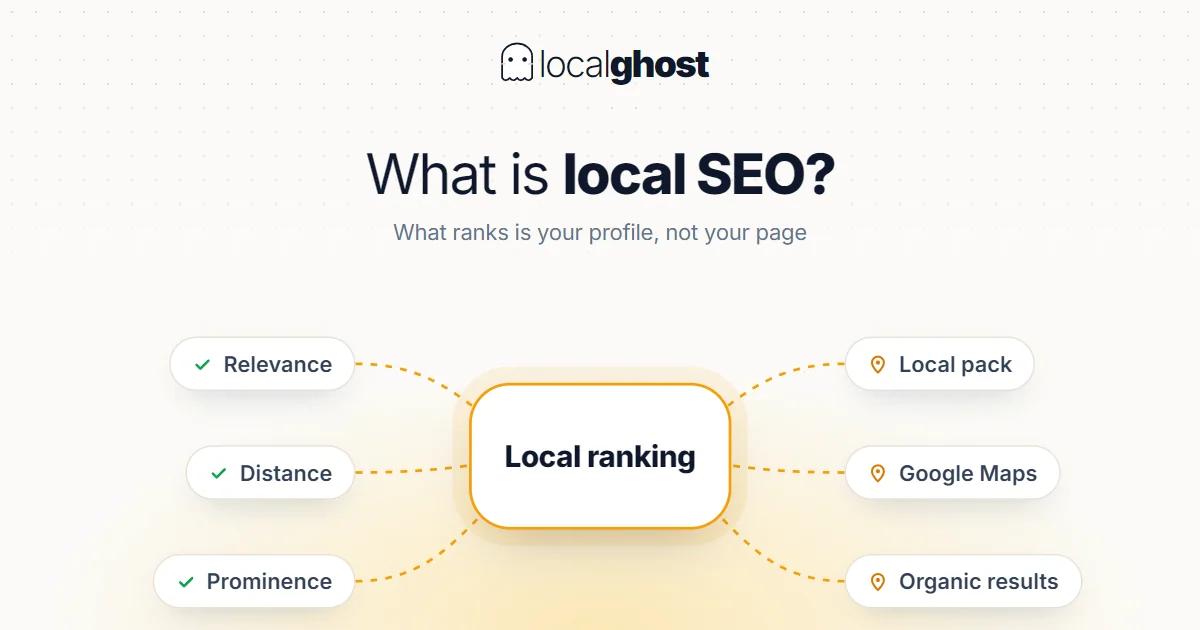
Local SEO is not a smaller version of classic SEO: what gets ranked is your profile, not your page, and distance is an input you cannot edit.
In this article
Summarize with AI
Local SEO is the work of improving how a business appears in searches made around a particular location. It is not a smaller version of classic SEO; it has two fundamental differences, and they change the whole method.
First difference: the ranked entity is not a page. In classic search Google ranks pages. In the block that arrives with a map, what is ranked is the business profile. It is possible to have an excellent website and be invisible on the map; it is also possible to have no website and do well.
Second difference: distance is a ranking input. The same query returns different results two streets apart. So "what position am I" has no single answer, and some targets cannot be reached whatever you do.
The three inputs Google states
Google documents three factors for local ranking, and taking them at face value is sensible:
Relevance. How well your profile matches what was searched. Category, service list and description do their work here. The input you control most directly.
Distance. How far you are from the searcher or from the location the query implies. Not editable, and heavily weighted.
Prominence. How well known the business is. Reviews, mentions across the web and directory records feed it. The slow-building side.
The practical reading: most "why am I not ranking" questions turn out to be relevance problems wearing a disguise. How the block is assembled is covered separately: how the 3-pack works.
Three surfaces: where the work happens
Local SEO is not work done in one place. There are three surfaces and they do not carry equal weight.
1. The business profile. The heavy lifting is here. Category, hours, services, photos, reviews. This is what appears on the map. The ordered job list: 10 golden rules of profile SEO.
2. The website. It does not replace the profile but has two jobs: helping Google understand relevance, and housing content that does not fit the profile. Some service-plus-district searches land on a page rather than a profile.
3. Traces across the web. Directory records, sector platforms, local media. The side that feeds prominence: what are local citations and NAP consistency.
The order matters: investing in the website while the profile is incomplete is the most common waste of effort. The profile is your presence on the map; the site is the layer supporting it.
Who needs local SEO and who does not
Not everyone needs it, and saying so is a matter of honesty.
Who needs it: businesses serving a defined area, whose customers arrive physically or who travel to their customers. Salons, clinics, restaurants, plumbers, removals, garages, wholesalers.
Who does not: businesses selling entirely online, operating independently of geography. For an e-commerce site or a remote software firm, local search is marginal; effort spent there returns more in classic SEO.
In between: businesses working both locally and remotely. The decision follows the revenue mix: if the share coming from local is low, local SEO sits second.
Realistic timelines
Being clear here prevents disappointment.
Registering within days: profile fixes. Category, hours, missing fields. These reflect quickly.
Accumulating over weeks: review flow, photo recency, a posting rhythm. Signal accumulation takes time.
Measured in months: moving from outside the top ten into the pack in a competitive urban category. That is not a two-week job.
Which is why the measurement method has to match: change one variable and wait weeks. Daily checking mostly measures noise: how to track rankings.
What local SEO cannot do
- It cannot change distance. You will not rank well across a whole city from one address. If a distant area matters, the answer is a second location or paid coverage.
- It cannot rescue bad service. More visibility means more people arriving and more reviews written; if the service is poor, that is accelerated damage.
- It cannot guarantee anything. An offer of a "first page guarantee" is a promise that cannot be kept by definition; no third party has access to Google's ranking data.
- It cannot produce lasting gains through violations. Name stuffing and fake reviews work briefly and end in suspension.
How it is measured
Two separate questions and two separate tools:
"How many contacts arrived?" — the profile report. Calls, directions, clicks, messages. Contacts that happened; reading impressions alone misleads: reading the statistics.
"How much of my service area sees me?" — location-aware ranking measurement. A check from your own premises tells you almost nothing.
There is a third question, usually skipped: "is the contact arriving the right customer?" If impressions rise while calls do not, the problem is not visibility but how convincing the profile is.
Who does the work: in-house, agency, tool
There are three routes and the choice follows the scale of the work.
In-house. For a single-location business most of the ten rules are a week's work and the rest is routine. This is usually the case where outsourcing is not needed.
An agency. Sensible with multiple locations, multiple languages or heavy competition. But an offer that guarantees rankings is problematic from the start; no third party has access to Google's ranking data.
A tool. It eases the measurement and routine side: review tracking, reply drafting, rank measurement, a posting schedule. What a tool cannot do is decide — category choice and service naming are the job of someone who knows the business.
The shape of local SEO by sector
The same discipline runs with a different weighting in each sector.
Trades where proximity is tight. In salons the race is within the neighbourhood; review velocity and hours accuracy decide — local SEO for hair salons.
Trades decided by the "open now" filter. In restaurants hours and menu matching move to the front — Google Business guide for restaurants.
Trades where distance loosens. For dental clinics and holiday accommodation people travel and the competitor pool is wide — Google Maps SEO for dental clinics and local SEO for hotels.
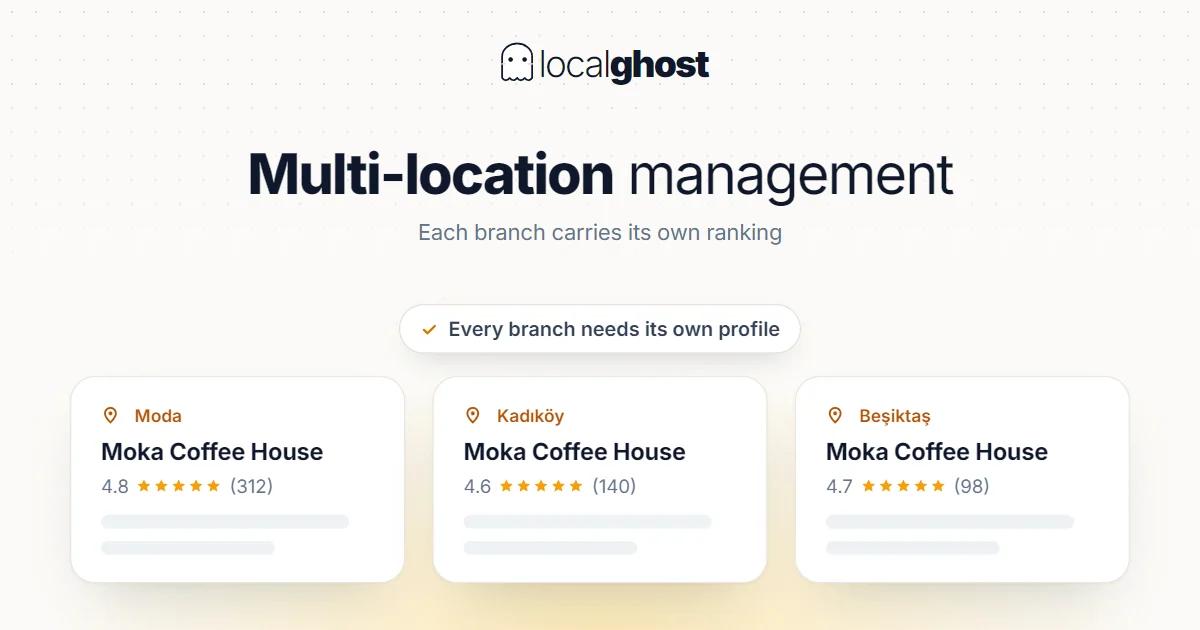
Trades working by area rather than address. In removals and mobile services the setup differs; a service area is not a ranking radius — service-area businesses.
Trades with few but qualified contacts. On the wholesale side the numbers look low and that is normal; one call can be a relationship lasting years — wholesale food suppliers.
Frequently asked questions
What is the difference between local SEO and classic SEO? Two fundamentals: in local search the ranked entity is your business profile rather than your page, and distance is a ranking input you cannot edit.
I have no website. Can I still do local SEO? Yes. What appears on the map is the profile; businesses without a site can do well in local search. The site is a supporting layer, not a precondition.
How long until I see results? Profile fixes register within days, review and photo signals accumulate over weeks, and entering the pack in a competitive category is measured in months.
Is local SEO the same as paid advertising? No. Advertising stops when payment stops; profile work persists. They can be used together, but neither replaces the other.
What about agencies offering a first-page guarantee? No third party has access to Google's ranking data or the ability to guarantee rankings. Such a promise cannot be kept by definition.
Which businesses should not spend time on local SEO? Those selling entirely online, independent of geography. There the same effort returns more in classic SEO.
Written by
Yunus Akan
Related tools: Grid rank tracking · Profile analysis · AI review responses · All local SEO tools