Google Maps SEO for Dental Clinics
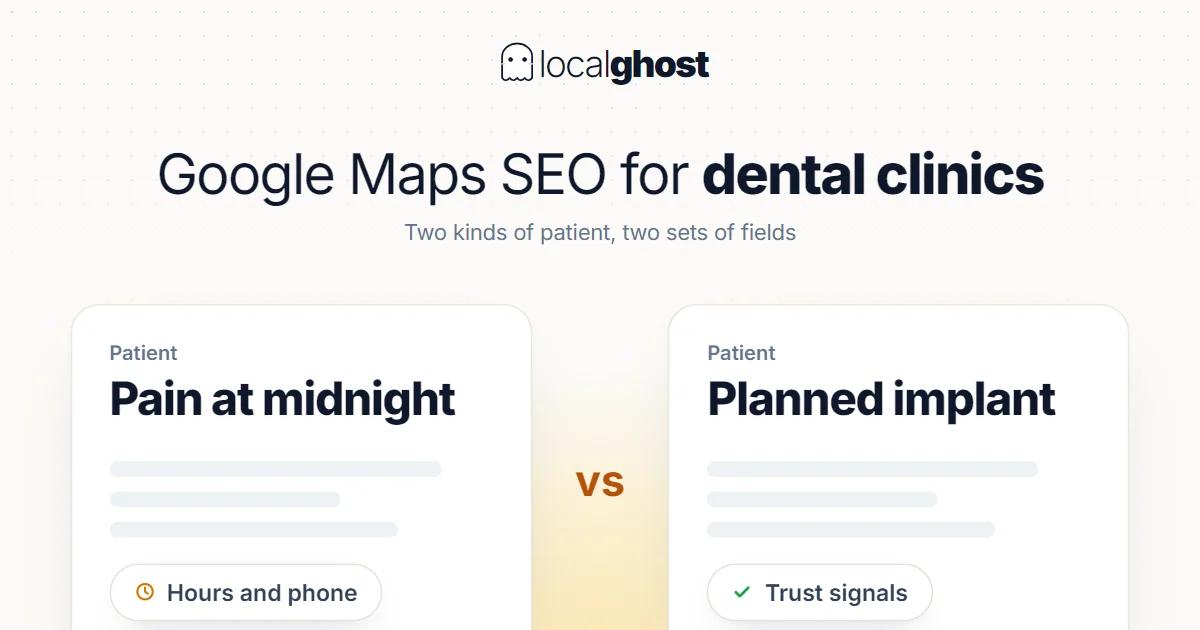
Two completely different patients read a dental profile: one in pain at midnight, one researching implants for weeks. Each is won with different fields.
In this article
Summarize with AI
Two very different people read a dental clinic's profile, and almost nothing about them is alike.
The first woke at midnight with toothache, typed "emergency dentist near me", and cares about exactly three things: are you open now, how far away are you, and will someone answer the phone. They are not reading reviews. They are not looking at photos. They decide in about ten seconds.
The second is considering implants, has been researching for three weeks, has read the reviews of five clinics, noted the dentists' names, and probably has not called anyone yet. Your opening hours are irrelevant to them. Trust is everything.
The same profile has to serve both. The good news is that they are won through different fields, so there is no trade-off. The bad news is that most practices optimise only for the second patient and quietly lose the first.
Emergency demand is won with boring accuracy
For the patient in pain, Google applies its "open now" filter, and that filter is unforgiving: if your hours are stale, you are removed from the result set at the exact moment someone was ready to walk in. Not deprioritised — absent.
That makes the highest-return tasks in dental local SEO also the least interesting ones:
Hours must match reality. If you stop accepting new patients 45 minutes before closing, your published closing time is misleading. Either adjust the hours or say so in your service descriptions.
Fill in holiday hours. Google prompts for these and the prompt is worth answering, because a profile showing "hours might differ" pushes the patient to call the next clinic instead. Public holidays are also when dental pain peaks and fewest practices are open — the opportunity is largest exactly when most profiles are least accurate.
The phone number must be answered. For an emergency patient that is the only conversion path. A number that routes to an unattended line after hours is the most expensive way to lose that patient.
If you offer emergency or out-of-hours care, list it explicitly. Entries like "emergency dental treatment", "walk-in appointments" and "out-of-hours dentist" match the words patients actually type.
Make the address findable. Floor, entrance, building name. Someone in pain is not in a state to hunt for your door.
None of this is impressive and all of it touches revenue directly.
Planned treatment is won on trust signals
Patients researching implants, orthodontics or cosmetic work compare for weeks, and they decide in the lower half of your profile: reviews, photos, clinician information.
What matters here is consistency rather than volume. A clinic with a hundred reviews whose newest is a year old signals worse than one with twenty that arrive steadily. The patient is subconsciously asking whether you are still operating and still good.
On the planned-treatment side:
- Name treatments the way patients say them. "Implants", "zirconia crowns", "clear aligners", "root canal", "hygienist appointment" — patient language, not internal terminology.
- Clinician names matter. Patients search by dentist name, especially those arriving on a recommendation. Names spelled consistently across your profile and website mean those searches land on you.
- Payment plans and insurance arrangements are most patients' first question. Putting them in service descriptions reduces pointless phone traffic.
- Treatment duration and number of visits move an undecided patient forward more than any adjective will.
Replying to reviews in healthcare is different
Replying to reviews helps in every sector. In healthcare there is an additional constraint: do not disclose anything about the patient's treatment in your reply.
"We're sorry your root canal is still causing discomfort" may be written with good intentions, but it confirms on a public page which treatment that person received. The patient's confidentiality is not waived because their own review mentioned it — your confirmation is a separate act.
The pattern that works: acknowledge the dissatisfaction, disclose no clinical detail, move the conversation off the platform.
"Thank you for the feedback and we're sorry about your experience. Please contact the practice directly so we can look into this properly."
Short, undefensive, detail-free. Remember the real reader of your reply is not the complainant — it is the next patient.
Reply to positive reviews too, under the same rule. "Glad you're happy with your implant treatment" becomes "Thank you for the kind words", which is both sufficient and safe.
General reply patterns live in review response templates; in healthcare you have to shorten them so they carry no treatment detail.
Photos should reduce anxiety, not show off
Dental anxiety is common and your photos are talking to it. An effective set shows:
- Reception and entrance — the patient can picture walking in, and it helps them find the building
- A treatment room, clean and well lit — the hygiene impression is formed in this frame
- The team — seeing faces lowers anxiety measurably more than equipment does
- Equipment and technology — shows investment, without needing technical detail
Be careful with before-and-after images. This kind of content is subject to healthcare advertising rules in many countries and may be restricted or outright prohibited. Check your national health authority's rules and your professional body's code before publishing; Google's policies and local healthcare advertising law are two separate constraints, and the second is usually stricter.
Do not use stock photography. Smiling-model images are recognised instantly and read as a clinic with nothing of its own to show.
The technical side of the photo surface — which image becomes the cover, sizing, ordering — is its own topic: photo optimization step by step.
Category choice decides which searches you can enter
Dentistry is not one category in Google Business Profile. "Dentist", "Dental Clinic", "Orthodontist", "Oral Surgeon", "Cosmetic Dentist" and "Pediatric Dentist" are distinct, and your primary category determines which query pools you are eligible for.
Running a general practice and setting "Orthodontist" as primary means opting out of the highest-volume general searches. The reverse applies too: if you only do orthodontics, a general category leaves you weak in orthodontic searches.
Practical approach: make the primary category the main body of the work and add specialisms as secondary categories. Google's own guidance is to choose the fewest categories that describe your core business — the goal is accuracy, not filling the field.
One category change does more than a month of posting, and most practices never make it because the profile "already works".
The sector-independent rules for category selection are covered separately: how to choose the right category.
Multi-dentist practices
A common question in practices with several dentists: should each clinician have their own profile?
Google has separate rules for individual practitioners and the situation is more nuanced than it looks — a self-employed dentist and an employed associate are not in the same position. A badly structured setup splits reviews or gets profiles filtered.
Read Google's guidelines for individual practitioners before deciding, because the right answer depends on how the practice is organised and a generic recommendation would be wrong. What is certain: opening a second *clinic* profile at the same address in the same category counts as a duplicate, splits your reviews, and is harder to undo than to avoid.
Distance is more forgiving here than in most local categories
Proximity is a ranking input in every local search, but a patient will travel across town for implants and will not travel for a haircut.
The practical consequence: for emergency demand your visibility radius is narrow and distance decides it; for planned treatment patients come from a wider area and trust signals partly compensate for distance.
So if you are invisible in emergency searches at your own address, the problem is the profile. If implant patients are not coming from the other side of the city, the problem is more likely review volume and content strength than geography.
Frequently asked questions
What should a dental clinic's primary category be? The most accurate category for the main body of the work — usually "Dentist" or "Dental Clinic" for a general practice, with specialisms added as secondary categories. Making a specialism primary means opting out of the highest-volume general searches.
How do I reply to a patient review? Acknowledge the dissatisfaction, disclose no clinical detail, and move the conversation to the practice. The reader you are writing for is the next patient, not the complainant. A sentence confirming the treatment makes patient information public even when written kindly.
Can I post before-and-after photos? That is a question for your national healthcare advertising rules and professional body rather than Google, and it is restricted in many countries. Do not publish without checking.
I offer out-of-hours care. How do I show up for it? Keep regular and holiday hours accurate, list emergency care explicitly in your services, and make sure the phone is genuinely answered. The "open now" filter decides what the emergency patient sees.
How many reviews are enough? There is no threshold. A steady flow signals better than a high but stalled count. Never offer anything in exchange — incentivised reviews put your whole review set at risk, and in healthcare a reputation loss is the hardest kind to recover.
Should each dentist have a separate profile? It depends on how they practise, and Google has specific rules for individual practitioners. What is certain is that a second clinic profile at the same address and category is a duplicate that splits reviews. Read the rules before setting anything up.
Written by
Yunus Akan
Related tools: Review Management · Local SEO Audit · Local Grid Scan · All local SEO tools