Customer Journey Mapping: For Local Businesses
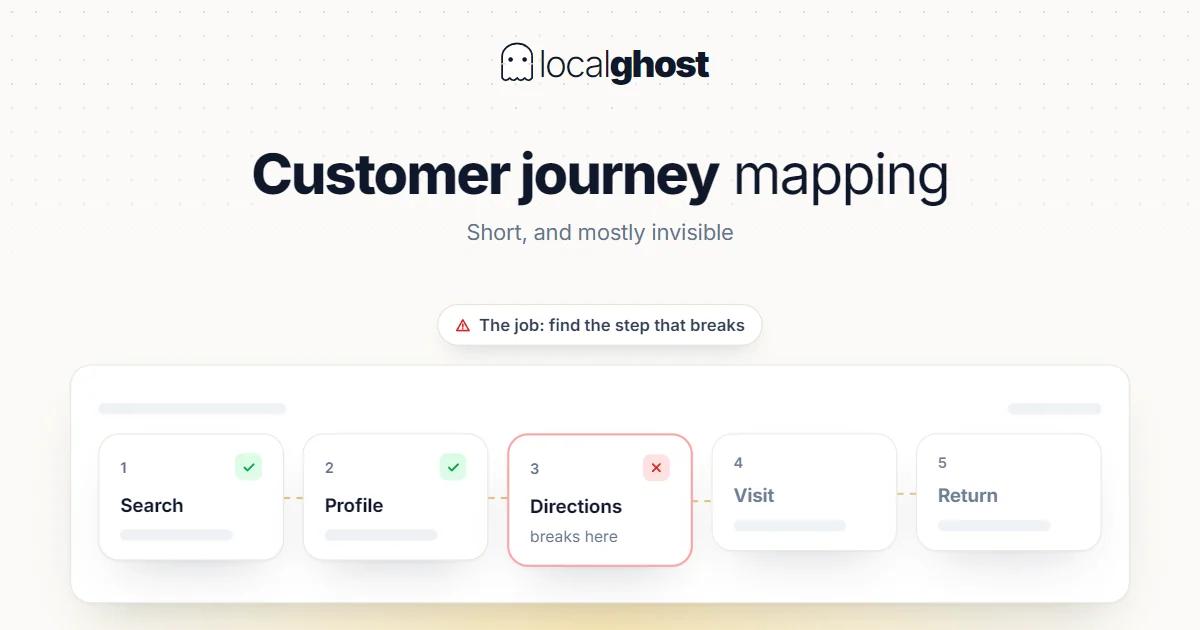
The local customer journey is short and largely invisible. The job of mapping it is not drawing personas but finding the step that breaks.
In this article
Summarize with AI
Customer journey mapping does not work when it is carried over from enterprise marketing to a local business unchanged. Drawing personas, building emotion graphs and producing seven-stage diagrams tells a business seeing 80 customers a month nothing at all.
A local journey is short. In some sectors it takes 90 seconds. And the critical part is this: most of it does not happen on your surfaces.
So the job of mapping is not producing personas. It is answering one question: where does the journey break?
Which parts of the journey do you control
Let us lay out the real steps in order and mark what is yours at each one.
1. A need forms. No control. Demand arises independently of you.
2. A search happens. No control — but you can learn which phrasing is used and name your services accordingly: local keyword research.
3. Appearing in the map block. Partial control. Relevance and prominence are yours, distance is not: Google Maps ranking.
4. Comparison in the list. Control. What shows: name, rating, review count, category, distance, photo.
5. Opening the profile. Control. Hours, photos, description, services, reviews.
6. Contact. Control. Phone, directions, site, appointment link.
7. Arrival. Partial control. Finding the door, parking, the entrance.
8. The service. Full control.
9. After the service. Control. Review request, invitation to return.
The list shows something: of the six steps you control, five sit on the profile. A local journey map turns out, in practice, to be a profile audit.
Where each step breaks
This is where mapping earns its keep. Each step has its own way of breaking, and the diagnosis differs.
Not appearing in the list — beyond distance, the places to look are category and missing information: how to choose the primary category.
Appearing but not being opened — something in what shows in the list is the problem: rating, review count, category name or photo. This step surfaces in the data as high views with low interaction.
Opened but no contact — a question on the profile went unanswered. The most frequent causes are hours and price uncertainty: hours optimization.
Contact but no arrival — the phone is not answered, the appointment link is broken, or the reply comes late. Local demand is present-tense; an answer two days later does not convert.
Arriving but unable to find you — there is no visual showing the walk from street to door. That is precisely the highest-return type of video: video guide.
Arriving but not returning — this is now an operations problem rather than a marketing one. Measuring it is its own subject: how to measure customer satisfaction.
Not leaving a review — because nobody asked. Reviews do not arrive on their own: strategies for increasing reviews.
You cannot see the journey, you infer it
Honesty is needed: there is no data showing step by step who went where. What you hold is fragments.
Profile data shows actions: search views, direction requests, calls, website clicks. These are a rough proxy for steps 3 to 6: reading the statistics.
Site data is a separate world and does not show demand arriving through the map.
The phone is the richest source and goes entirely unrecorded. "How did you find us" and "have you been here before" collect data no tool provides.
A customer walking through the door appears in no data at all.
The practical rule that follows: rather than trying to measure the journey, verify that each step works. Measuring is hard, verifying is easy.
Walking the journey yourself
This is mapping at its most productive and it requires no tooling.
Not on your own phone — on someone else's, signed out, and from a location away from your business:
Search for your service. Not your name, the phrase a customer would use. Are you in the list? In what position?
Look at how you appear in the list. Compare against the competitor beside you. Would you pick yourself?
Open the profile. Are the hours right? What does the photo say? What do the first three reviews say?
Press the call button. Did the phone get answered? By whom, and how quickly?
Press directions. Is the pin at the building entrance?
Go to the site. How many seconds? Is the information you wanted on the first screen?
Try the form or the booking. Go all the way and submit. Did a notification arrive?
The round takes twenty minutes and usually finds two or three concrete breaks. Tying the same round to monthly maintenance catches silent failures: weekly maintenance calendar.
Finding the questions that delay decisions
What stops people at step 5 is uncertainty, and that uncertainty differs by sector.
The way to find it is not research: it is the questions already asked on the phone. When whoever answers writes down incoming questions for a week, the decision-delay list produces itself.
Then those questions go where they belong: short answers to the profile's questions section, longer ones to a service page: website SEO for local businesses.
That has two benefits at once: fewer calls, and better-qualified enquiries.
Journey length varies by sector
The shape of the map is not the same everywhere, and it determines which step to invest in.
A 90-second journey. In taxi and transfer work the need, the search and the call happen in the same minute. The comparison step barely exists; the phone being answered is everything: taxi ranks and airport transfer.
A same-day journey. In food and drink, "open now" and the photos decide it: Google Business guide for restaurants.
A journey spanning weeks. In accommodation there are weeks between the search and the booking, and the person returns many times: local SEO for hotels.
A quote-round journey. For removals the customer gets prices from three places; the break points are response speed and how the price is explained: moving companies.
A trust-round journey. In healthcare, team, credentials and reviews get read before deciding; the journey is long and there is a lot of reading: Google Maps SEO for dental clinics.
What not to do
Producing personas. A local business already knows its customers. An invented persona does little beyond documenting what is known.
Drawing emotion maps. Not measurable and not tied to any decision.
Building a seven-stage diagram. The local journey is short; lengthening the diagram does not reflect reality.
Trying to fix every step at once. Find the biggest break and fix that, and the steps behind it get more traffic on their own.
Investing in a step you do not control. Distance does not change; energy spent there is wasted.
Frequently asked questions
Does a local business need a journey map? Not in its enterprise form. The useful version reduces to one question: where does the journey break? Five of the six steps you control sit on the profile.
Can I measure the journey? Not step by step. Profile data gives actions, the phone gives reasons. Verifying that each step works is more practical than measuring.
Where does it break most often? It varies by sector, but two places stand out: the profile gets opened but no contact happens (uncertainty), and contact happens but the reply is late.
Should I build personas? No need. A local business knows its customers; the energy belongs on finding the break.
How do I test the journey? On someone else's phone, signed out, from a location away from the business, walking it end to end. It takes twenty minutes and usually finds two or three concrete breaks.
Which step should I invest in first? The biggest break. Fixing it also raises traffic through the steps behind it; trying to fix everything at once leads to scattering.
Written by
Yunus Akan
Related tools: Review Management · Local Grid Scan · Free Photo Geotag Tool · All local SEO tools