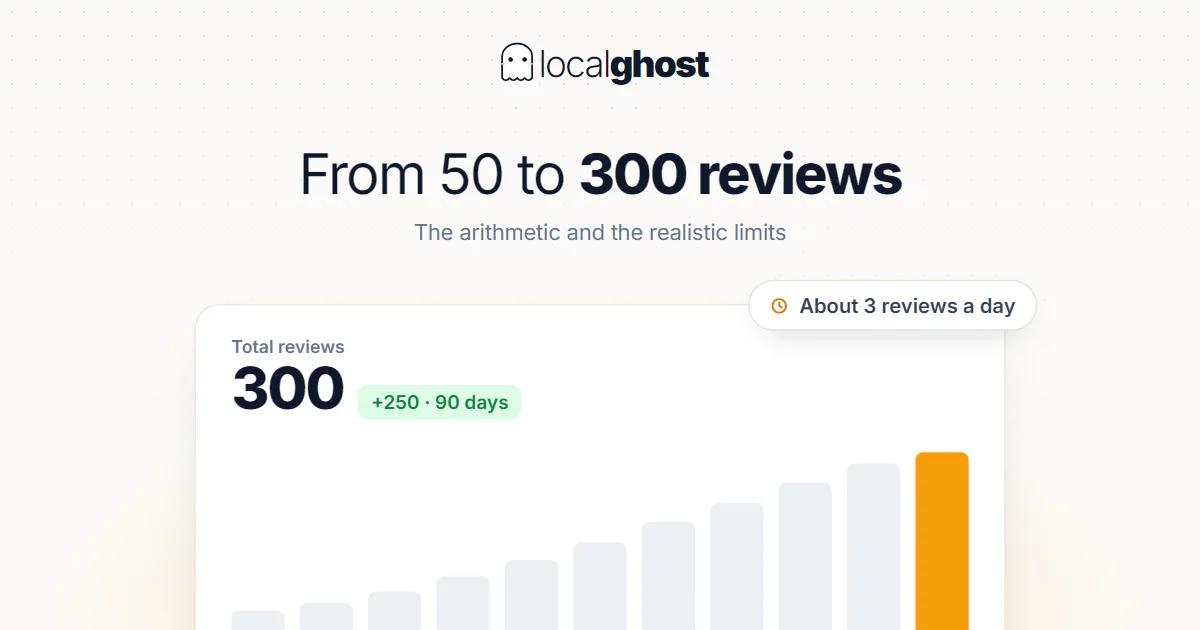
From 50 to 300 Reviews: The Arithmetic and the Limits
Divide 250 reviews by 90 days and you get about three a day. What that requires is calculable — and it is not possible for every business.
In this article
Summarize with AI
When a target like "from 50 to 300 reviews in three months" comes up, the first thing to do is arithmetic. This guide does not describe a particular client; it calculates what the target requires and answers which businesses it is possible for.
The calculation starts here: 250 new reviews divided by 90 days is about 2.8 reviews a day. That sounds small. The problem is not that number but how many customers you have to reach to produce it.
The whole chain: from customer to review
Reviews do not arrive from everyone asked. There are three drop-off points in between:
1. How many customers get asked. If a shift serves 100 customers, in practice not all of them are asked. The rate falls at the busiest hours.
2. How many of those asked try. With a spoken request and the link ready to hand the rate rises noticeably; saying "review us on Google" and leaving it there lowers it.
3. How many who try complete it. Leaving a review requires being signed into a Google account. Some of those whose session is closed give up at the login screen. That loss cannot be removed; the rule is on Google's side.
Combine those three and the number of customers needed for three reviews a day is far above three. So the target is really a question of customer volume: if your daily footfall is low, 250 reviews in 90 days is arithmetically unreachable.
The practical conclusion: set the goal not as a review count but as getting the asking into a routine. With the routine in place the number finds itself; starting from a number turns it into a campaign before the routine exists.
Why a burst pattern is risky
"Then let's ask everyone for a month" is exactly the route that does not work. A large pile of reviews arriving in a short window creates an unnatural pattern and the spam filter removes them. The effort is spent, the count falls back, the profile gets flagged.
There is also this: review recency is a signal read continuously. Collecting 250 reviews in three months and then stopping leaves a profile whose newest review is "from last year" nine months later. So a burst is both risky and unsustainable.
The right setup is a flow: one or two a week, uninterrupted. It looks slow but it is a hundred reviews a year, and those hundred stay. Detail and prohibited tactics: increasing Google reviews.
What the review count actually does
Before chasing a count, it helps to be clear about what a count does, because the expectation is usually set wrongly.
A count is a threshold, not an infinite lever. A profile with a handful of reviews looks weak beside competitors who have them. But going from 300 to 600 does not create the same difference as going from 5 to 50.
Protecting the average is also the count's job. As the count rises, the effect of one bad rating shrinks. The arithmetic: the arithmetic of raising your star rating.
The text counts too. A review where the customer names the service in their own words creates context; "very happy" carries only the score.
Where it sits in ranking is the prominence input: how the 3-pack works.
The right moment to ask in a cafe
In food and drink, timing makes more difference than method. The right moment is when satisfaction peaks:
At the bill. The most common and most effective point; payment is a natural ending. A QR on the receipt and one sentence from the server work together.
A table card — but not alone. A card nobody mentions does not get scanned. The card is an enabler, not a reminder: collecting reviews with QR codes.
Packaging for takeaway. The touchpoint that goes home; the customer is at home, phone in hand and signed in.
The point to avoid: the exit door. Nobody stops on the way out to write a review; a card placed at the exit is usually the one that never gets scanned.
Quiet hours and quiet tables. Nobody can be asked at the busiest hour; at a quiet hour both staff and customer have time. A target of two or three a day is met in the quiet hours, not the busy ones.
Whoever does the asking also has to be named. "Everyone should ask" means in practice nobody asks; one person per shift has to own it.
Tying the flow to operations
The reason a review flow never gets built is almost never "not knowing how". The reason is that it is nobody's job. Four steps fix that:
Put the job on the shift. Who asks at the till should be as defined as who counts at closing.
Give them the sentence. One line, short enough to memorise: "If you were happy, two lines here would help us." Expecting everyone to invent their own phrasing ends with most never asking.
Keep the material visible. On the receipt, the table, the packaging. It should be an item checked at the start of a shift; if used-up cards are not replaced, the flow quietly stops.
Share the results. Showing arriving reviews to the team is what feeds the habit most. Someone who reads a review mentioning them by name asks more the next day.
Flow in a seasonal or uneven business
Where footfall is not steady through the year, a single weekly target does not work. Ten reviews a day may be possible in the peak while one a week is hard in the quiet season.
The right setup scales the flow to volume: tie the asking to a routine in the busy period and do not stop in the quiet one. The aim is not a fixed number but keeping the date of the newest review fresh.
That has a side benefit: reviews collected in the peak keep the profile looking alive during the quiet months. So seasonality is an opportunity on the review side rather than a disadvantage — as long as the collection is steady rather than a pile.
If the review count falls
Some of the reviews you collect disappearing later is common, and usually not a fault. The causes in order:
The spam filter. A pile arriving in a short window, reviews from the same network, very short text. The most frequent outcome after fast campaigns.
The reviewer deleted it. Outside your control and a normal rate of loss.
The account closed. Reviews from deleted Google accounts go too.
A policy report. Content against the rules gets removed; this mechanism usually works in your favour.
A duplicate profile merge. With two listings your reviews were split, and counts move during the merge.
The practical consequence: setting the goal as gross reviews collected misleads; what remains is what matters. Which points back to the same place — a steady flow is both safer and more permanent than a pile.
The prohibited line
When a count target creates pressure, prohibited routes get tempting. Two are clear:
You cannot offer incentives. A "free item for a review" campaign is offering a benefit in exchange, and it is banned — sounding harmless does not change it.
You cannot gate. Asking "were you satisfied" first and routing only the happy ones to the review page is not accepted. Everyone gets the same route and the outcome is accepted as it comes.
There is a third and most common one: buying reviews. When detected the reviews are removed, so the money and the count go together.
How to set a realistic target
Three steps are enough:
- Look at how many reviews arrived in the last three months. That is your current rate.
- Build the routine and aim to double the rate. Tripling is a stretch; doubling is sustainable.
- Measure monthly, watching continuity rather than the count. The measurement side: reading the statistics.
At the end of those three steps what you hold is not a number but a rate: reviews per week. Setting the goal as a rate is both more realistic and more sustainable than setting it as a number, because while the rate continues the number arrives anyway.
Frequently asked questions
Is 250 reviews in three months possible? It means about three a day, and reaching that requires asking far more customers than three. Possible in a business with high daily footfall; arithmetically not in a low-volume one.
Does collecting reviews fast do damage? A pile arriving in a short window creates an unnatural pattern and the spam filter can remove those reviews. And when the flow stops afterwards, the profile looks stale.
Which matters more, count or average? They do different jobs: the count is a threshold and a buffer protecting the average, while the average affects the decision to choose you.
How many reviews are enough? There is no fixed number; the benchmark is competitors in your sector. But sustaining the flow is a better setup than making the count the goal.
Can I give a free item for a review? No. Collecting reviews in exchange for incentives is explicitly prohibited.
A customer wanted to leave a review and gave up. Why? Most likely because leaving one requires being signed into a Google account. Which is why the best moment to ask is when the customer is already doing something on their phone.
Written by
Yunus Akan
Related tools: Review Management · All local SEO tools