AI-Powered Review Management: A Comprehensive Guide
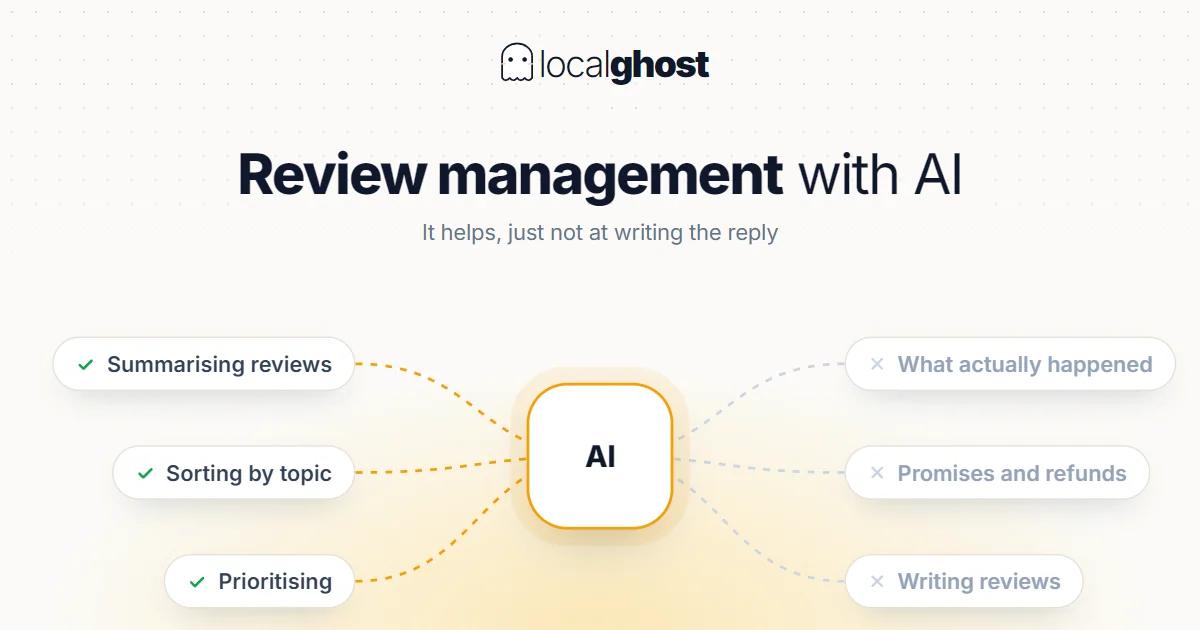
AI works in review management, but not at the writing-the-reply part. Drawing the line correctly saves both time and reputation.
In this article
Summarize with AI
AI genuinely helps with review management — just not where people expect.
The common setup is this: let AI write the reply to an incoming review and have a human approve it. That setup automates the wrong half. Because the hard part of review management is not writing the reply, it is deciding who replies to what, and when.
The right division: AI for triage and drafting, humans for the facts of the incident and the decision.
Review replies go through moderation
This is the most important technical fact to know before setting up automated replies, and most content skips it.
Per Google's support documentation, if your reply is not approved for posting you will be asked to edit it. Reviewing replies usually takes up to 10 minutes, but sometimes that can stretch to 30 days.
That has practical consequences:
Your reply may not be live immediately. The "I wrote it, done" assumption is wrong. Exactly when speed matters most — on a negative review — a reply sitting in review looks like no reply at all.
Patterns that trip filters cost you time. Replies containing links, phone numbers, promotional language or personal data carry risk. In automatically generated text those elements can slip in unnoticed.
You need to verify it published. An industry analysis reports that some replies can sit in a rejected state without any notification. So a reply that appears written in your dashboard but is not live is possible.
The rule that follows: if you sent replies in bulk, comparing what you sent against what appears live should be a check step: weekly maintenance calendar.
What AI genuinely does well
These are the boring, repetitive jobs that do not deserve human time — precisely what should be automated.
Finding unanswered reviews. In a multi-branch setup especially, working out which reviews went unanswered takes hours by hand. The chain average hides the weak branch: multi-location management.
Grouping complaints by theme. This is the most valuable use. Reading a hundred reviews and extracting "waiting time 14 times, parking 9 times, price 6 times" is far more useful than writing replies. Because that is an operations report, not a communications task.
Catching a repeated complaint. The same complaint arriving twice is a process problem; a reply does not close it: turning negative reviews into opportunities.
Translation. Understanding a review in another language and replying in the same one. A serious convenience in tourist areas: local SEO for hotels.
Tracking sentiment over time. A rating average moves slowly; the frequency of complaint themes signals earlier.
A first draft. For neutral, positive and thank-you type reviews a draft is more than sufficient. This is where the time saving comes from.
What should not be left to AI
This list is the side that tools selling automated review replies do not mention.
A reply that knows the incident. If a customer describes a specific day, person or event, the reply needs to know about it. A reply written without that knowledge reads like a template, and template replies do not build trust — the reader notices.
Invented commitments. This is AI's most dangerous failure: promising a policy, a discount or a remedy in a reply that does not exist. A published reply becomes a commitment, and the customer will claim it.
Legal claims. Reviews mentioning lawsuits, compensation or formal complaints should not get an automated reply. Those replies go on the record.
Health and safety. In healthcare, a reply to a complaint must be written without implying patient information and may be subject to professional regulation. Check your own rules: Google Maps SEO for dental clinics.
A crisis. Incidents with potential to reach the press should escalate; a branch or a tool should not reply alone: local SEO management for franchises.
The hard line: the review itself is never generated
So far we have discussed replies. The review itself is an entirely different matter, and there is no flexibility there.
Google's guidance is clear: contributions to Maps must reflect a genuine experience; a review or rating should reflect an actual experience with a business, and be genuine and unbiased.
Offering customers incentives — free or discounted goods or services — in exchange for posting a review, changing one, or removing a negative one is treated as fake and misleading content and is strictly prohibited.
So generating reviews with AI, or buying generated ones, is not a grey area to debate. The outcome can be reviews removed and accumulation reset. The right route is the slow, boring one: strategies for increasing reviews.
The same logic applies to web content: Google's guidance states that using automation — including AI — to generate content with the primary purpose of manipulating rankings violates its spam policies. Producing many pages without adding value can also fall under scaled content abuse. In a local business the equivalent is pages duplicated with the district name swapped: website SEO for local businesses.
The data privacy side
Sending review text to a tool usually happens without much thought.
Reviews are already public, so the text itself is generally not the issue. The issue is adding information from your records while preparing a reply: the customer's name, phone number, appointment detail, transaction information.
Three practical rules work:
Do not feed personal data to the tool. Pasting a customer record while drafting a reply is unnecessary; a summary of the incident is enough.
Do not let personal data appear in the reply. A reply along the lines of "the customer who came last Tuesday for X" makes their information public. The right route is moving the conversation to a private channel.
Know where the tool sends data. In fields like healthcare this is a compliance matter, not a preference.
The workflow that works
Putting the distinctions above in order produces this sequence.
Triage. Collect new reviews, flag the unanswered ones, bring negatives forward.
Classify. Routine, requires incident knowledge, or escalates? Those three go down different paths.
Draft. Only for the routine group.
Human touch. Add the concrete facts of the incident, confirm there is no commitment, check no personal data appears.
Send and verify. Check the reply appears live — moderation can delay it or reject it.
Turn repeats into a report. If the same complaint arrives a second time, it is a process job rather than a communications one.
Ready-made patterns sit in this flow as a starting point, not as the final text: review response templates.
Frequently asked questions
Can I reply to reviews with AI? As a draft for routine and neutral reviews, yes. For reviews describing an incident, containing legal claims, or touching health and safety, a human should write it.
Why is my reply not showing immediately? Replies get reviewed. Per Google's documentation this usually takes up to 10 minutes but can stretch to 30 days; if not approved, you are asked to edit it.
How do I know a reply I sent published? By checking it live. An industry analysis reports some replies can sit rejected without notification, so comparing after a bulk send is necessary.
Can I generate reviews with AI? It breaches policy. Contributions must reflect a genuine experience; fake content can lead to reviews being removed and accumulation reset.
Can I offer a discount in exchange for a review? No. Offering free or discounted goods or services in exchange for posting, changing or removing a review is strictly prohibited.
What is AI's most useful application here? Not writing replies, but grouping complaints by theme. "Waiting time came up 14 times" is an operations report, and that does the most work.
Written by
Localghost Team
Related tools: Review Management · Local SEO Audit · Post Management · All local SEO tools