Where AI Actually Helps in Running a Business
When AI gets sold to local businesses, volume is the part left out. Models want data; a business seeing 80 customers a month does not have it.
In this article
Summarize with AI
This piece makes no predictions about the future.
The reason is simple: predictions cannot be verified. "In five years it will be like this" cannot be checked on the day it is written and gives the reader no decision. There is a more useful split available instead: the uses that genuinely work today versus the ones being sold that do not.
And one thing separates them: data volume.
The real limit: volume
This is the most skipped part of any conversation about what AI will do for a business.
Models need data to learn patterns. In enterprise examples that data exists: hundreds of thousands of transactions, records spanning years, thousands of customers. In a local business it does not.
A salon seeing 80 customers a month has 960 transactions a year. That number is small enough for a person to hold in their head — and too small for a model to extract a pattern from.
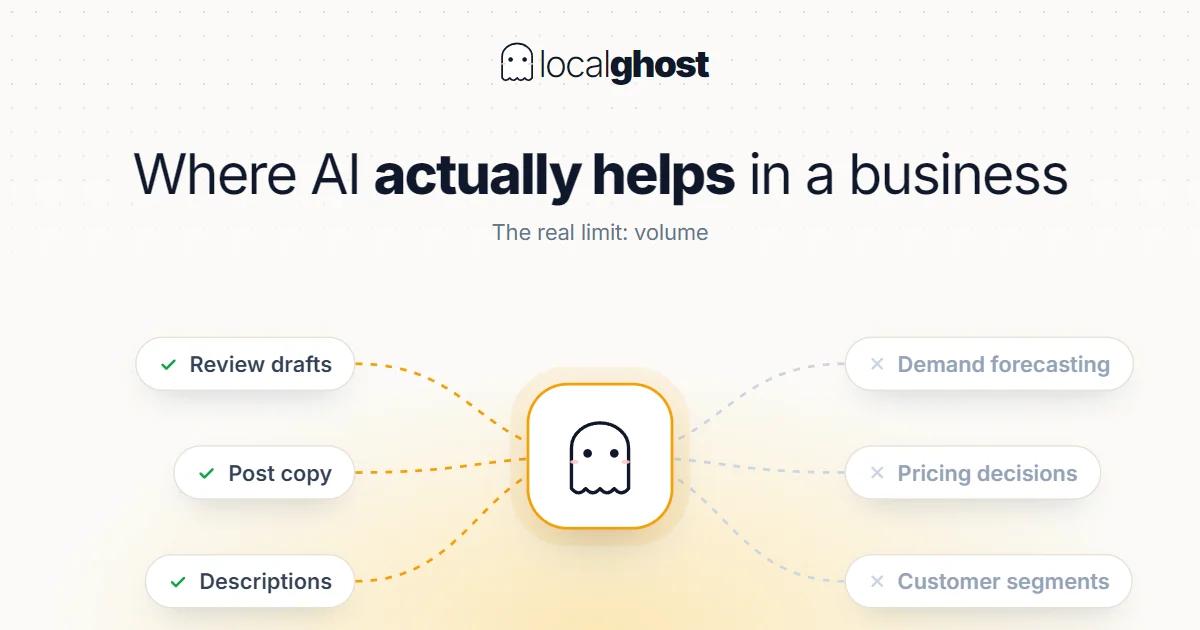
A practical rule follows: AI helps with work that repeats often but needs little data. Editing text, for instance. Work requiring inference from data — demand forecasting, price optimisation — has no local-scale payoff.
That is not the same as saying it never will. It is what is true today.
Uses that genuinely work today
Their common traits: the input comes from you, the work repeats, and the cost of an error is low.
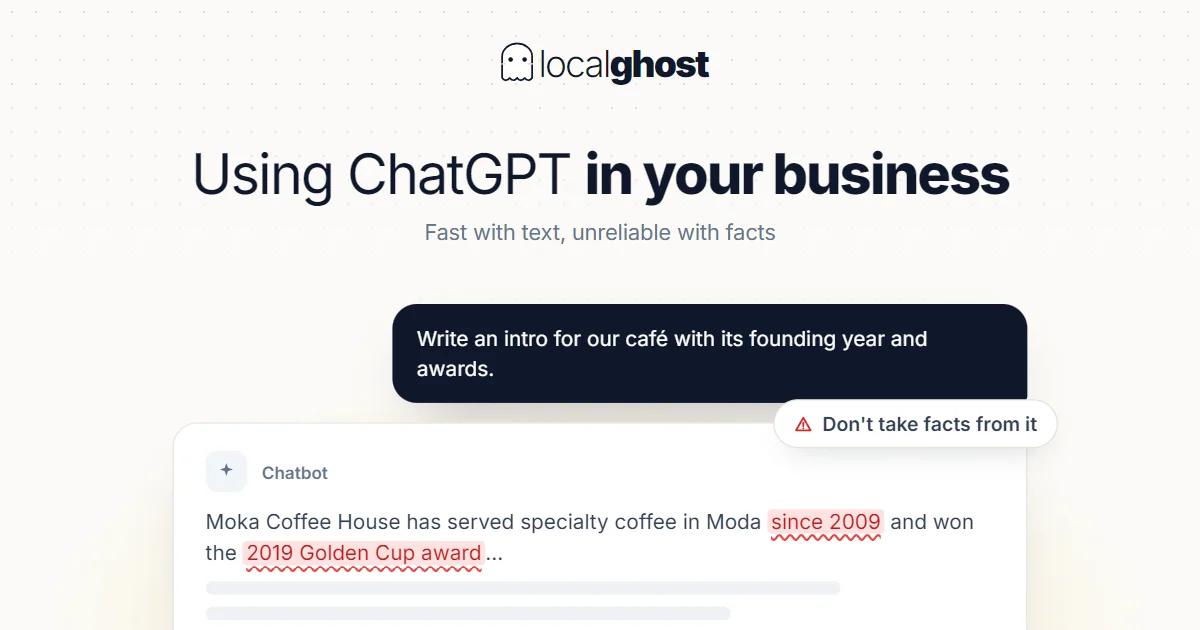
Text work. Turning phone questions into page copy, shortening long text, translating. The most mature use and the biggest time saver: where to use ChatGPT in your business.
Review triage. Finding unanswered reviews, grouping complaints by theme. "Waiting time came up 14 times" is an operations report: AI review management.
Turning speech into text. Recording a voice note in the van or behind the counter, then converting it. A real convenience for a business that keeps no notes.
Classifying records. Sorting incoming enquiries by type, expenses by category. The model does the first pass, a human confirms. The saving is in time, not in guaranteed accuracy.
Communicating with foreign customers. Live translation at the counter. In tourist areas that touches sales directly: local SEO for hotels.
Answering repeated questions. Questions whose answer is fixed and documented — hours, location, price range. Questions whose answer is uncertain are not on this list.
Sold but not working at local scale
This list is where budget gets wasted.
Demand forecasting. A model needs records spanning years to project future demand from the past. With one season of data, the forecast it produces is no better than yours. Establishing seasonality from a single year is already misleading: seasonal campaign management.
Personalisation. Its enterprise meaning is segmenting thousands of customers. In a local business you know customers by name; the model knows less than you do.
Price optimisation. The transaction volume needed for a signal is not there. Pricing gets decided on cost, capacity and competition.
Fully automated phone answering. The nuance here matters. A bot that cannot book an appointment or quote a price loses the call — local demand is present-tense and that person rings the next place. But a system that captures a callback number beats voicemail. The test: does the bot end the call, or hand it to you?
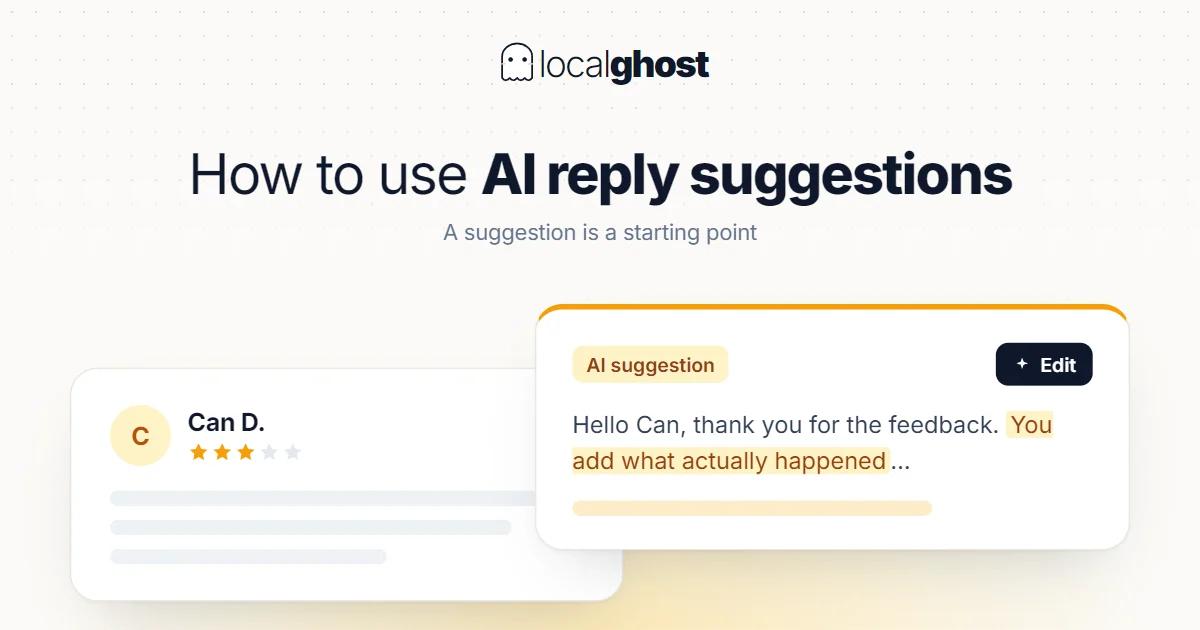
Automated review replies. A reply that does not know the incident reads like a template, and a generated reply can promise a remedy that does not exist. The boundary is firm here: review response templates.
Content production at scale. Using automation to generate content with the primary purpose of manipulating rankings violates spam policies, and producing many pages without adding value can fall under scaled content abuse.
Setup cost has to be counted
A tool "saving time" is not enough on its own; setup and verification time are costs too.
The calculation has two sides. Gain: hours saved per week. Cost: subscription, setup, learning, and the time to verify every output.
That last line is the most skipped. Text published without verification, or a wrong answer sent to a customer, can cost more than the time saved.
A concrete test: if the job is done once a week, automation usually does not pay for itself. If it is done several times a day, it does. The same logic applies on the API side, where the threshold is higher still: Google Business Profile API automation.
In a single-location business most automation does not clear that bar. In a multi-branch structure it does: multi-location management.
Data and responsibility
This is the question to ask before any technical feature when choosing a tool.
What are you sending? Customer names, phone numbers, appointment details, transaction information. Sending those to a tool is unnecessary for most jobs; a summary of the incident is enough.
Where does the data go? In fields like healthcare this is a compliance matter, not a preference. You need to check your own regulations: Google Maps SEO for dental clinics.
Who has access? How many of the team log into the tool, and does a departing employee's access get closed? A Google Account shows which apps have access and that access can be removed at any time.
Who owns the output? If the model wrote a commitment that does not exist, the responsibility sits with the business. "The tool wrote it" is not a defence.
What to do instead
In a local business the constraint is usually not intelligence but simple jobs left undone.
An unanswered phone, stale opening hours, a broken appointment link, an unanswered review, no photo added for months. None of those needs AI, and each returns more than any automation.
So the order runs: correct category, complete information, accurate hours, a continuing flow of reviews and photos, fast replies. AI can speed that list up but does not substitute for it: the right order in digital marketing.
There is also the matter of routine: setting up automation does not replace setting up a routine. Ten minutes weekly and half an hour monthly needs no tooling at all: weekly maintenance calendar.
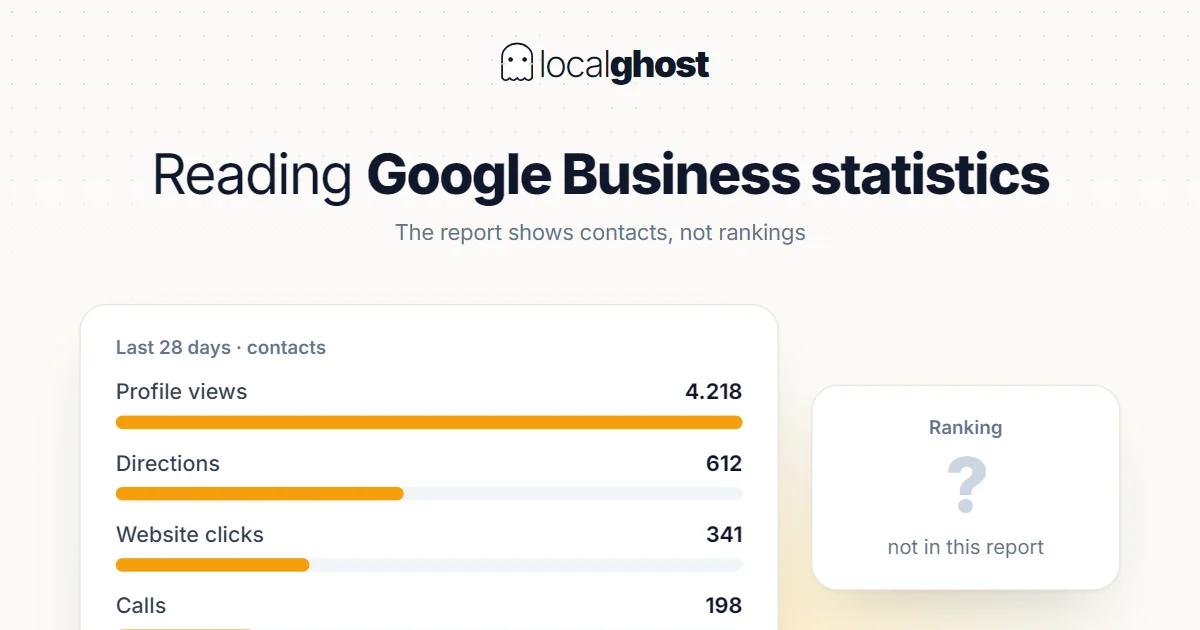
The same simplicity holds on measurement: the most valuable data source is free and collected by hand — "how did you find us": how to calculate the return on local SEO.
Frequently asked questions
What does AI add to a small business? Today its most concrete contribution is text work: turning phone questions into pages, shortening, translating, and grouping reviews by theme.
Can I use it for demand forecasting? There is no local-scale payoff. A model needs records spanning years; a forecast from one season's data is no better than your own.
Can I put AI on my phone line? The test: does the bot end the call or hand it to you? A bot that cannot book loses the call; a system that captures a callback number beats voicemail.
When does automation make sense? When the job happens several times a day. For work done once a week, setup and verification usually exceed the gain.
Can I give customer data to a tool? It is unnecessary for most jobs; a summary of the incident is enough. In fields like healthcare it is a compliance matter and you need to check your own rules.
Will AI improve my local SEO? Not directly. The constraint is usually simple jobs left undone: an unanswered phone, stale hours, unanswered reviews. AI speeds that list up rather than replacing it.
Written by
Yunus Akan
Related tools: Profile analysis · All local SEO tools