How to Measure Customer Growth: What Does 200% Mean?
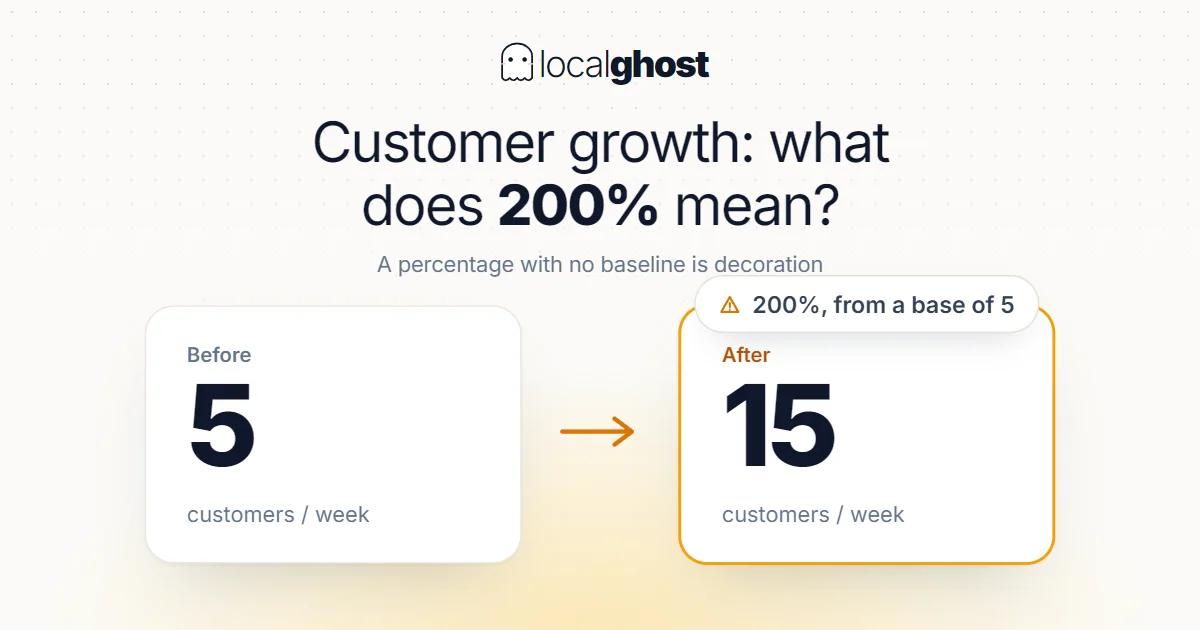
Going from 5 customers to 15 is also 200% growth. A percentage with no baseline stated is decoration, not information.
In this article
Summarize with AI
The most common form of claim in local SEO is percentage growth: "200% more customers", "three times more calls". What they share is a missing baseline.
The arithmetic is simple: going from 5 customers to 15 is 200% growth. Going from 100 to 300 is also 200% growth. The two sentences look identical and describe completely different businesses. A percentage without a baseline is decoration, not information.
This guide does two things: how to measure growth honestly, and what actually moves demand for a salon.
Why percentages mislead
Three mechanisms, all pulling the same way.
A small base produces a big percentage. On a new or neglected profile every movement looks large in percentage terms. Doubling from the first month to the second is easy while the absolute numbers are small.
Season contaminates the percentage. For a salon, the run-up to a holiday and the middle of January are not the same baseline. A comparison that does not exclude season measures the calendar rather than the work.
The wrong metric gets chosen. "Impressions rose 200%" is not good news if the call count stayed flat. Impressions are a count of opportunity, not of results.
So an honest sentence is built like this: "From this date to this date, on this metric, from this number to this number." When all four are not given, the claim cannot be verified.
How honest measurement is set up
Five steps, none requiring a tool:
- Write down the baseline. The numbers for the three months before you change anything: calls, direction requests, website clicks, bookings.
- Change one thing. Category, hours, a review routine. Changing everything at once means being unable to attribute the result to any of it.
- Compare periods of equal length. Four weeks against four weeks; because months differ in length, a "last month" comparison introduces skew.
- Match the season. Where possible, compare with the same period last year. That requires exporting the data regularly, because history does not sit there indefinitely.
- Record the absolute number alongside. Not the percentage alone but "from 43 to 68".
Which metric says what is a separate topic: reading the statistics. Ranking is not in that report; measuring it is a different method: how to track rankings.
Which metric answers which question
The most common measurement mistake is gathering every available number under one heading called "success". Each metric answers a different question, and mixing them produces wrong decisions.
Impressions — "how many people saw me?" A count of opportunity. The most misleading metric read alone.
Share of unbranded searches — "how many people who did not know me saw me?" This is where local SEO work actually shows. Rising branded searches show offline recognition, not acquisition.
Calls — "how many people made contact?" One of the closest conversion signals for a salon.
Booking link clicks — "how many tried to book?" A clearer intent indicator than calls.
Direction requests — "how many decided to come?" The closest proxy for a physical visit.
Review flow rate — "is the profile alive?" A continuously read signal and the most visible difference in a competitor comparison.
The right reading takes these in pairs: impressions with calls, calls with booking clicks. If impressions rise while calls do not, the profile is not convincing; if calls rise while bookings do not, the loss is on the phone — which is an operations problem, not a profile one.
Reading an agency or tool report
When a report arrives from outside, four questions immediately show whether it is useful:
Is there a baseline? A report that only says "this month was X" cannot be compared.
Are the periods equal in length? Comparing a five-week period with a four-week one manufactures growth.
Are branded and unbranded separated? If not, the source of the growth is unclear.
How was the ranking claim measured? From one point or several? A position taken from a single point is not a meaningful number in local search — the distance input makes it change with where you look from.
There is also one item to reject outright: a ranking guarantee. No third party has access to Google's ranking data or the ability to guarantee positions.
What actually moves demand for a salon
Setting percentages aside and looking at the mechanism, the things that make a difference in this sector are specific.
The primary category. "Hairdresser", "barber" and "beauty salon" are different pools on Google's side. Which one you are in changes who finds you — and it is the fastest gain on the list: how to choose the right category.
Hours accuracy. The client is searching for "today". Appearing open while closed means a customer turned away; appearing closed while open means not appearing at all: hours optimization.
Review velocity. The structural advantage of this sector: clients come often and the result is visible immediately, so natural opportunities to ask are plentiful: increasing Google reviews.
Portfolio photos. In a salon the result of the work is effectively the product; the decision is made by looking at photos: photo optimization.
The booking link. The field that converts visibility into appointments. Click counts can be more informative than call counts.
The whole sector, and how tightly proximity behaves here: local SEO for hair salons.
A realistic three-month picture
Thinking in absolute numbers and order rather than percentages keeps expectations in place. On a neglected profile a three-month span roughly works out like this:
First week. Category, hours, service list and photo coverage. Those four take a few hours, and the fastest visible effect is the category — because moving from a wrong category to a right one is a threshold jump.
First month. The review routine goes in and the first steady reviews arrive. In the profile report impressions usually move before calls. Knowing that order matters: when impressions rise and calls do not, waiting a week or two beats panicking.
Second and third month. Review recency accumulates and photos get updated. In a competitive neighbourhood, position movement usually becomes visible here.
The one thing missing from that picture is a guarantee. The number of competitors in your area, their review velocity and your location decide the outcome — and some of that is not in your hands.
What cannot be changed
The second half of honest measurement is knowing what is unreachable.
Distance. One of the three factors Google documents, and not editable. Proximity works tightly in salons: a client two districts away will not choose you whatever you do. Trying to appear across the whole city here is burning money.
Competitor activity. The pack has three slots. If a competitor gained forty reviews you were passed without getting worse; that is not a fault, it is the race.
Demand volume. Salon searches in your area are what they are. Profile optimisation gets you a larger share of existing demand; it does not grow the demand. That distinction sits at the centre of setting expectations: growing the share is profile work, growing the demand is a different job.
What a real case study contains
It is worth saying plainly that this article is not a case study: there is no particular client's data here. What a verifiable case study has to carry is clear:
- The business name, or at minimum the sector, size and area type
- The start date and the end date
- Baseline numbers and final numbers — absolute, not percentages
- A list of the work done, and the order
- Other factors that could have had an effect in the same period (season, a campaign, a new competitor, new signage)
Without those five, what is being told is a claim rather than a case study. Recording the same five for your own business is the only way to answer "did it work" six months later — and without that record there is no answer.
Frequently asked questions
Can "200% growth" claims be trusted? Not when the baseline and date range are missing. Going from 5 to 15 is also 200%; two identical-looking sentences describe different businesses.
How should I measure growth? Write the baseline, change one thing, compare periods of equal length, match the season, and record the percentage alongside the absolute number.
Impressions rose but calls did not. Good or bad? The problem is not visibility but how convincing the profile is: the description, photo coverage and review replies are what get read at the moment of decision.
What is the fastest gain in a salon? The primary category. If it is wrong, everything else accumulates in the wrong pool. After that come hours accuracy and review flow.
Can I aim to appear across the whole city? Proximity works tightly in salons and distance is not editable. If a distant area matters commercially, the answer is a second location or paid coverage.
How long until I see a difference? Category and hours fixes register within days; review and photo signals accumulate over weeks. In a competitive neighbourhood a lasting difference is measured in months.
Written by
Yunus Akan
Related tools: Local Grid Scan · All local SEO tools